
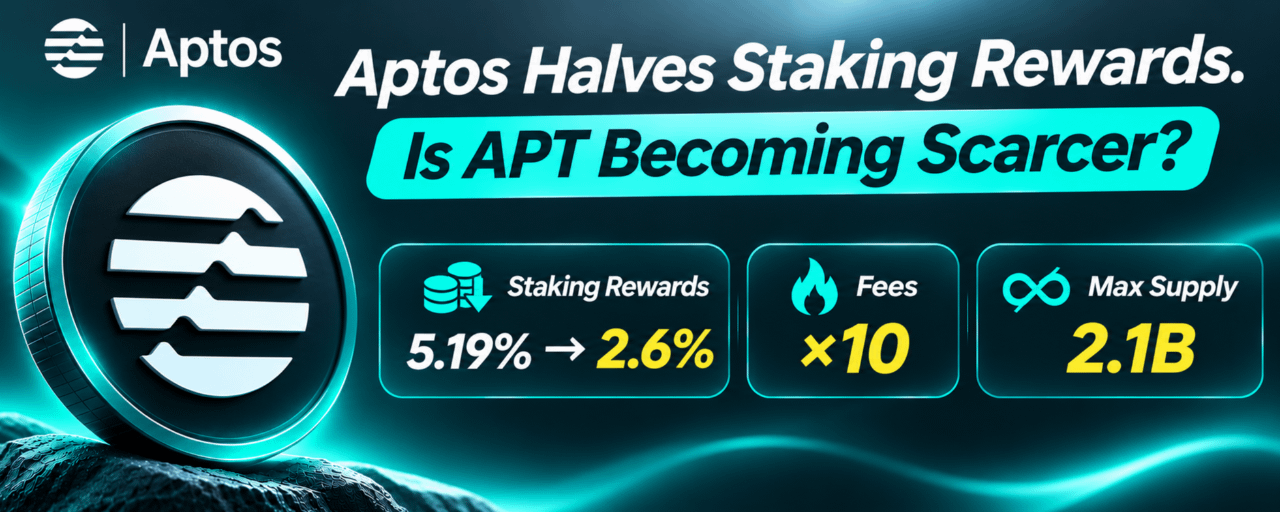


Aptos has made some serious changes to its tokenomics this year.
Staking rewards have been cut almost in half. Transaction fees were increased tenfold, and the network now has a hard supply cap of 2.1 billion APT.
There's also a major change to the unlock schedule.
On October 12, the four-year vesting period for Aptos' original investors and core contributors came to an end.
For a token that spent years dealing with concerns about inflation and unlock pressure, this is worth examining.
But I wouldn't call APT deflationary just yet.
Let's look at what actually changed.
In March, Aptos governance approved a reduction in annual staking rewards from 5.19% to 2.6%.
That means fewer new APT are issued to reward validators and stakers.
The network also increased its gas fee schedule by 10 times.
Normally, higher fees would be something users complain about. In Aptos' case, the fees remained relatively inexpensive even after the increase.
And there's an important detail here.
Aptos burns its transaction fees.
So when people use the network, a portion of APT supply is permanently removed through gas payments.
According to Blockworks Research's October report, the combination of higher gas fees and reduced staking issuance brought annualized net supply growth down from roughly 5% to 1.5%.
That's a substantial improvement.
But supply is still growing overall.
And this is where the adoption story becomes relevant.
Aptos has been positioning itself as infrastructure for stablecoin transfers, trading, and tokenized financial assets.
According to DeFiLlama, stablecoin supply on Aptos reached approximately $948 million on November 23, up 17.5% over the previous seven days.
USDT and USDC account for most of that supply.
The network also had around $672 million in active tokenized real-world asset value, based on DeFiLlama's tracking.
Those figures suggest Aptos is attracting financial assets.
But here's something I would look at carefully.
Aptos processed roughly 12.7 million transactions over the most recent 24-hour reporting window.
That's a lot of transactions.
Yet DeFiLlama recorded only around $2,200 in chain fees during that same period.
Low transaction costs are useful for payment applications. Businesses aren't going to choose an expensive blockchain for routine transfers if cheaper alternatives work well.
The challenge for APT is that inexpensive transactions don't generate much token burning individually.
Even millions of transactions may not remove enough APT to offset staking rewards.
That puts more pressure on sustainable transaction growth.
Aptos needs activity that continues beyond trading incentives, automated transfers, or temporary campaigns.
There's another distinction worth remembering.
Stablecoin transfers can happen without users personally holding APT when an application sponsors the gas fees.
Someone might send USDC through an Aptos-based service without ever buying the native token.
The network still consumes APT for gas, but the economic demand per transaction can remain very small.
I find the supply changes encouraging, especially the end of the original investor and contributor vesting schedule.
Monthly scheduled releases have become smaller, although Community and Foundation allocations can still enter circulation.
And the 2.1 billion token cap prevents unlimited future issuance under the current rules.
But the cap doesn't mean all 2.1 billion tokens already exist.
Nor does the end of one vesting schedule eliminate future supply pressure.
For me, the next useful comparison is simple.
How much APT gets burned through real network activity each month, and how much new APT gets issued during the same period?
I'd also watch whether stablecoin balances translate into regular payments, lending demand, and trading activity that produces measurable fees.
Aptos has changed the way its token supply works.
Now the network needs enough sustained economic activity to make those changes matter.
