
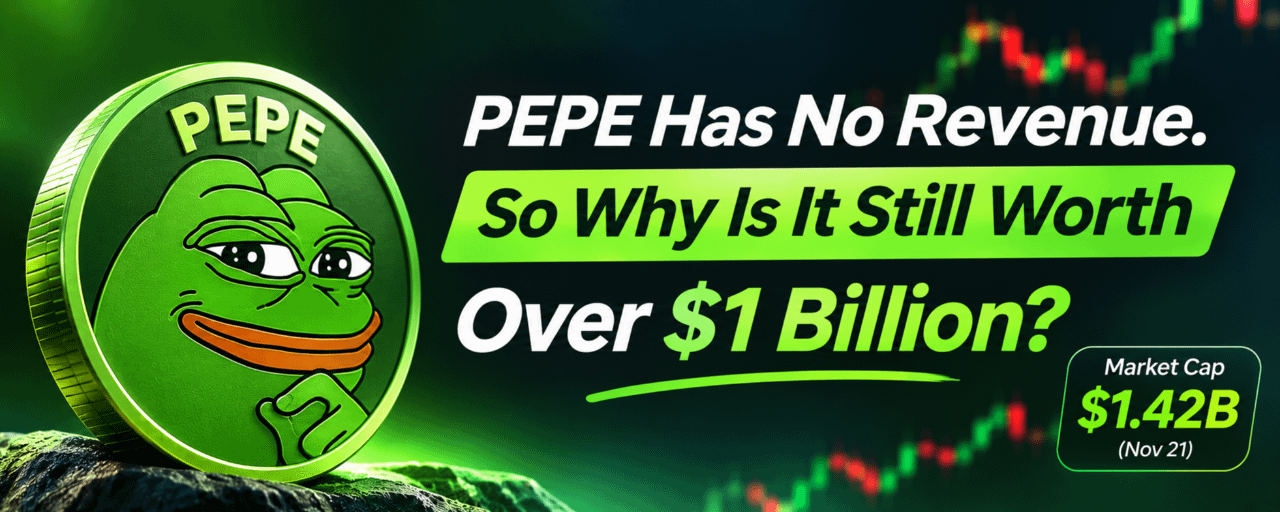


PEPE doesn't operate a lending protocol. It doesn't collect trading fees for token holders, and there's no staking system built into the original token.
Yet its market capitalization was still around $1.42 billion on November 21.
That's what makes PEPE interesting to study.
Most crypto research starts with a familiar question. How much revenue does the project generate, and how much of that value reaches token holders?
With PEPE, that approach doesn't get us very far.
The token launched on Ethereum in April 2023, inspired by the Pepe the Frog internet meme.
There was no conventional venture-capital fundraising round, and the original contract was designed without transfer taxes or a mechanism for minting additional tokens.
Contract ownership was renounced.
PEPE wasn't built around a complicated business model. Its appeal came from an internet culture that already had a large audience.
And somehow, that audience turned into a substantial trading market.
According to Castle Labs, PEPE recorded approximately $384 million in trading volume during the 24 hours leading up to its November 21 snapshot.
That's considerable activity for an asset with no direct revenue distribution.
But I'd be careful about what the number tells us.
High trading volume means PEPE is changing hands frequently. It doesn't necessarily mean investors are accumulating it for the long term.
A large part of that activity can come from short-term traders, market makers, and people reacting to price movements.
In fact, the same dataset estimated that only about 0.54% of PEPE's reported trading volume came from decentralized exchanges.
Most of the activity occurred on centralized platforms.
That matters because exchange liquidity is one of the main reasons a meme coin can remain relevant long after its initial viral moment.
Traders need markets where they can enter and exit positions.
PEPE has those markets.
Still, liquidity can disappear when sentiment changes, especially during periods of heavy selling.
There's another detail worth watching.
PEPE has a fixed-supply contract. The original allocation was approximately 420.69 trillion tokens, with some subsequently burned.
Unlike DOGE, it doesn't continuously issue new coins as block rewards.
That removes one source of ongoing dilution.
But fixed supply doesn't automatically make an asset valuable.
A token can be scarce and still lose most of its market value if buyers disappear.
And PEPE's price depends heavily on whether people continue finding the meme culturally relevant and worth trading.
The recent ETF developments are interesting in that context.
Canary Capital filed registration documents for a proposed PEPE investment product in 2026, including an amended S-1 in October.
That shows some financial firms are exploring ways to package exposure to meme coins for traditional investors.
But a filing isn't an approval, and a potential investment product doesn't create revenue for PEPE holders.
Even if such a fund eventually launches, demand would still depend on whether investors actually allocate capital to it.
I think that's the part of the PEPE story people sometimes overlook.
There isn't a business generating cash flow that investors can use to estimate a fundamental valuation.
There is a recognizable brand, a large holder base, substantial exchange access, and a market driven by attention.
Those things have value to traders, but they're difficult to price with confidence.
For me, the numbers worth following are spot trading liquidity, holder concentration, exchange balances, and whether market interest survives extended periods without viral attention.
I'd also separate genuine spot demand from leveraged futures activity, which can make short-term price movements much more violent.
PEPE has already shown that a meme can become a billion-dollar crypto asset.
How long it can retain that valuation will depend on whether people still want to own and trade it when the excitement fades.