


CELO | Global Payments | Stablecoins | Ethereum Layer 2 | AI Agents
Celo’s opportunity is not simply to process more transactions. It is to make stablecoin payments usable for people, businesses, and eventually autonomous AI agents.
The problem: Crypto has money, but everyday payments still have friction
There is a contradiction in the current financial system.
Blockchain networks can transfer digital assets around the world, but using those assets for ordinary payments is still more complicated than it should be.
Consider someone receiving money from another country. They may need to deal with currency conversion, banking delays, transfer charges, and limited access to financial services.
Crypto introduced an alternative through stablecoins, but stablecoin ownership alone does not solve the entire problem.
Users still need accessible wallets, reliable settlement, local currency liquidity, and an interface that does not require technical knowledge.
This is the problem I find interesting about $CELO
Rather than focusing exclusively on blockchain performance, Celo has spent years developing infrastructure around mobile-first financial applications, stablecoins, and global payments.
Its strategy is to make blockchain infrastructure less visible to the end user while allowing applications to benefit from programmable money underneath.
That distinction is important.
The strongest payment infrastructure is not necessarily the one users talk about most. It is the one that lets them complete transactions without thinking about the underlying network.
What is Celo, and why did it move to Ethereum Layer 2?
Celo is an open source blockchain ecosystem originally launched as an independent Layer 1 in 2020.
Its focus has been financial inclusion, mobile payments, and accessible stablecoin infrastructure.
However, one of its biggest architectural changes came in March 2025, when Celo transitioned to an Ethereum Layer 2 using the OP Stack.
The migration followed community approval in 2024.
Why make this change?
Operating as an independent Layer 1 means maintaining a separate network security and validator ecosystem. Moving to an Ethereum Layer 2 allows Celo to align more closely with Ethereum’s settlement and security ecosystem while retaining a specialized execution environment.
Its infrastructure combines several components:
OP Stack: The Layer 2 execution foundation.
EigenDA: Modular data availability.
Succinct SP1: Zero knowledge proving infrastructure.
Fee abstraction: Enables transaction fees using supported ERC 20 tokens, including stablecoins.
The objective is to combine Ethereum alignment with a payment focused user experience.
One feature deserves particular attention: fee abstraction.
Imagine someone receiving stablecoins but not having any $ETH or CELO available to pay transaction fees.
For an ordinary user, that is an unnecessary complication.
Celo’s fee abstraction allows supported tokens to be used to cover network fees, reducing the need to acquire a separate gas asset before making a payment.
This is the kind of infrastructure decision that can make a real difference to mainstream usability.
How Celo’s payment infrastructure connects
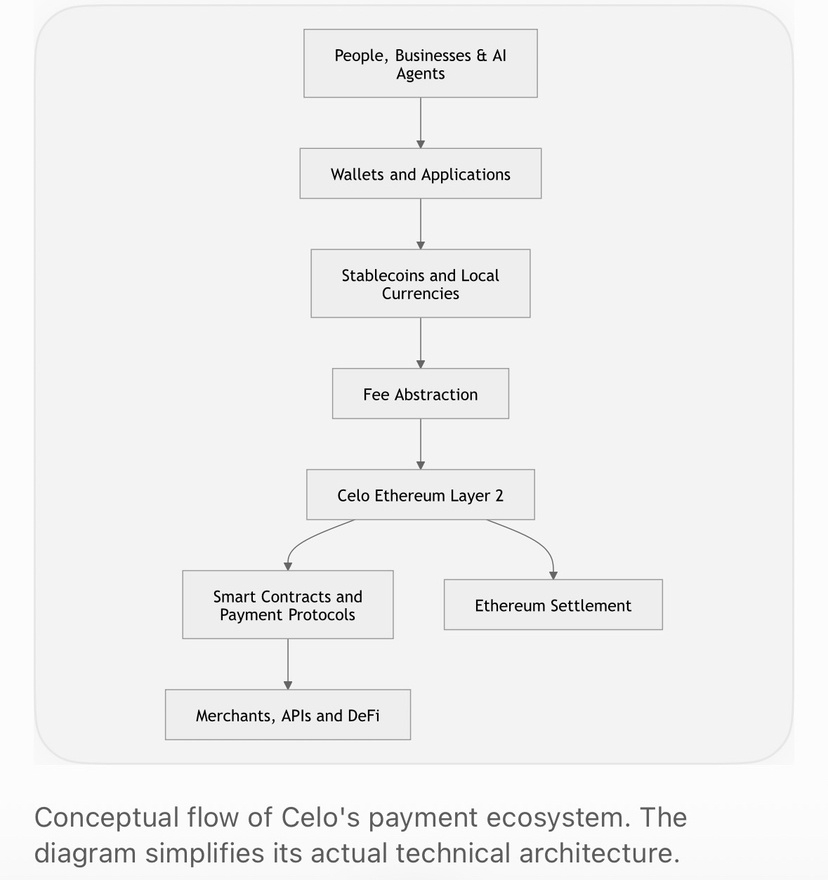
The important point is that Celo is not just providing transaction execution. It is trying to connect wallets, stablecoins, payment applications, and settlement into one usable financial environment.
MiniPay: Bringing stablecoins to everyday users
One of the strongest parts of Celo’s strategy is MiniPay.
MiniPay is a self custodial stablecoin wallet developed by Opera, designed around mobile first access.
Its approach is different from the traditional crypto wallet experience.
Instead of expecting users to understand blockchain networks, gas tokens, and complicated wallet interfaces, MiniPay focuses on making digital dollar payments accessible through a familiar mobile experience.
Consider a practical scenario.
A freelancer receives payment from a client abroad. Instead of relying entirely on traditional banking transfers, the freelancer can receive supported stablecoins into a wallet and use available services to move or convert funds.
The wallet provides the interface, while Celo supplies the underlying blockchain infrastructure.
According to the November 19, 2026 announcement, MiniPay reported:
20 million plus activated wallets.
600 million plus processed transactions.
Availability across more than 70 countries.
77 Mini Apps.
These are significant distribution indicators.
However, activated wallets should not be confused with monthly active users. Transaction counts also do not independently establish profitability.
MiniPay’s November 2026 upgrade involving Privy, a Stripe owned wallet infrastructure provider, is another development worth watching. Its aim is to simplify account access through options such as email, social login, and passkeys while retaining self custody.
The larger idea is straightforward: make stablecoins accessible to people who may never consider themselves crypto users.
How MiniPay connects users to digital payments
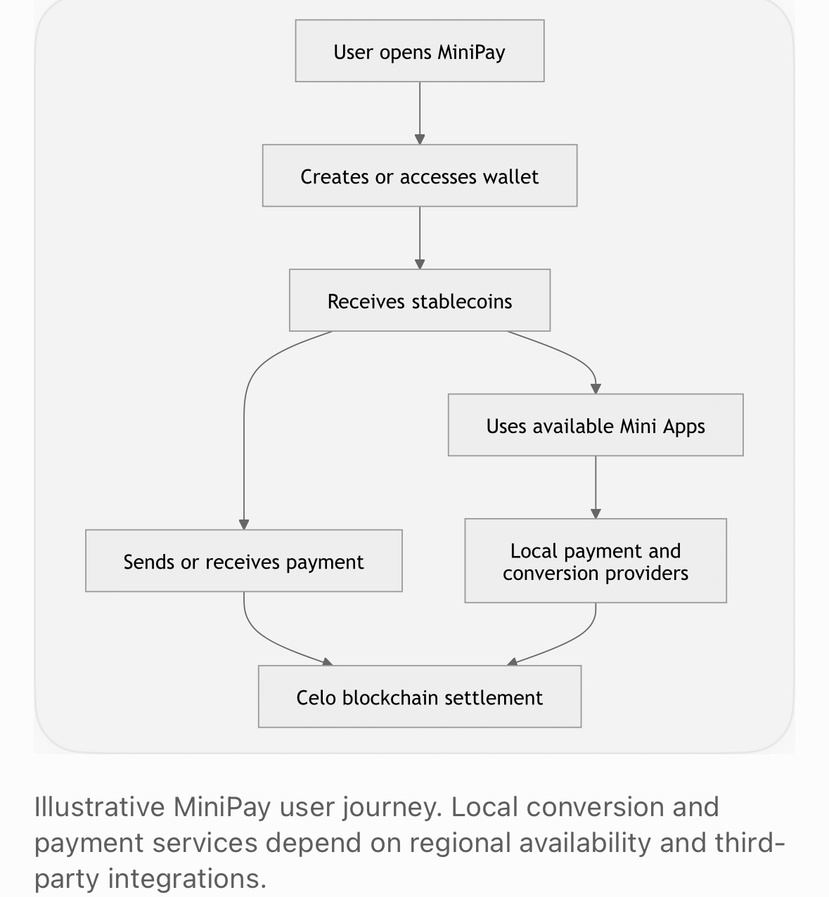
What I find particularly interesting is the distribution advantage.
Opera’s existing mobile ecosystem gives MiniPay a potential route to users outside the traditional crypto native audience.
The next question is whether those users continue using it after their initial transaction.
Stablecoins: The foundation of Celo’s payment strategy
I think this is where Celo’s positioning becomes especially interesting.
Many blockchain ecosystems focus heavily on their native tokens. Celo has placed significant emphasis on stablecoins as practical payment instruments.
Its ecosystem supports assets including $USDT , USDC, USA₮, USDm, EURm, BRLm, XOFm, and other local currency stablecoins.
By late 2026, Celo reported more than 33 stablecoin assets representing approximately 20 currencies.
Why is that important?
Because global payments should not assume that every user wants to transact in US dollars.
A merchant in Brazil may prefer Brazilian reais. A user in Argentina may need pesos. A business operating in West Africa may have different currency requirements.
Local currency stablecoins can reduce unnecessary conversion steps and make blockchain payments more relevant to local financial activity.
Celo’s multi currency stablecoin ecosystem
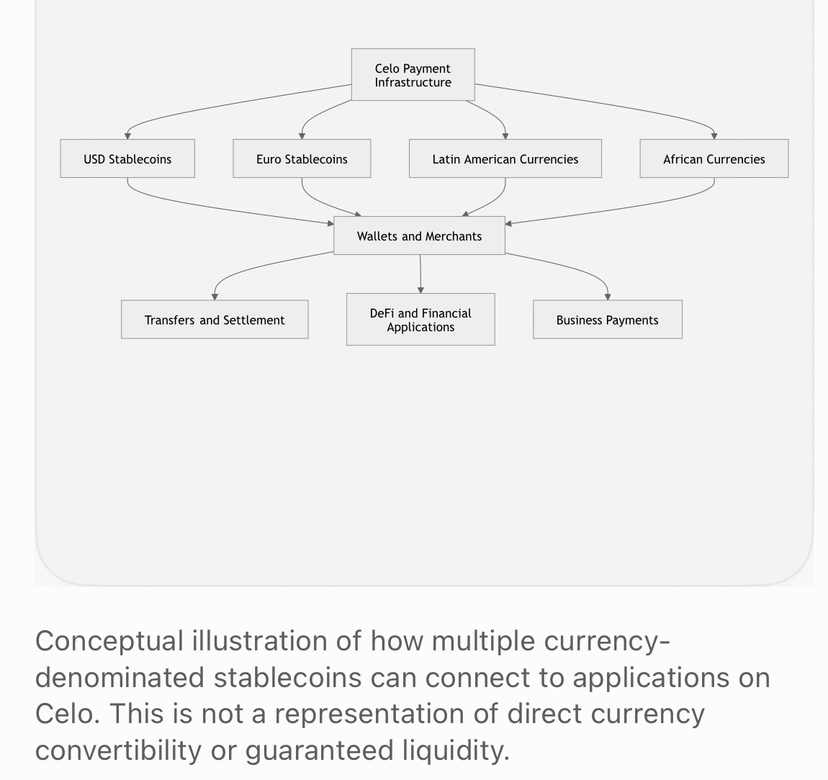
There is an important distinction, though.
A stablecoin representing a particular currency is not automatically equivalent to holding a bank deposit in that currency. Its issuer, reserves, redemption mechanisms, and liquidity all matter.
That is why I would evaluate the quality of the stablecoin ecosystem, not just the number of supported assets.
AI agents: The next payment users may not be human
One of the newer directions in Celo’s ecosystem is AI agent payments.
AI agents are increasingly capable of interacting with websites, using APIs, researching information, and completing tasks.
But there is a practical limitation: these agents also need to pay for services.
An AI agent might need computing resources, access to a data service, or a paid API call.
Traditional payment infrastructure was largely designed around human account holders and subscription based relationships.
Celo is exploring a different approach through stablecoin native agent payments.
In July 2026, Celo introduced its native x402 facilitator.
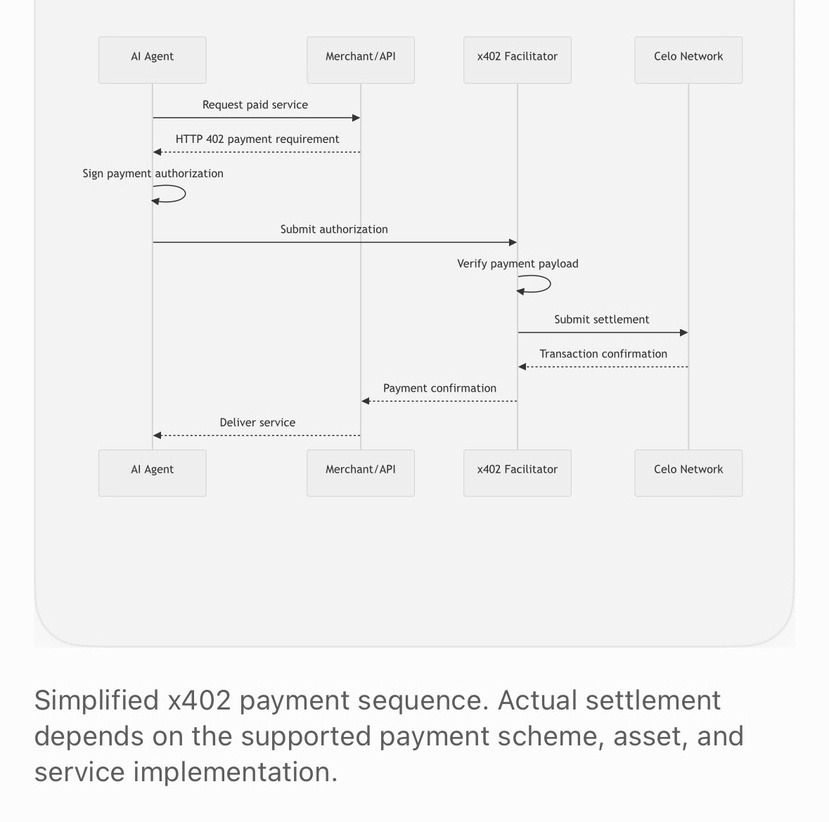
The x402 approach uses the HTTP 402 Payment Required response to allow web services to request payment before providing access.
Here is the basic process:
An AI agent requests a paid service.
The service returns a payment requirement
The agent signs a stablecoin payment authorization.
The facilitator verifies the authorization.
The facilitator submits the settlement transaction and sponsors gas.
The service receives confirmation and delivers the requested resource.
The implementation uses EIP-3009 transferWithAuthorization for supported assets.
This is particularly interesting because the facilitator can coordinate verification and settlement without taking custody of the buyer’s funds.
Celo expanded this infrastructure in October 2026, with its x402 facilitator supporting ten stablecoins across eight currencies.
The project also introduced buy, a services marketplace where agents can discover and pay for more than 700 services spanning compute, data, and APIs.
This creates a new possibility: AI agents could purchase services using stablecoins without requiring a human to manually approve every individual payment.
How an AI agent pays through x402
I find this direction worth monitoring because it connects Celo’s established stablecoin infrastructure with a potentially new category of demand.
However, having the infrastructure does not mean autonomous payments have already achieved mainstream commercial adoption.
Recurring payment activity will be the real test.
DeFi and tokenized real world assets
Celo’s payment focus does not mean its ecosystem is limited to wallets and transfers.
Its Ethereum compatible environment supports decentralized finance applications, including Aave, Uniswap, Morpho, Curve, and other ecosystem participants.
Stablecoins can serve as the foundation for lending, borrowing, liquidity provision, and onchain foreign exchange.
Tokenization is another important opportunity.
Tokenized financial assets need reliable settlement infrastructure, liquidity, and access to programmable currencies.
For example, a tokenized financial instrument could use stablecoins for settlement while connecting to decentralized lending markets.
The combination of Ethereum compatibility and stablecoin infrastructure makes this a relevant area for Celo.
But I would distinguish technical capability from actual institutional adoption.
The existence of tokenization infrastructure does not prove that large financial institutions are already using Celo at scale.
The indicators that matter are actual issuance, recurring liquidity, integrations, and commercial activity
Adoption: What do the numbers actually tell us?
I prefer looking at measurable activity instead of relying entirely on a project’s narrative.
Celo’s first year as an Ethereum Layer 2 provides an important reference point.
Its March 2026 ecosystem review reported more than $65.9 billion in stablecoin transaction volume during 2025, representing approximately 142% growth over 2024.
That is a significant figure, but volume alone does not tell the entire story
A network can process substantial transaction volume without generating equivalent revenue.
For a broader perspective, the November 22, 2026 Growthepie snapshot cited earlier reported:
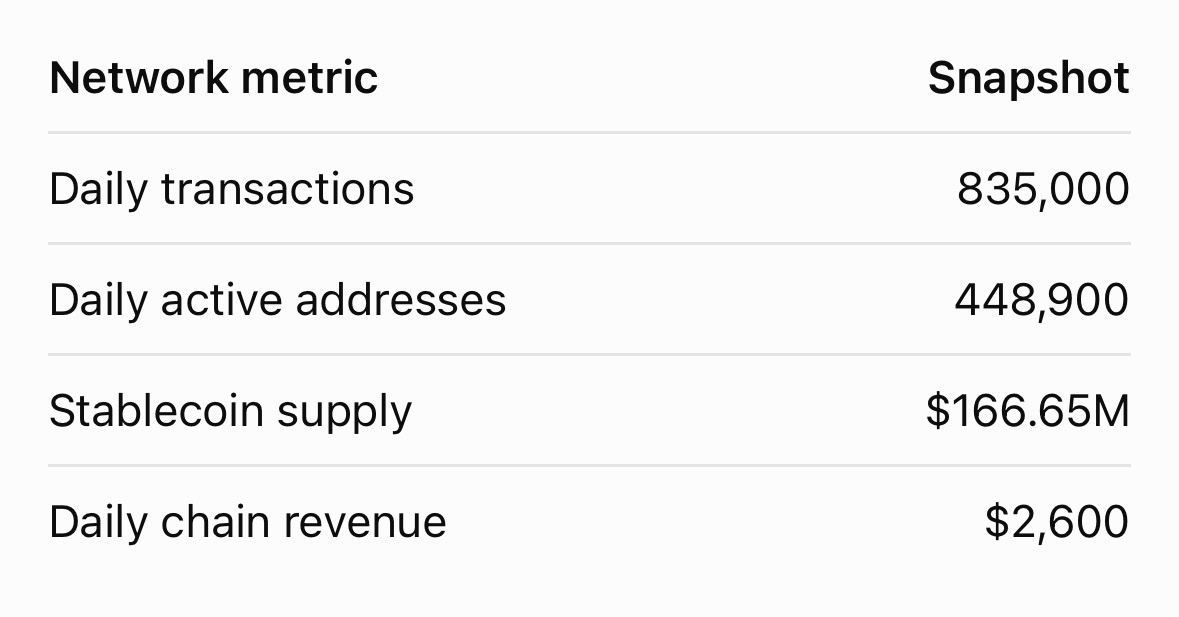
These metrics measure different things:
Transactions show how much network activity is taking place.
Active addresses indicate onchain participation, not necessarily unique people.
Stablecoin supply indicates the value of stablecoins present on the network.
Chain revenue provides insight into the network’s ability to capture economic value.
The distinction between usage and revenue is particularly important.
Stablecoin volume growth
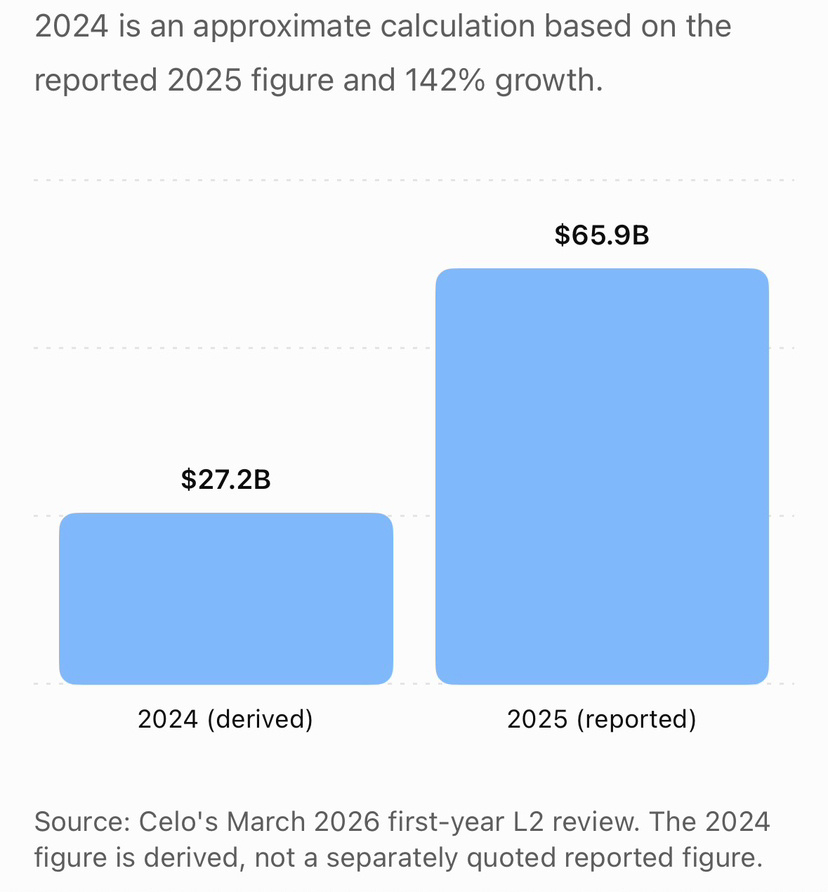
What I take from these numbers is that Celo has established meaningful stablecoin activity
The next challenge is demonstrating that this activity translates into sustainable network economics.
CELO token utility: Connecting network activity with economic value
Now comes the part token holders should understand
CELO is the native token of the Celo ecosystem.
Its functions include staking, network participation, governance, and supporting the protocol’s economic model.
But one development I find particularly interesting is the CELOccelerate tokenomics initiative.
Its economic model aims to connect network revenue with the CELO ecosystem.
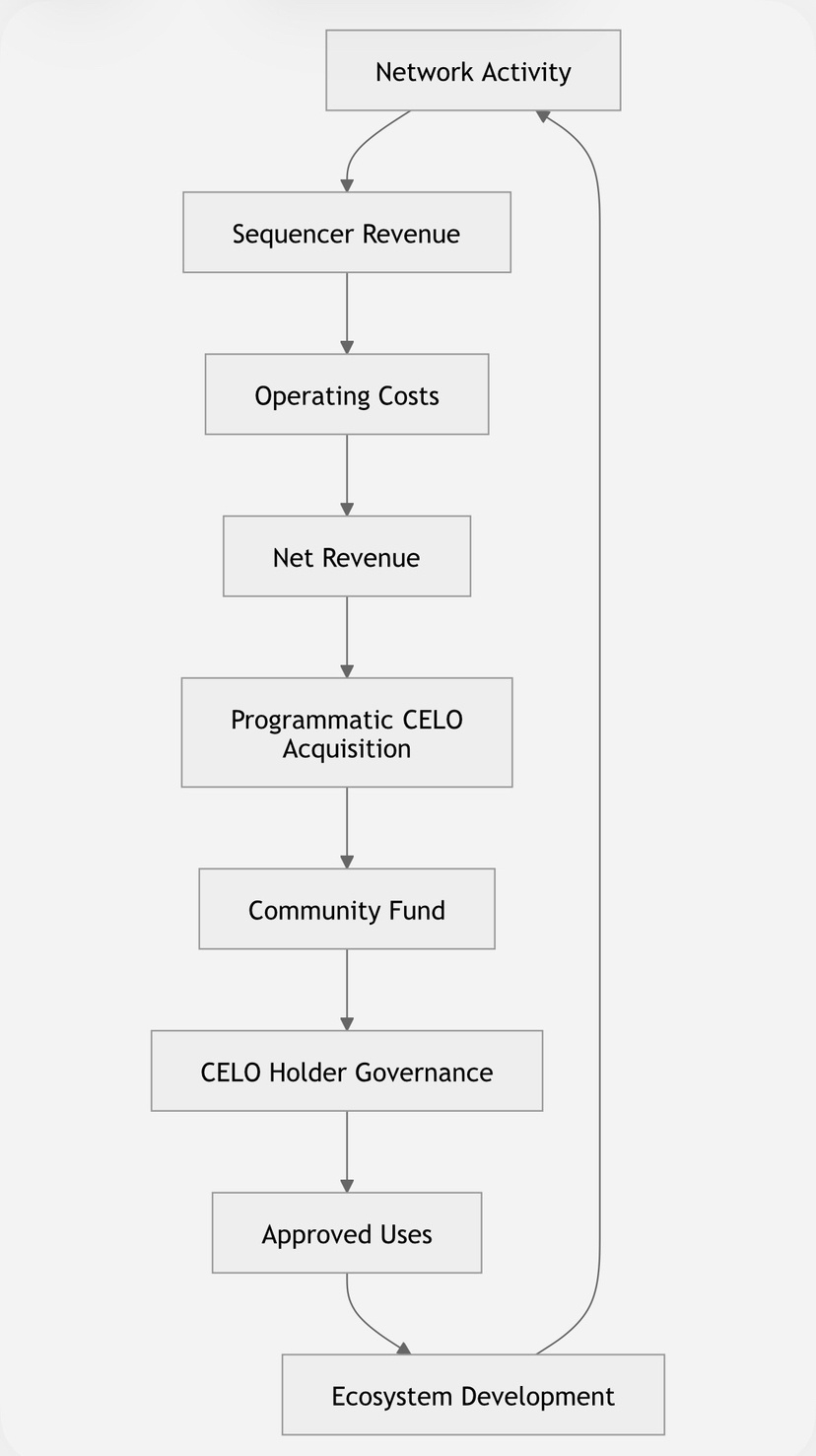
The proposed mechanism works through several stages:
The network generates sequencer revenue.
Relevant operating costs are accounted for.
Net revenue is directed toward the Community Fund through programmatic CELO acquisition.
CELO holders participate in governance decisions concerning the fund.
Approved allocations can support ecosystem development or other authorized uses, including burning tokens where approved.
This is interesting because it attempts to connect network activity with the native token’s economic role
CELO has a maximum supply of 1 billion tokens according to its published token information.
However, token acquisition does not automatically guarantee price appreciation.
The outcome depends on sustainable revenue, operating expenses, governance decisions, and actual implementation.
The CELO economic flywheel
Conceptual representation of the CELOccelerate revenue mechanism. Actual fund allocation and token treatment depend on approved governance decisions and implementation.
I would pay particular attention to whether network revenue grows alongside stablecoin activity.
That relationship will tell us more about CELO’s long term economic model than transaction counts alone.
Where I remain cautious
There are several challenges worth discussing.
Competition
Ethereum Layer 2 networks and payment-focused blockchains are competing for the same developers, liquidity, and applications. Celo needs to maintain a clear reason for businesses to choose its ecosystem.
Stablecoin dependencies
Celo does not control every stablecoin issuer, local payment provider, or redemption mechanism. Those external relationships influence the reliability of its payment ecosystem.
User retention
Twenty million activated wallets is an encouraging distribution metric, but recurring users are more important than registrations.
Network economics
High transaction volume does not automatically translate into high revenue. The relationship between operating costs, sequencer revenue, and token economics needs continued examination.
AI agent adoption
The x402 infrastructure is an interesting development, but actual recurring commercial payments from AI agents still need to demonstrate meaningful scale.
These challenges do not invalidate Celo’s strategy. They identify the areas where execution will matter most.
What I am watching next
Instead of focusing exclusively on the CELO price chart, I would monitor five developments.
MiniPay retention: Are activated wallets becoming regular payment users?
Stablecoin activity: Is volume translating into sustained economic demand?
AI agent payments: Are x402 and MPP integrations generating recurring transactions?
Protocol economics: Is sequencer revenue growing enough to support the Community Fund after operating costs?
Ecosystem expansion: Are more developers, merchants, local-currency issuers, and financial applications choosing Celo?
These are more useful indicators of long term progress than short term market movements.
My Take:
What makes Celo interesting to me is its focus on a practical problem.
Crypto does not necessarily need another network competing for attention. It needs infrastructure that makes digital money easier to move, easier to use, and more accessible across different financial markets.
Celo has made several meaningful moves in that direction.
Its Ethereum Layer 2 transition, MiniPay distribution, stablecoin ecosystem, local currency payment infrastructure, and emerging AI agent payment tools form a coherent strategy.
The strongest part of the thesis is the combination of distribution and infrastructure.
MiniPay provides the user facing entry point, while Celo provides the programmable settlement layer underneath it.
But the next chapter is about economics.
Can Celo turn millions of activated wallets and substantial stablecoin activity into sustainable, recurring financial usage?
Can its protocol revenue support the network’s longterm development?
And can it maintain a meaningful position as competing payment networks evolve?
Those are the questions I would continue investigating.
I would rather watch real payments, returning users, and sustainable revenue than rely on a compelling narrative alone.
Because the future of digital payments will not be decided by how many networks exist. It will be decided by how many people actually find them useful.
Disclosure: This article was created as original educational research for the Binance Square Celo Creator Challenge. It reflects my own analysis and interpretation of publicly available information.
Disclaimer: This content is for educational purposes only and is not financial advice. Cryptocurrency assets are volatile and involve significant risks. Always conduct your own research before making investment decisions.