
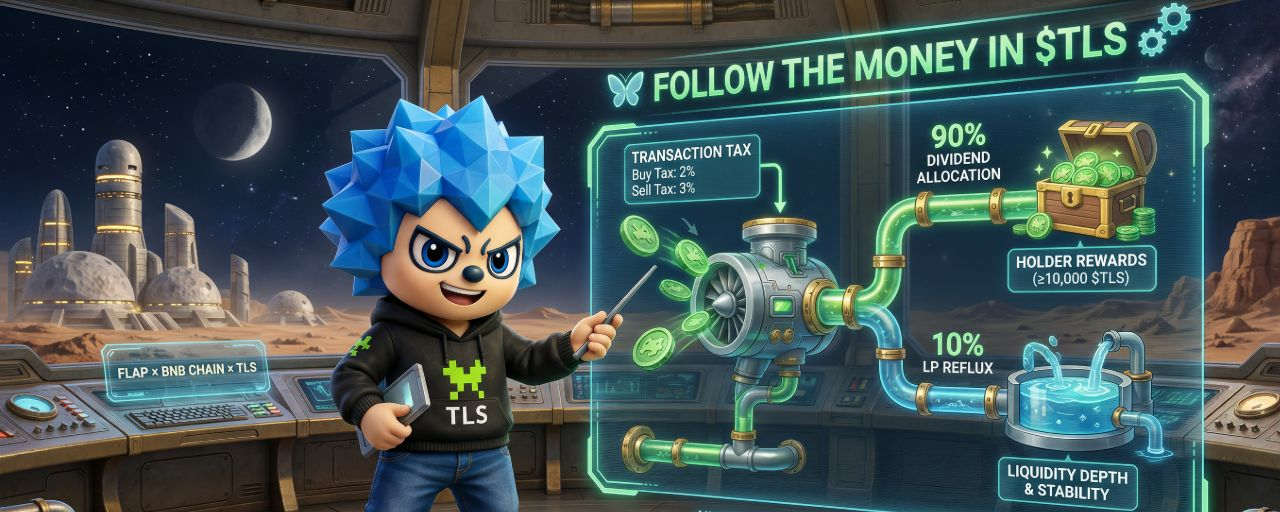

Ever wondered what actually happens when someone buys or sells $TLS?
Let's explore the financial mechanics behind TLS: transaction taxes, dividend allocation, LP Reflux, and how these mechanisms contribute to the ecosystem.
1️⃣ Transaction Tax Collection
TLS's published tokenomics describe:
🟢 Buy Tax: 2%
🔴 Sell Tax: 3%
Every taxable transaction contributes to the ecosystem through its fee mechanism.
For example:
• Buy transaction: $1,000 → $20 tax
• Sell transaction: $1,000 → $30 tax
These are illustrative calculations before considering any other applicable protocol fees or contract-level routing.
2️⃣ Tax Distribution & Accounting
The published TLS tokenomics describe the following allocation of collected tax:
💎 90% — Dividend Allocation
💧 10% — LP Reflux Allocation
For example, if $100 of distributable tax is collected:
• $90 is allocated toward the dividend mechanism.
• $10 is allocated toward the liquidity-related LP Reflux mechanism.
This allocation creates a structured approach to distributing collected transaction taxes across two important parts of the ecosystem.
3️⃣ Dividend Accounting
How does the dividend mechanism work?
• Eligible holders need at least 10,000 TLS.
• Dividend funds are allocated according to the applicable distribution mechanism.
• Holder balances and eligibility determine their share of rewards.
• Eligible holders can receive rewards generated through the dividend mechanism.
The objective is to connect ecosystem trading activity with rewards for qualifying holders, encouraging participation and long-term community engagement.
4️⃣ LP Reflux — The Liquidity Mechanism
Liquidity is one of the most important foundations of a token ecosystem.
LP Reflux is designed to direct a portion of collected taxes toward the liquidity-related mechanism.
Why does liquidity matter?
💧 Supports trading liquidity.
⚙️ Strengthens the ecosystem's liquidity mechanism.
📊 Greater pool depth can help reduce price impact during trading.
By connecting transaction activity with liquidity support, LP Reflux adds another important component to TLS's financial ecosystem.
5️⃣ The Complete Financial Flow
Here's the simplified mechanism:
Trading Activity
⬇️
Transaction Tax Collection
⬇️
Tax Accounting & Allocation
⬇️
90% Dividend Allocation + 10% LP Reflux
⬇️
Holder Rewards & Liquidity Mechanism
🦋 Final Thoughts
What makes TLS interesting is the combination of community participation, transaction-based incentives, and DeFi liquidity mechanisms.
Built around the FLAP ecosystem on BNB Chain, TLS brings together community engagement, tokenomics, dividend mechanisms, and liquidity infrastructure.
Understanding the accounting behind a token is just as important as following its price.
Don't just follow the token. Understand where the money flows! ⚙️
💬 What do you think will matter most for TLS's long-term growth: sustained trading volume, transparent tax allocation, or stronger liquidity depth?
🦋 Keep building. Keep growing. Keep supporting TLS!
$BTC




@Flap 蝴蝶 @FLAPTLS @Jackie_TLS
#CanBTCReboundAfterFallingBelow60K?
#TLS #Flap #BNBChain #DeFi