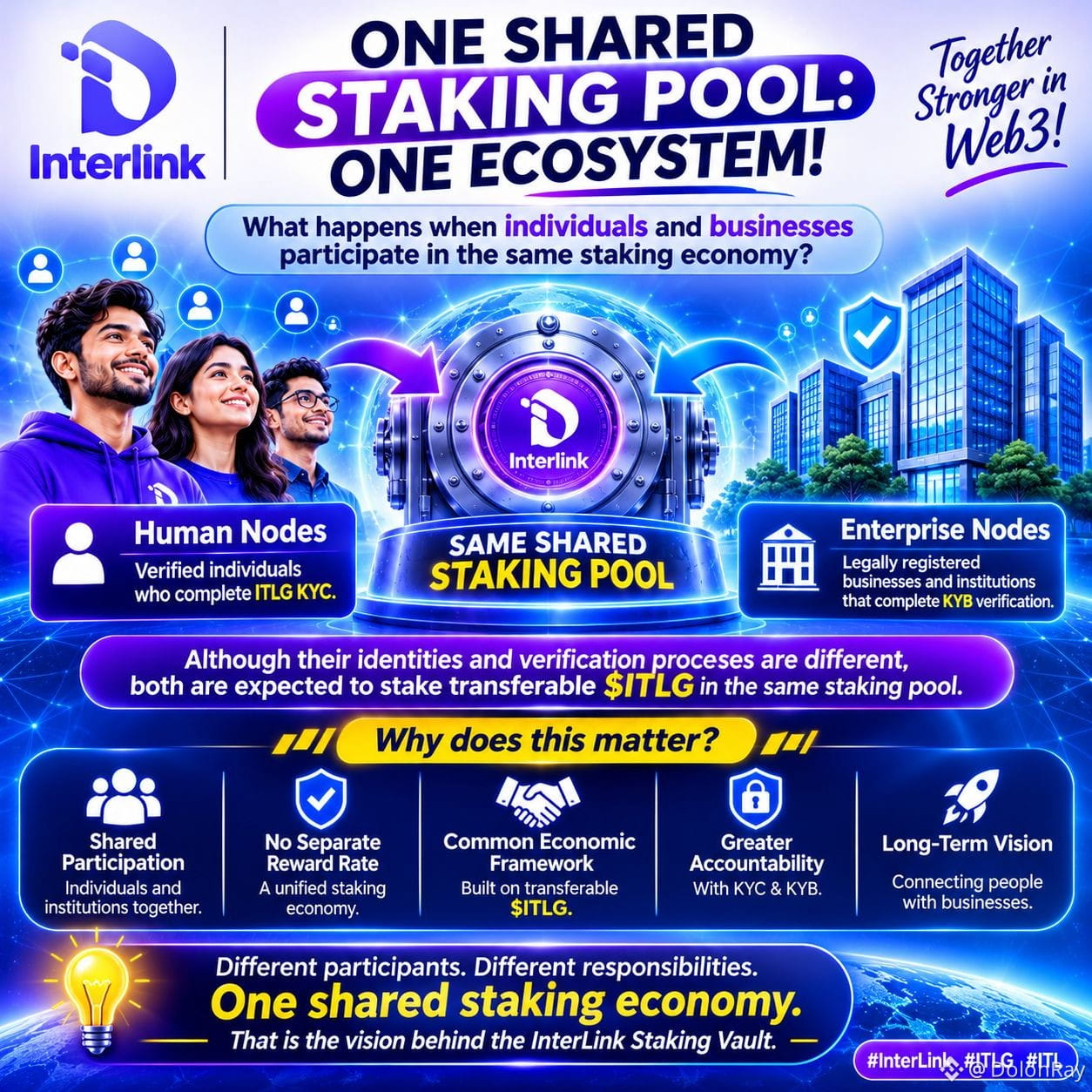
🏦 𝗢𝗡𝗘 𝗦𝗛𝗔𝗥𝗘𝗗 𝗦𝗧𝗔𝗞𝗜𝗡𝗚 𝗣𝗢𝗢𝗟: 𝗢𝗡𝗘 𝗘𝗖𝗢𝗦𝗬𝗦𝗧𝗘𝗠! 🌍
What happens when individuals and businesses participate in the same staking economy?
That is one of the most interesting ideas behind the proposed $ITLG Staking Vault.
InterLink introduces two participant categories:
👤 Human Nodes: Verified individuals who complete ITLG KYC.
🏢 Enterprise Nodes: Legally registered businesses and institutions that complete KYB verification.
Although their identities and verification processes are different, their proposed staking model has something important in common.
Both are expected to stake transferable $ITLG in the same shared staking pool.
Why does this matter?
🔹 Shared Participation: Individuals and institutions become part of one staking ecosystem.
🔹 No Separate Institutional Reward Rate: Enterprise Nodes are not designed to receive a separate institutional staking rate.
🔹 Common Economic Framework: Both participant categories contribute through transferable $ITLG staking.
🔹 Greater Accountability: KYC and KYB introduce identity verification into the participation structure.
🔹 Long-Term Vision: This model aims to connect human participation with institutional involvement.
The interesting part is that InterLink is not simply proposing two different staking systems.
It is exploring one shared economic framework where verified people and businesses can participate together.
Of course, the effectiveness of this model will depend on its final implementation, reward distribution, and governance mechanisms.
Different participants. Different responsibilities. One shared staking economy.
That is the vision behind the InterLink Staking Vault.
#InterLink #ITLG #ITL