Gold’s Safe-Haven Status Meets Market Reality Today
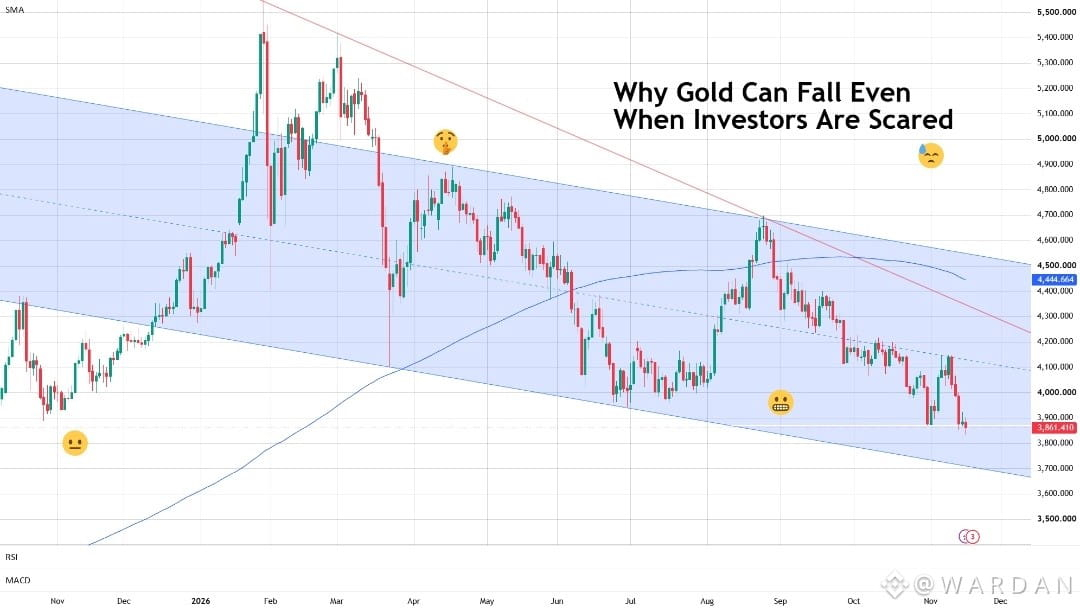
Something about gold's recent decline caught my attention. Despite its traditional safe-haven status, gold recently fell towards $3,796, raising an important question: Are investors actually abandoning it?
I don't think the price decline tells the entire story.
According to the World Gold Council, gold-backed ETFs attracted $2.7 billion in October, increasing holdings by 19 tonnes to 4,275 tonnes. Yet COMEX net-long positioning declined by 94 tonnes.
This difference is particularly interesting.
It suggests that long-term investment demand and short-term speculative positioning can move in opposite directions.
I think we need to look beyond price alone.
Gold can also experience selling pressure when investors need liquidity. During financial stress, leveraged traders may sell liquid assets to meet margin requirements or cover losses elsewhere. Selling gold doesn't always mean losing confidence in its long-term value.
However, macroeconomic pressure remains significant. A stronger US dollar and rising real yields increase the opportunity cost of holding a non-yielding asset like gold.
Looking at the chart, I see a descending channel, lower highs and lower lows. Sellers remain in control while price trades below the displayed moving average.
My focus is on the $3,800–$3,850 region. A sustained breakdown could extend the decline, while reclaiming $4,000 would be an early sign of improving momentum.
I see three possible outcomes: weaker yields and dollar strength could support recovery; continued macroeconomic pressure could extend losses; or gold could consolidate while demand and monetary conditions remain in conflict.
My biggest takeaway: Falling prices do not automatically mean disappearing demand.
What matters is whether underlying buying pressure can eventually overcome macroeconomic and liquidity-driven selling.
Are you watching gold's investment demand or the US dollar and real yields more closely?
$XAU