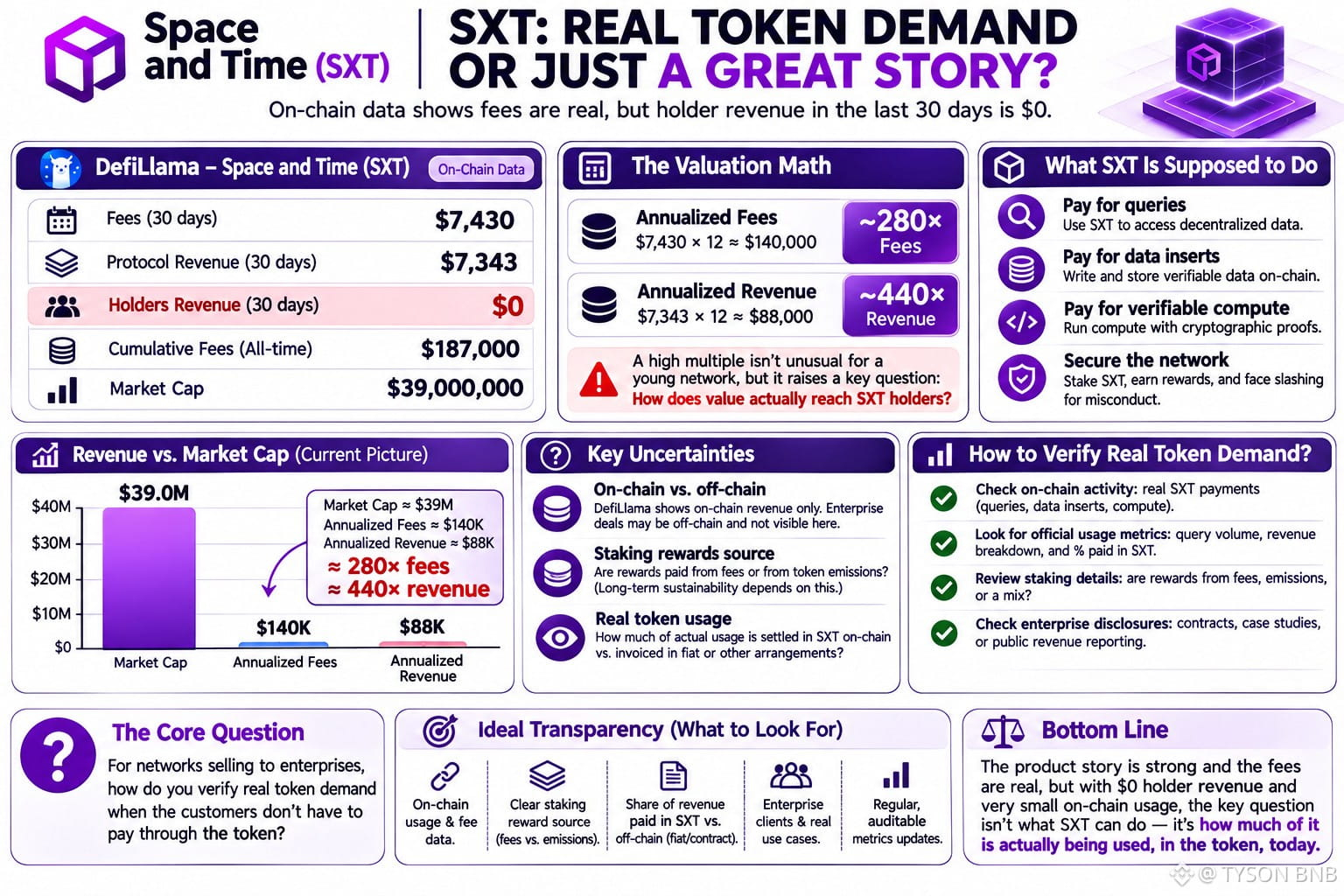

I pulled up DefiLlama's page for Space and Time and one row stopped me: holders revenue, 30 days, $0. Not low. Zero.
same page, same period: $7,430 in fees, with $7,343 counted as protocol revenue. Cumulative fees are about $187K. Against a market cap near $39M, annualized fees of roughly $140K put the token at around 280x fees. On revenue it's closer to 440x.
a high multiple alone isn't damning for a young network. What I'm trying to understand is how value is supposed to reach the token. The official token post says SXT pays for queries, data inserts and verifiable compute, and that security is anchored in staking and slashing. So the design is stake to secure, pay in SXT to use. That makes token demand depend on paid usage, and onchain that usage is still very small. There's a fair counterpoint. DefiLlama only shows what it can index. If institutional customers in tokenized assets pay through contracts or offchain arrangements, that revenue may never appear in these numbers. I can't verify either way from public dashboards. i also couldn't confirm from what I read where staking rewards come from over the long run: fees or emissions. That answer probably matters more than the chart. hmm.. The single metric I'd want is how much of the paid usage the team describes is actually settled in SXT onchain, and how much is invoiced somewhere else.
For networks selling to enterprises, how would you verify real token demand when the customers don't have to pay through the token?
#sxt $SXT @SpaceandTime