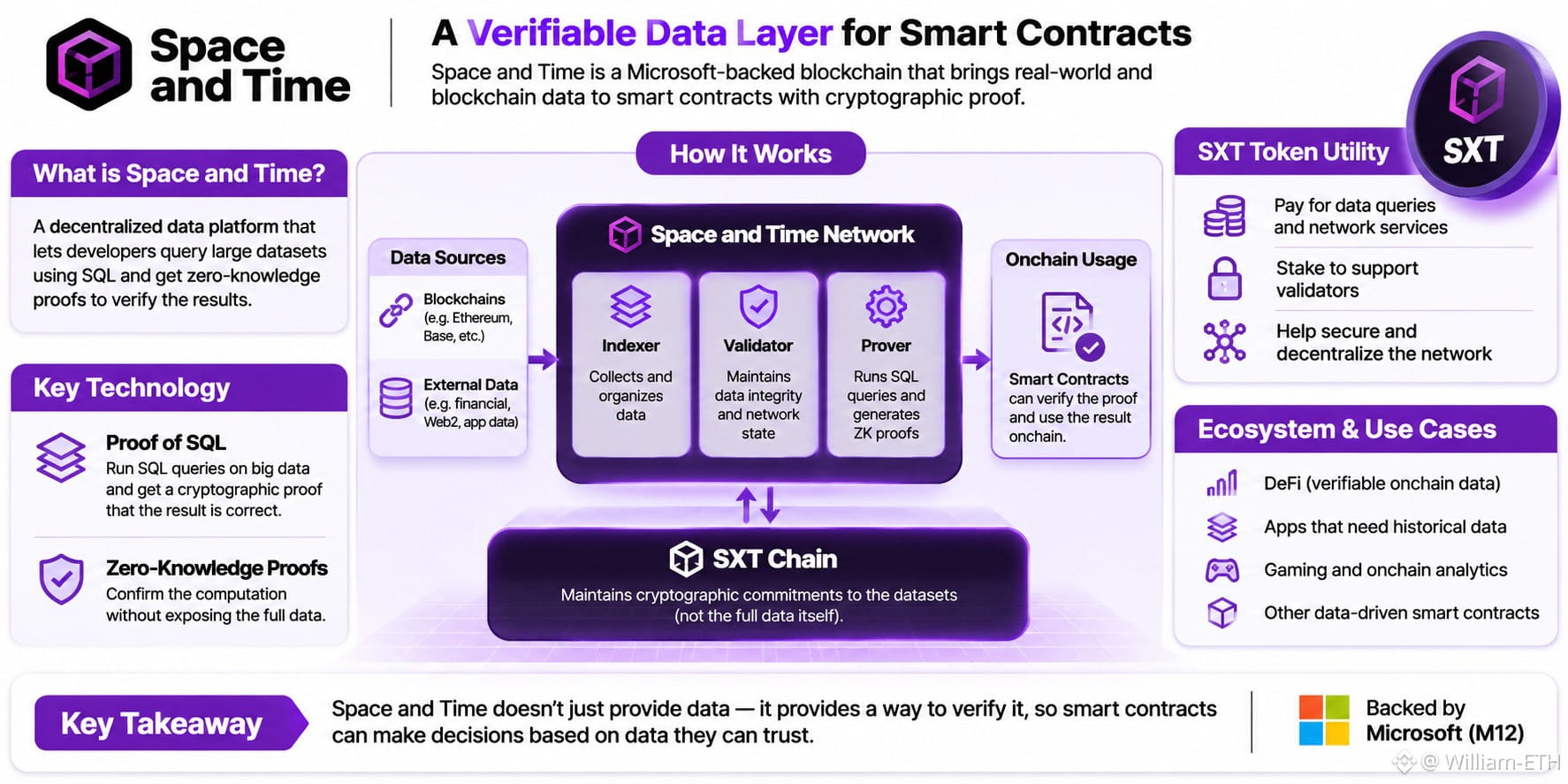

I've been spending some time exploring Space and Time, and one thing genuinely caught my attention. The project is looking at a problem that doesn't always get enough attention in crypto: how can smart contracts use large amounts of data without simply trusting an outside source?
That's where Space and Time comes in.
Its Proof of SQL technology is probably the most interesting part for me. It lets developers run SQL queries on large datasets and generate zero-knowledge proofs to show that the results were calculated correctly.
What I like about this idea is pretty simple. Instead of asking users to trust the result, Space and Time gives them a way to verify how that result was produced.
I also spent some time looking at its architecture. Indexers organize the data, Validators help maintain its integrity, and Provers handle the work of generating cryptographic proofs. Each part has a different job, which makes the overall design interesting to study.
Then there's SXT, the native token. It's used for network services and validator staking, connecting the token to the actual operation of the infrastructure.
The Microsoft connection through M12 is another interesting detail, but I don't think backing alone tells us how successful a project will become. What matters more to me is whether developers actually use the technology and whether demand for its services grows.
I'm still watching how the ecosystem develops, especially around DeFi and applications that need reliable blockchain data.
One thing I don't want to overlook: proving that a calculation is correct doesn't automatically mean the original data was accurate. That's an important challenge the project still needs to address.
Personally, I find Space and Time interesting because it's working on something deeper than another blockchain narrative.
I'm curious to see whether it can turn verifiable data into something developers genuinely depend on.
#sxt $SXT @SpaceandTime