$KORUB : What Would Make a Recovery More Convincing?
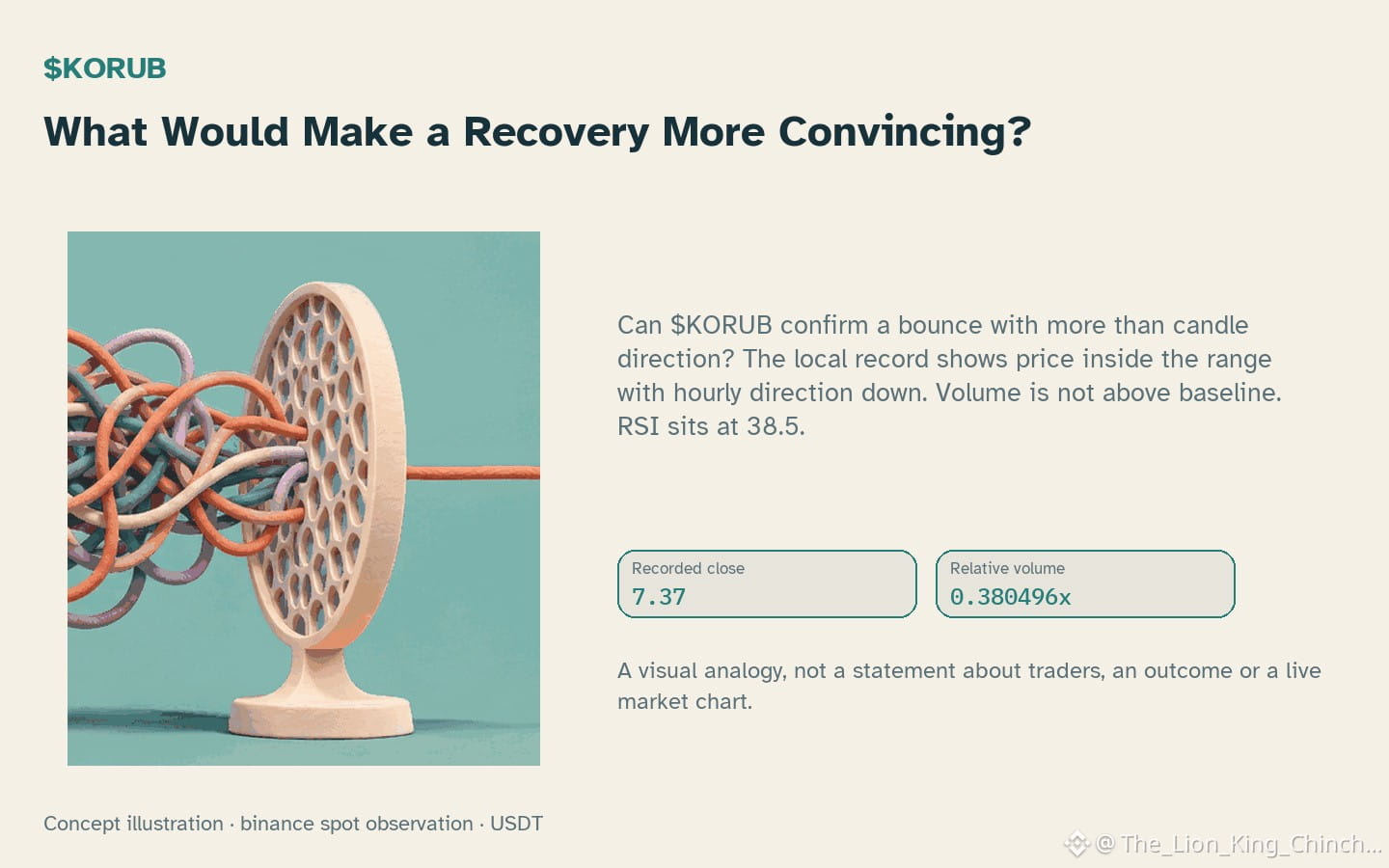
Can $KORUB confirm a bounce with more than candle direction? The local record shows price inside the range with hourly direction down. Volume is not above baseline. RSI sits at 38.5.
Hypothetical decision framework. Imagine a rule requiring two checks for a bounce: price closes above resistance and relative volume exceeds baseline. This is a thought experiment, not an observation of trader behavior. The first filter is the local range high, 7.5. The second is activity, measured as 0.38x baseline. Neither condition is met in the saved state. The second condition prevents a single-candle spike from being labeled a trend.
Where the analogy helps. It separates reaction from confirmation. A bounce without elevated activity could be a pause. A bounce with it suggests participation. This is a logic filter, not a prediction. It does not prove causation.
Where the analogy fails. Volume can rise on shorts, not just buyers. A close above resistance can be a fakeout. The rule ignores price structure and higher-timeframe context. It treats all volume equally.
If price closes above 7.5 but relative volume remains at or below baseline, the dual-filter logic rejects the bounce. If volume spikes but price fails to close above the level, the first filter rejects it. The self-check is to log both conditions for each candidate bounce. If both fail, the signal is invalid. This reduces false positives in a hypothetical model. The current observation does not meet the criteria. Price is inside the range. Volume is flat. RSI is 38.5. The hypothesis remains unverified. Future closed-candle data is needed to test the logic. This is a structural check, not a market read.
Probabilistic market research, not a recommendation or guaranteed return.
#KORUB #MarketAnalysis #CryptoLearning