
I’ve been chewing on $SXT for a few days, and it’s made me notice something kind of annoying about DeFi.
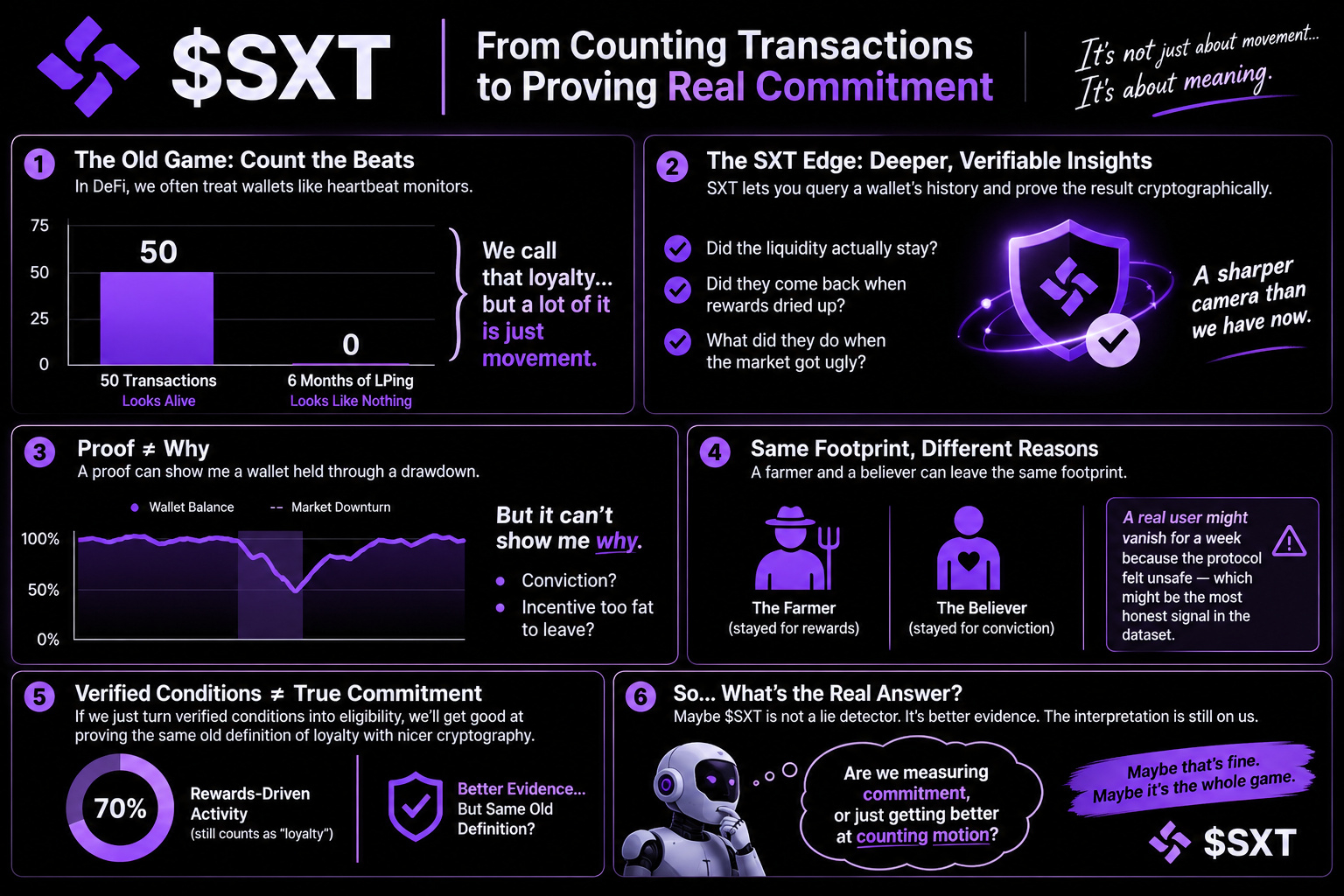
We treat wallets like heartbeat monitors. Count the beats. Fifty transactions? Looks alive. Six months of quiet LPing? Looks like nothing happened. One gets points, the other gets scrolled past. We call that loyalty, but a lot of it is just movement.
The SXT angle makes sense to me: query a wallet’s history and prove the result cryptographically. Not just “how many txs,” but did the liquidity actually stay, did they come back when rewards dried up, what did they do when the market got ugly. That’s a sharper camera than we have now.
But here’s where I get stuck. A proof can show me a wallet held through a drawdown. It can’t show me why. Maybe it was conviction. Maybe the incentive was just too fat to leave. A farmer and a believer can leave the same footprint. And a real user might vanish for a week because the protocol felt unsafe — which might be the most honest signal in the whole dataset, even though it looks like absence.
So I don’t think $SXT is a lie detector. It’s better evidence. The interpretation is still on us. And if we just turn verified conditions into eligibility, we’ll get really good at proving the same old definition of loyalty with nicer cryptography.
Maybe that’s fine. Maybe that’s the whole game. But I keep wondering if we’re measuring commitment, or just getting better at counting motion.
#sxt $SXT @SpaceandTime