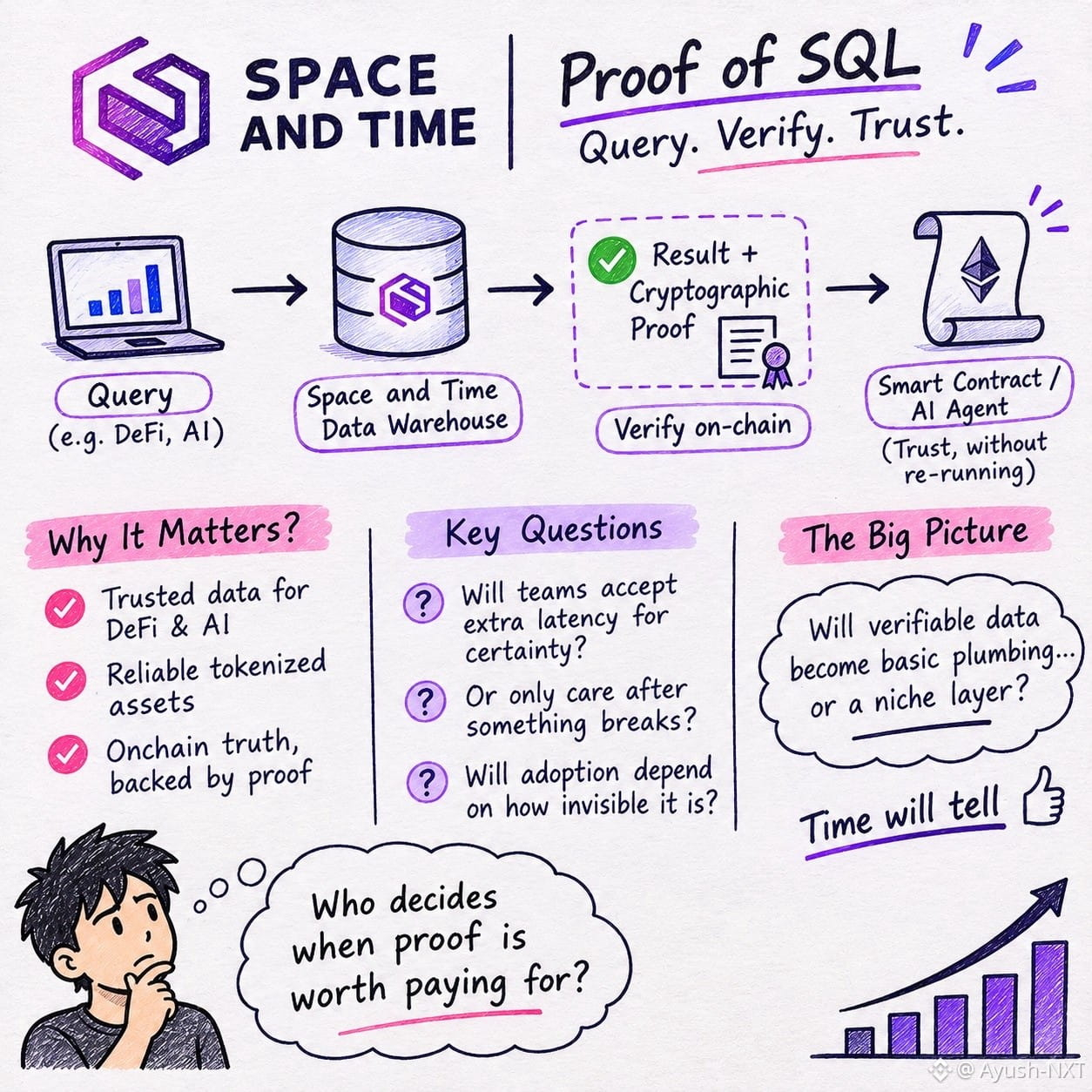
I was going through Space and Time’s docs last night and kept getting stuck on one small idea: a query result that comes with a proof that it was computed correctly. I sometimes wonder how much of AI and DeFi quietly rests on data we just agree to trust.
What seems interesting is the Proof of SQL approach, where the warehouse doesn’t only return an answer, it returns something a contract or an AI agent can check without rerunning it all. It makes me think about tokenized assets too, since an onchain record is only as believable as what sits offchain.
I’m not completely sure how this holds up at scale. Proofs cost something, and developers often choose convenience first. Will teams accept extra latency for certainty, or will they only care after something breaks? Looking from the outside, adoption may hinge less on the cryptography and more on how invisible it becomes.
Maybe verifiable data becomes basic plumbing, or maybe it stays a niche layer for the cautious. The question that comes to mind is who decides when proof is worth paying for... anyway, time will tell👍
#sxt $SXT @SpaceandTime