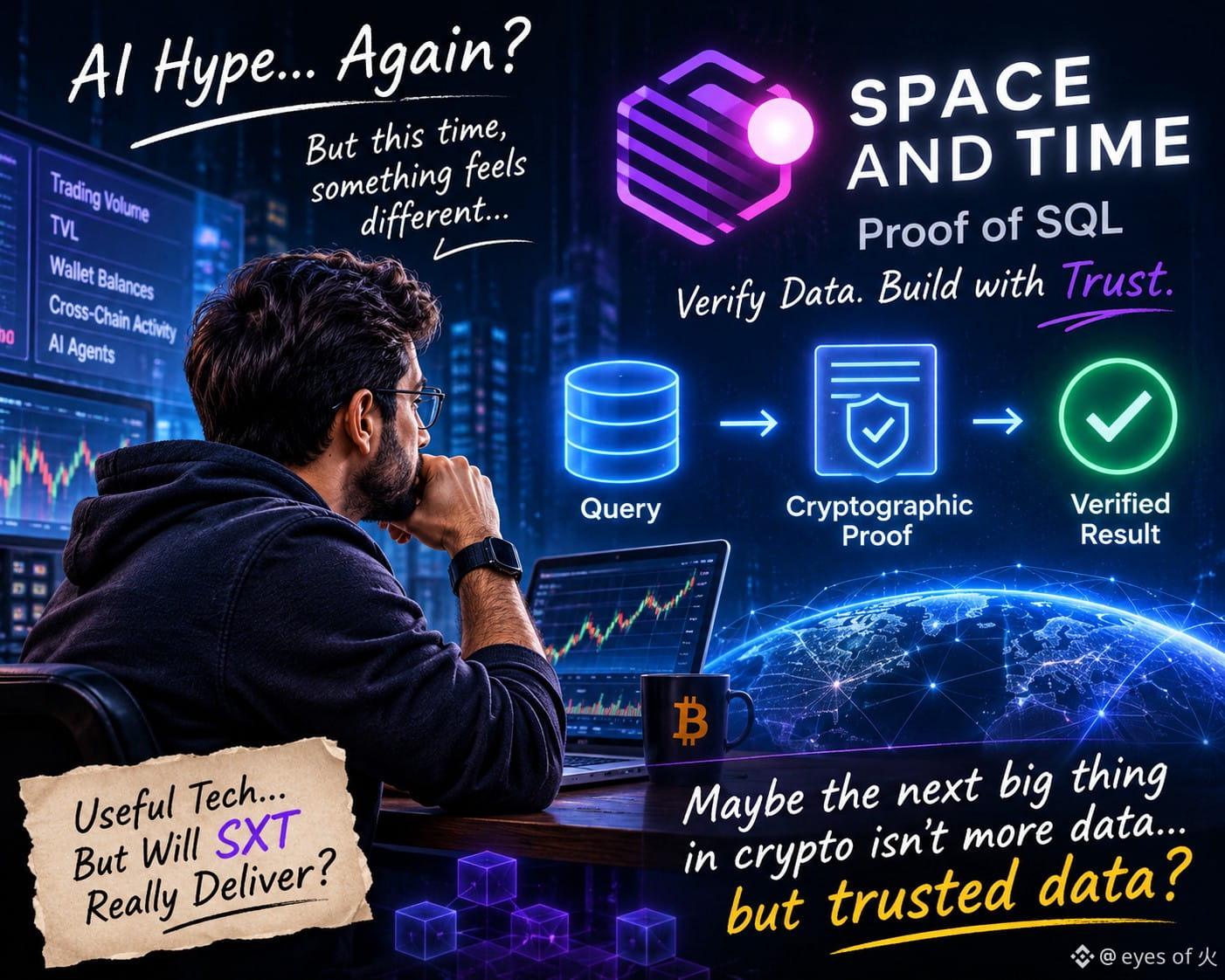

I've been around crypto long enough to know that whenever a new narrative takes over, hundreds of projects suddenly seem to be doing the same thing. AI is that narrative right now. Honestly, I was expecting Space and Time to be another project trying to benefit from the hype. But after spending some time looking into it, I started seeing things a little differently.
Think about how much we rely on data in crypto. Trading volume, wallet balances, TVL, cross-chain activity, and eventually the decisions made by AI agents. Almost everything depends on getting the numbers right. But one question rarely gets enough attention: how do we actually know those numbers are correct?
That's where Space and Time caught my interest. Its Proof of SQL technology is designed to let users verify that a database query was executed correctly, rather than simply trusting whoever provides the result. And I think that matters more than people might realize, especially as DeFi and AI agents start handling more complicated financial activity.
Of course, I'm not saying this solves every problem. A cryptographic proof can't magically make bad source data reliable. There are still questions around adoption, costs, integrations, and whether developers will actually use it in real applications.
And that's where I remain a little cautious about SXT. Having useful technology doesn't automatically mean the token will perform well. What matters is whether real projects integrate it, whether people keep using it, and whether that activity creates meaningful demand for the token.
I've seen too many projects look impressive on paper and struggle when it comes to actual usage. So I'm not rushing to conclusions here.
But something about Space and Time feels worth watching. Maybe the next important competition in crypto won't just be about who has more data, but who can actually prove that the data everyone relies on can be trusted.
#sxt $SXT @SpaceandTime