Most traders watch the spread between major pairs like BTC and high-beta assets likeETH without realizing how relative volatility dictates risk exposure.
When Bitcoin enters a multi-week consolidation range, capital naturally rotates outward into major layer-1s and mid-caps searching for yield. The common mistake is sizing an $ETH or altcoin swing trade using the exact same dollar position you’d use on $BTC.
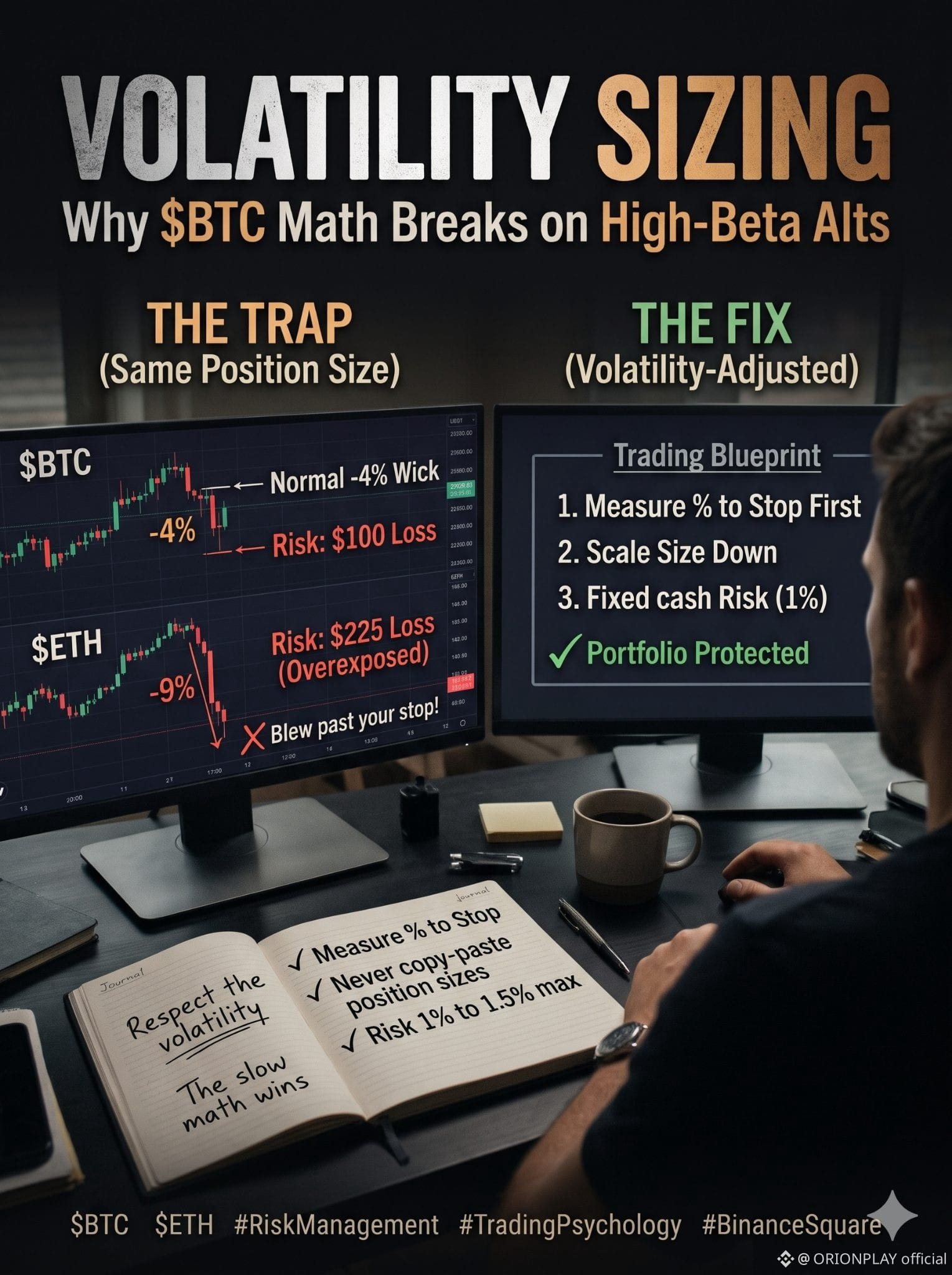
Because alt volatility profiles are significantly wider, an identical dollar allocation actually doubles your portfolio risk. A normal 4% liquidity wick on Bitcoin can easily translate into an 8% to 10% flush across larger alts, triggering stops that were technically sound on the macro chart but placed too tight for local order book depth.
Instead of hunting for breakout trades during range bound sessions, align your trade sizing with asset volatility:
Calculate your stop distance in percentage terms first.
Adjust position size downward so your maximum cash risk remains fixed at 1% to 1.5%.
Look at relative liquidity depth rather than relying solely on candle patterns.
Managing your size relative to asset volatility will keep you solvent far longer than trying to predict where the next candle closes.
How do you adjust your position size when shifting between $BTC and alt majors?
#CryptoTrading #RiskManagement #BinanceSquare #TradingPsychology
When Bitcoin enters a multi-week consolidation range, capital naturally rotates outward into major layer-1s and mid-caps searching for yield. The common mistake is sizing an $ETH or altcoin swing trade using the exact same dollar position you’d use on $BTC.
Because alt volatility profiles are significantly wider, an identical dollar allocation actually doubles your portfolio risk. A normal 4% liquidity wick on Bitcoin can easily translate into an 8% to 10% flush across larger alts, triggering stops that were technically sound on the macro chart but placed too tight for local order book depth.
Instead of hunting for breakout trades during range bound sessions, align your trade sizing with asset volatility:
Calculate your stop distance in percentage terms first.
Adjust position size downward so your maximum cash risk remains fixed at 1% to 1.5%.
Look at relative liquidity depth rather than relying solely on candle patterns.
Managing your size relative to asset volatility will keep you solvent far longer than trying to predict where the next candle closes.
How do you adjust your position size when shifting between $BTC and alt majors?
#CryptoTrading #RiskManagement #BinanceSquare #TradingPsychology