

I’m Agung Rayls Ambassador.
Lately, many people have been asking me about the difference between tokenized deposits and stablecoins like USDT or USDC. This question often comes from people who are still new to blockchain, and I believe it’s important to answer it clearly and honestly.
I wrote this article based on
@raylslabs
official documentation and blog, combined with my own observations while studying the ecosystem. I’ve tried to keep the language as simple as possible so that even those who are new to Rayls can follow along.
Who Issues the Money?
USDT and USDC are issued by third-party companies (Tether and Circle). They hold reserves and then issue tokens that can circulate freely across many blockchains. Banks can usually hold or sell these tokens, but they do not issue them and have limited direct control.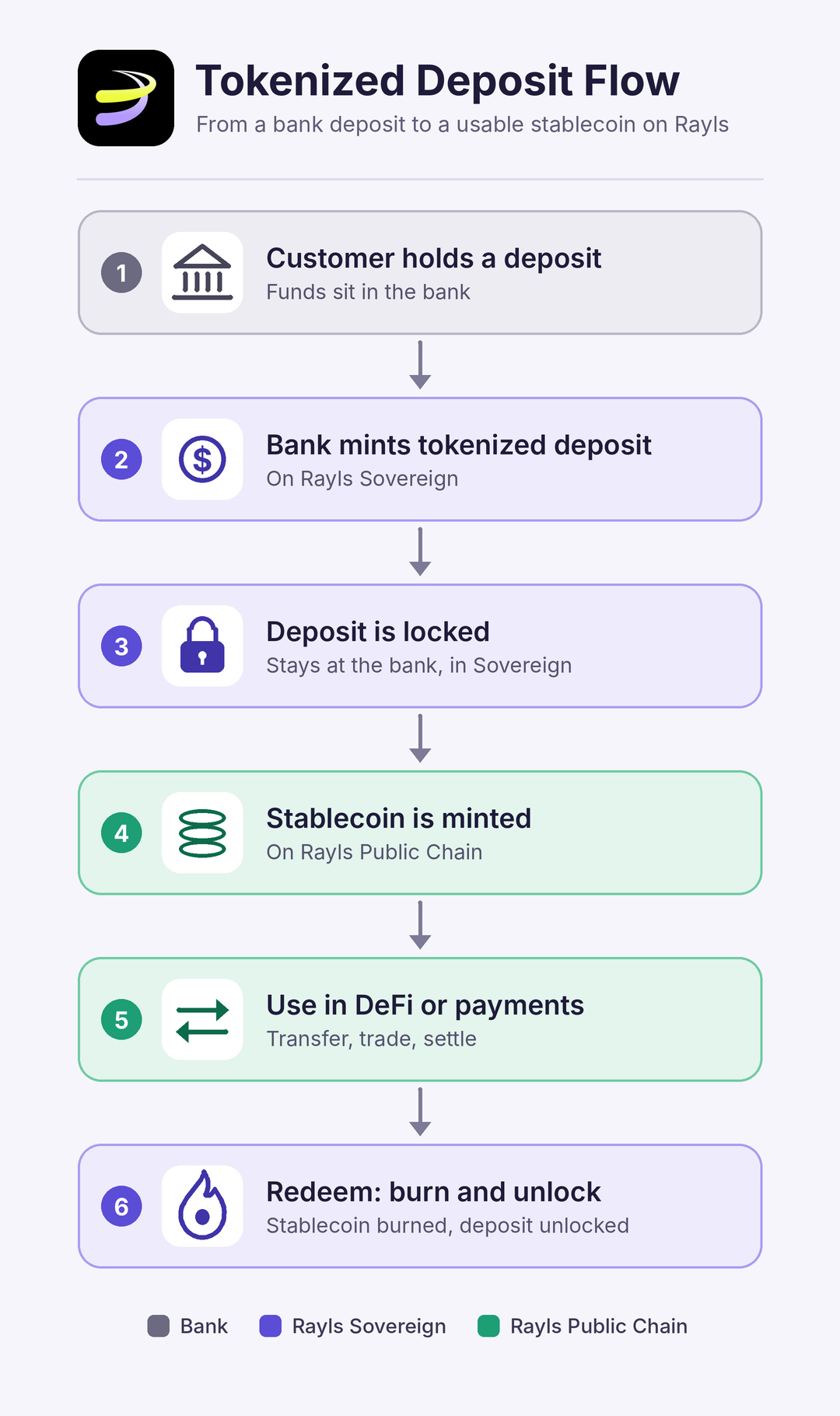
Tokenized deposits,on the other hand, are issued directly by the bank. According to Rayls’ official documentation, a tokenized deposit is a digital representation of value issued by an institution, often designed for consumer use in retail payments, settlements, or incentive schemes. Within a Rayls Sovereign ledger, these tokens can be securely minted, programmed, and transacted.[](<
https://docs.rayls.com/docs/rayls-node-use-cases-tokenised-deposit
>)
From what I’ve seen in Rayls’ architecture, this is one of the biggest differences: the bank remains the issuer, not just a user.
Control: Who Can Set the Rules?
With USDT/USDC, banks have little direct control. If there’s an issue (fraud, compliance, or a regulator’s request), the bank usually cannot freeze the customer’s tokens on its own.
On Rayls Sovereign, the bank retains control. Official documentation states that institutions can run smart contracts that enforce governance rules such as freezing, seizing, or locking tokens. There’s also a clear mechanism where a deposit can be locked on Sovereign, while a stablecoin representing its value is minted on the Public Chain. The original deposit stays on the institution’s balance sheet and never leaves its perimeter.[](<
https://docs.rayls.com/docs/a-warm-introduction-rayls-sovereign
>)
The flow works like this:
1. The tokenized deposit is registered and activated.
2. The deposit is locked in the institution’s own Rayls Sovereign ledger (not burned).
3. A stablecoin is minted on the Rayls Public Chain against that locked collateral.[](<
https://docs.rayls.com/docs/rayls-node-use-cases-tokenised-deposit
>)
In my view, this is why many institutions are interested. They don’t have to release customer funds just to give them access to the on-chain world.
From the Customer’s Perspective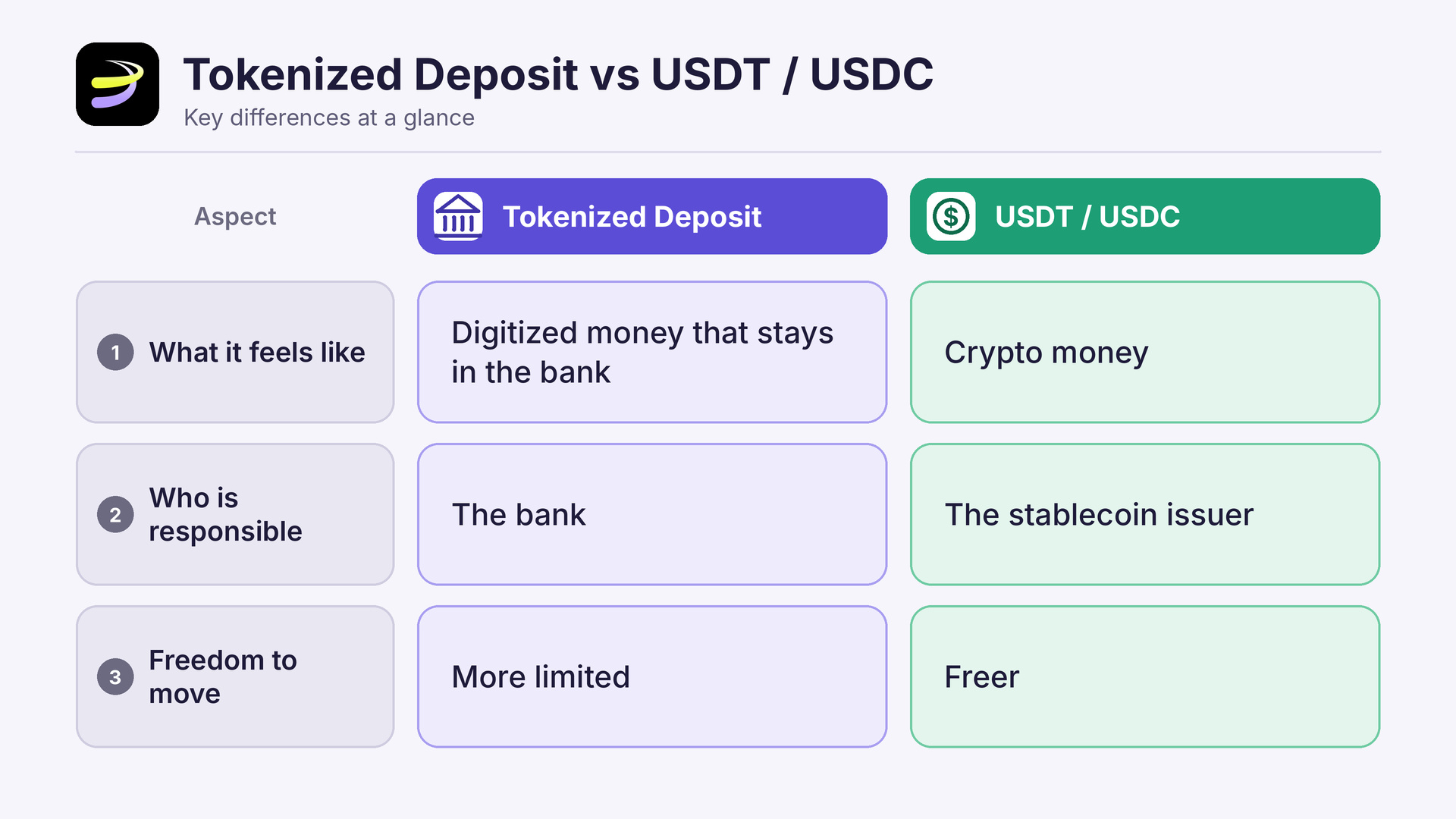
I often tell friends who are new to this concept:
“If you want your money to still feel like money in the bank, a tokenized deposit is closer. If you want the freedom to move it anywhere in the crypto world, USDT/USDC is a better fit.”
Real Examples Already in Production
Several institutions have already used this approach in production environments, for example:
- XP Inc. issued USDXP (a USD stablecoin) on Rayls infrastructure.
- Several banks in Brazil participated in the Drex pilot with the Central Bank of Brazil, which involves tokenized deposits.
- Nuclea (a major financial market infrastructure in Brazil) has already run tokenization in production.
This is no longer just a concept on paper. Some of it is already live.
Simple Illustration: How the Flow Works
Here’s a simple flow of how a tokenized deposit works on Rayls: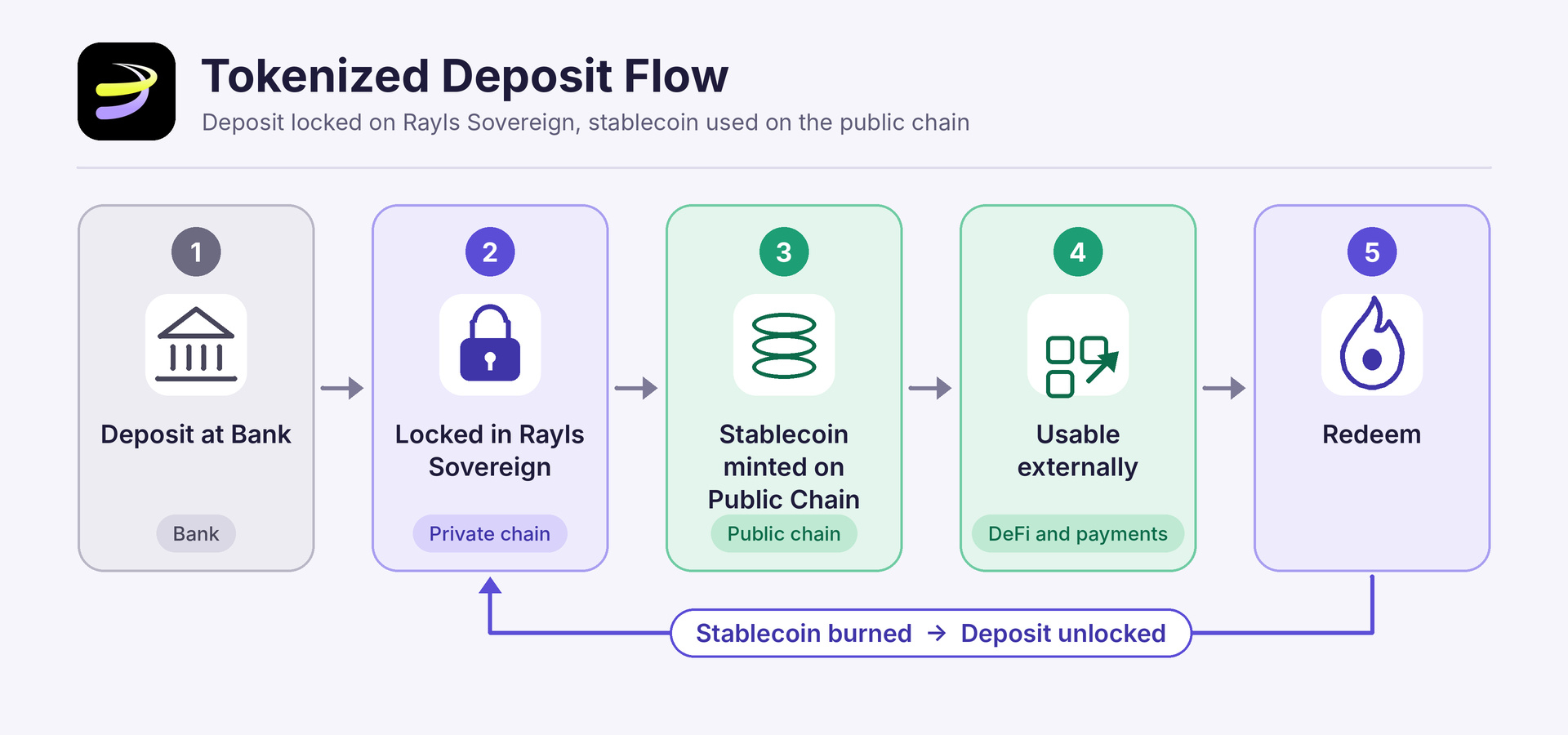
This diagram shows the core mechanism: the deposit stays locked at the bank on Sovereign, while a usable stablecoin is minted on the public chain.
Important Note (For Accuracy)
From the official Rayls documentation and blog that I’ve read:
- A tokenized deposit is a product issued by an institution and remains under their control.
- The lock-and-mint mechanism is supported.
- However, the legal status and whether a tokenized deposit is automatically covered by deposit insurance schemes is not explicitly stated. This still depends on regulations in each country. I don’t want to overclaim on this point.
Quick Conclusion
USDT/USDC and tokenized deposits are both “digital money,” but their purpose and control differ.
- Want maximum freedom in the crypto world → USDT/USDC is more suitable.
- Want on-chain innovation while staying under the bank’s control → Tokenized deposits are more relevant.
In my opinion, both will likely coexist rather than replace each other. Banks need control and compliance, while crypto users need flexibility. Rayls is trying to bridge the two.
If you have questions or want me to explain any part in more detail (for example, the lock-and-mint mechanism or the examples in Brazil), feel free to ask in the comments or DM. I’m happy to discuss this.
---
Sources
1. Tokenised deposits and stablecoins on Rayls Sovereign
https://docs.rayls.com/docs/rayls-node-use-cases-tokenised-deposit
(Main source for definition and lock-and-mint flow)
2. Rayls Sovereign – Introduction
https://docs.rayls.com/docs/a-warm-introduction-rayls-sovereign
(Governance features: freeze, seize, lock)
3. The private-public settlement flow: tokenised deposits and stablecoins on Rayls
https://www.rayls.com/blog/the-private-public-settlement-flow-tokenised-deposits-and-stablecoins-on-rayls
4. Introducing Rayls Sovereign: the onchain gateway for institutions
https://www.rayls.com/blog/introducing-rayls-sovereign-the-onchain-gateway-for-institutions
5. Rayls product pages (Public Chain & Sovereign) for production examples (Drex, Nuclea, etc.)
#Rayls #RWA $RLS