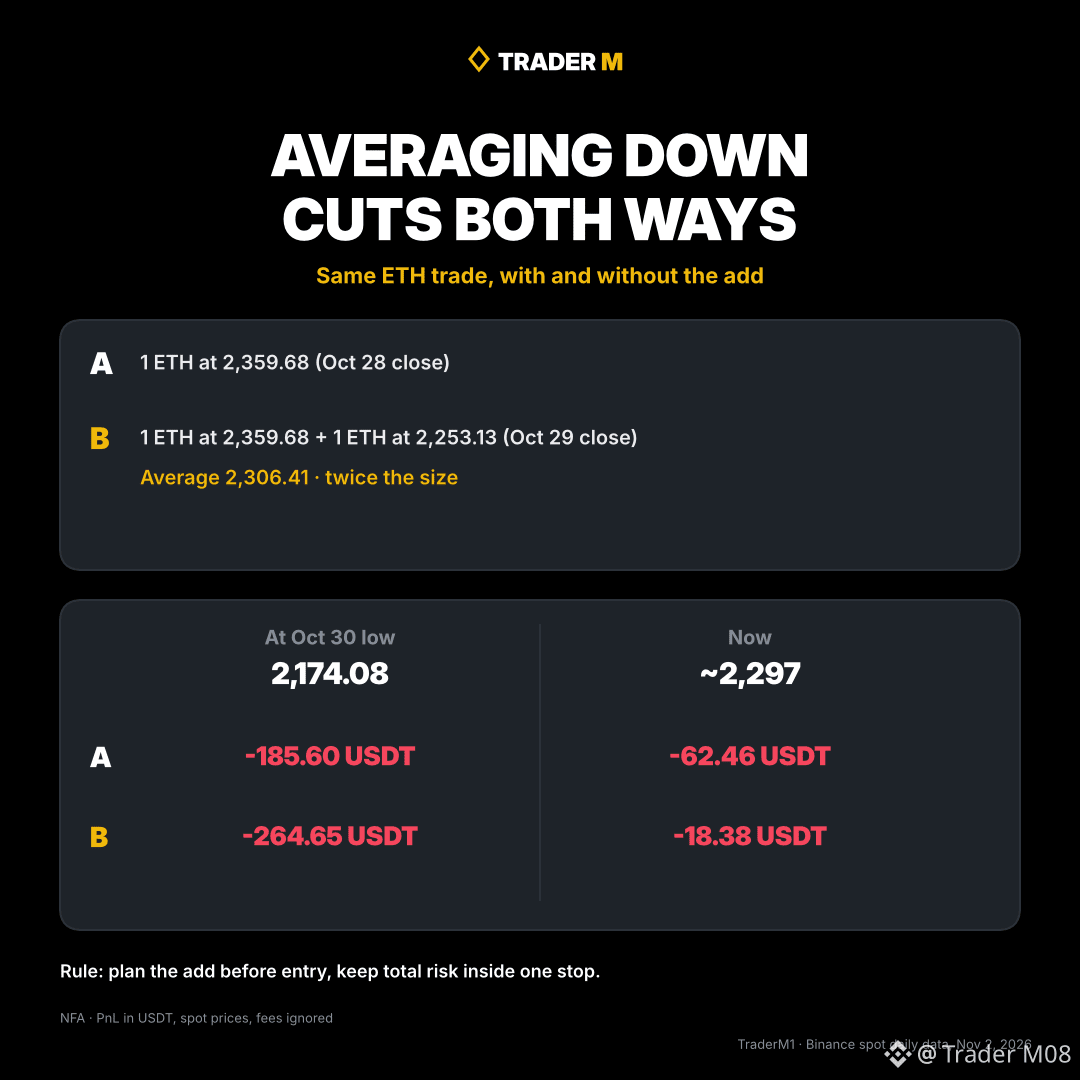
Averaging down looks smart when price bounces. It doubles the damage when it doesn't. $ETH showed both sides this week.
Trader A buys 1 ETH at 2,359.68 (Oct 28 close). Trader B buys the same, then adds 1 ETH at 2,253.13 (Oct 29 close). B's average: 2,306.41.
At the Oct 30 low of 2,174.08:
- A (1 ETH): down 185.60 USDT
- B (2 ETH): down 264.65 USDT
Now, with ETH near 2,297:
- A: down 62.46 USDT
- B: down 18.38 USDT
B looks right today. But on Oct 30, B had the bigger loss on twice the size, and nothing on the chart said the drop had to stop at 2,174.
The add isn't the problem. Adding with no rule is. Mine:
- The add is planned before the first entry, at a set level.
- Total risk with the add stays inside one stop.
- No add after the stop level breaks.
NFA. Do you average down: never, always, or only by plan?