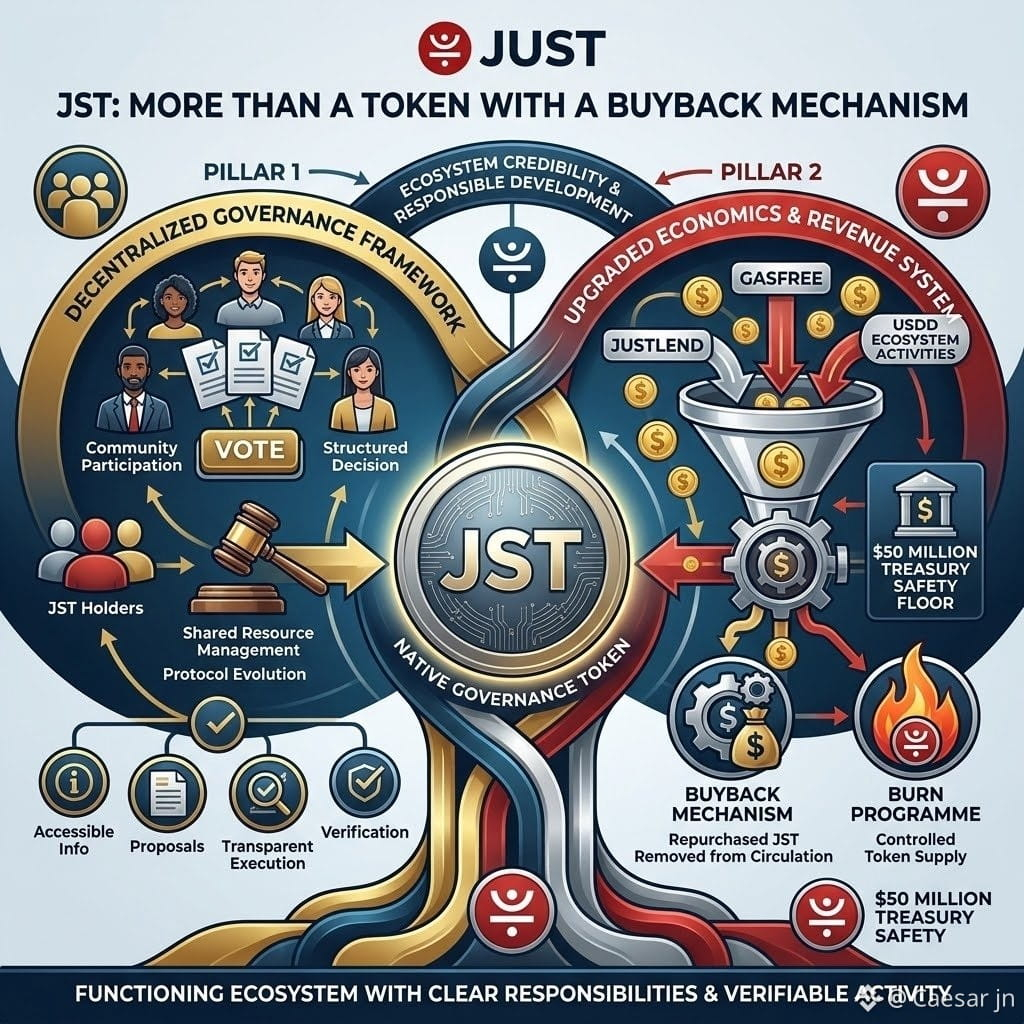
JST: MORE THAN A TOKEN WITH A BUYBACK MECHANISM
When discussing JST, attention often focuses on market activity, token supply, and the ecosystem's buyback and burn programme.
While these subjects are important, they represent only part of the token's role within JUST.
JST is the native governance token of the JUST ecosystem and provides a framework for community participation in protocol decisions.
Governance is a fundamental component of decentralized finance because protocols need mechanisms for discussing and determining how their systems should evolve.
As an ecosystem expands, decisions may involve market parameters, financial policies, product development, and the management of shared resources.
A governance token can provide a structured way for eligible holders to participate in these processes.
Within JUST, this gives JST relevance beyond its presence in the market.
The token is connected to the ecosystem's broader governance framework, while its updated buyback mechanism introduces another relationship between protocol operations and token economics.
Under the upgraded model, eligible revenue from JustLend, GasFree, and qualifying USDD ecosystem activities contributes to JST buybacks.
The repurchased tokens are subsequently removed from circulation through periodic burns.
These mechanisms serve different purposes.
Governance supports participation in ecosystem decisions, while buybacks and burns address the token's circulating supply.
It is important not to confuse the two functions or assume that a burn automatically creates additional governance rights.
For the ecosystem to remain credible, governance must be supported by accessible information, understandable proposals, transparent execution, and meaningful participation.
Token holders should be able to examine the decisions affecting the protocol and understand how approved arrangements are implemented.
The broader objective is to align the interests of the community with the responsible development of the ecosystem.
@Justin Sun孙宇晨 @DeFi_JUST #TRONEcoStar