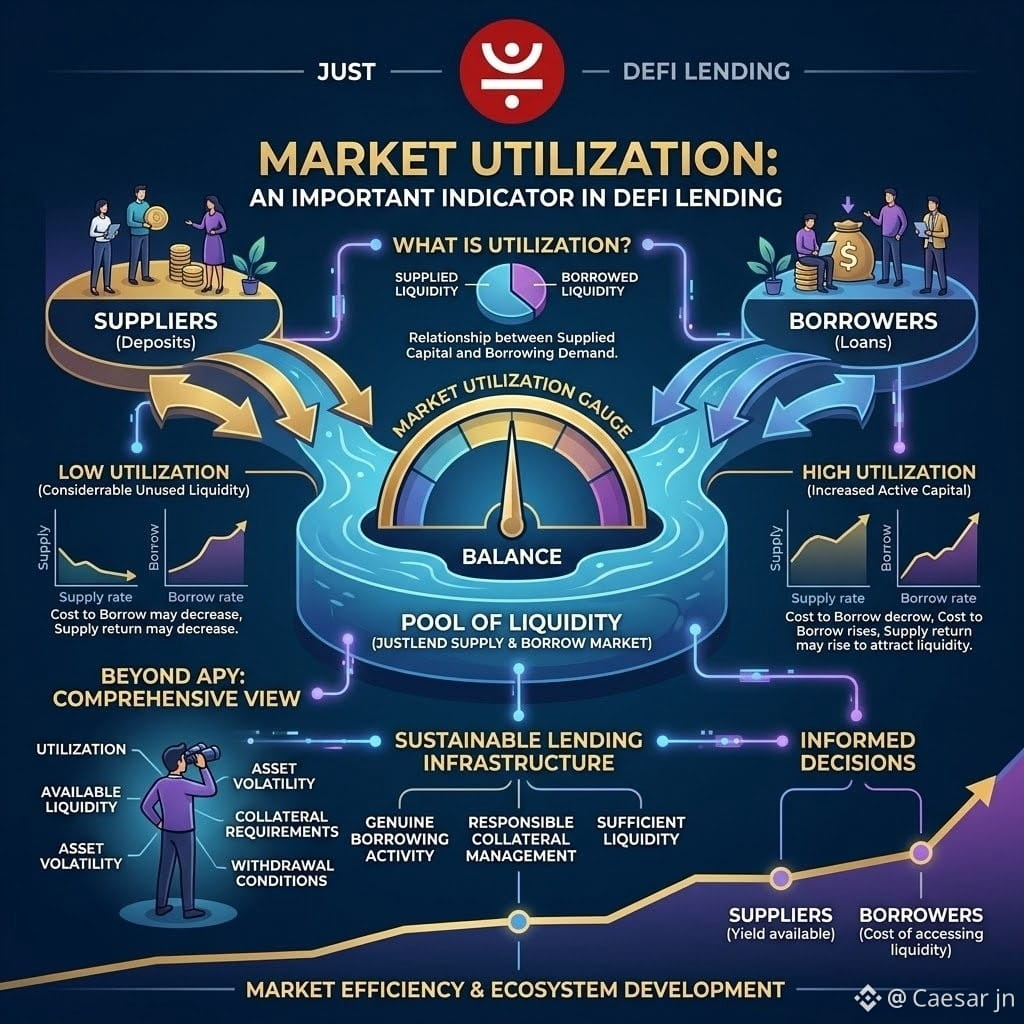
MARKET UTILIZATION: AN IMPORTANT INDICATOR IN DEFI LENDING
When evaluating a decentralized lending market, the amount of supplied liquidity is only one part of the picture.
Another important factor is utilization.
Utilization describes how much of the available supplied liquidity is currently being borrowed. It helps explain the relationship between capital provided by suppliers and demand from borrowers.
This is particularly relevant to JustLend's Supply and Borrow Market.
Consider a lending market with a substantial amount of supplied assets. If only a small portion is borrowed, the market has considerable unused liquidity.
However, when borrowing demand increases, more of the supplied capital becomes active.
This changes the market's utilization level and can influence interest rates.
In many lending protocols, borrowing rates respond to utilization through predefined interest-rate models. As utilization increases, borrowing costs may rise to balance demand and encourage additional supply. Supplier returns are also influenced by the amount of capital being borrowed and the interest generated.
This relationship is important because suppliers and borrowers depend on the same pool of liquidity.
For suppliers, utilization can affect the yield available from their deposits. For borrowers, it influences the cost of accessing liquidity.
Understanding this mechanism helps users make more informed decisions instead of evaluating a market based on APY figures alone.
A high supply APY may attract attention, but users should also examine utilization, available liquidity, asset volatility, collateral requirements, and withdrawal conditions.
Likewise, borrowers should consider whether the borrowing cost is appropriate for their intended financial activity.
Market utilization is therefore not simply a technical statistic. It provides insight into how actively a lending market is being used.
For JustLend, maintaining a balanced relationship between supply and borrowing demand is an important
@DeFi_JUST @Justin Sun孙宇晨 #TRONEcoStar