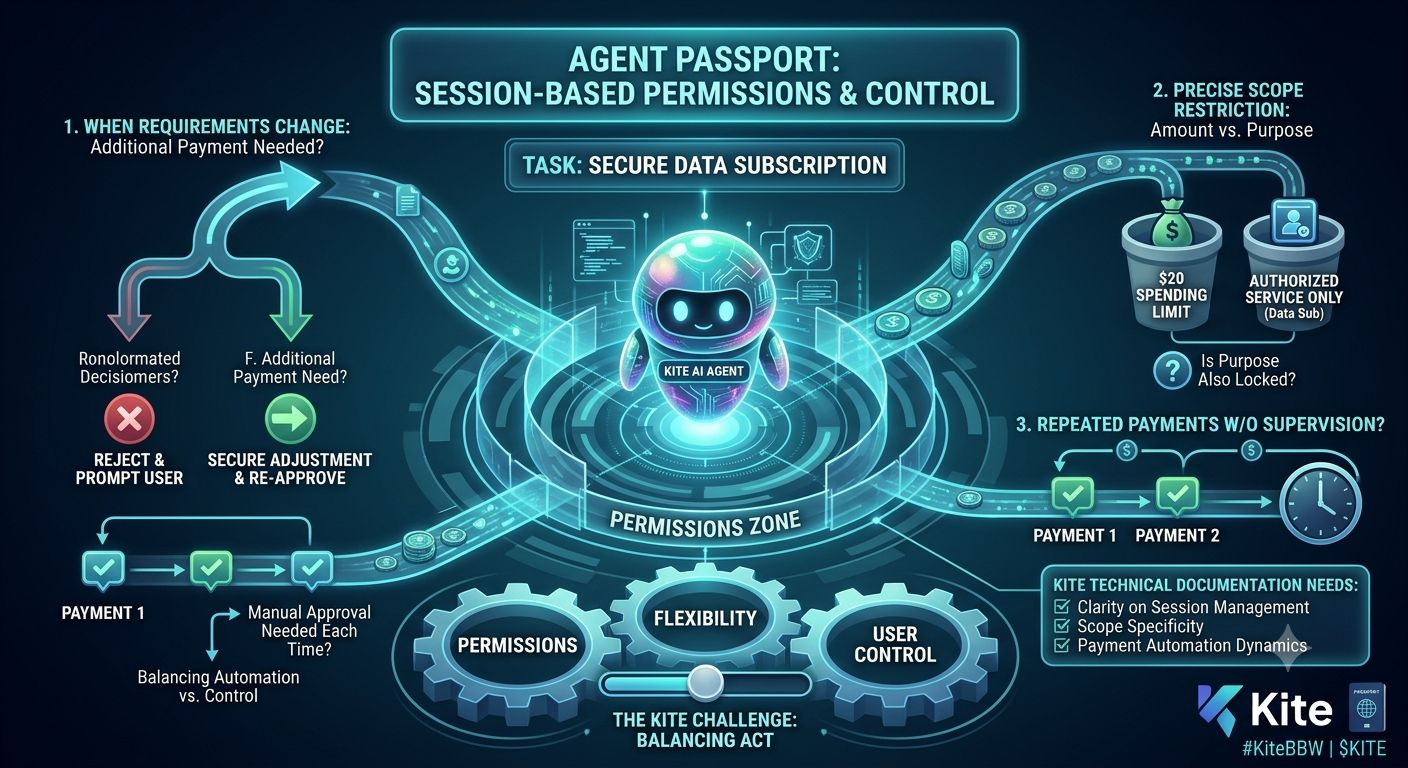
There’s a scenario I think is worth exploring with Kite: when an AI agent is authorized to make payments, how can we ensure that its permissions remain aligned with the task it was given?
What stands out to me about Agent Passport is its session-based approach to permissions, with predefined limits tied to the user’s passkey. This creates a clearer boundary for what an agent can do instead of giving it unrestricted access.
But I want to look deeper into three questions.
First, how are session limits managed when requirements change? If an agent needs to make an additional payment that wasn’t anticipated, will the system reject it, ask the user to approve it again, or allow the permissions to be adjusted? The answer directly affects the balance between automation and user control.
Second, how precisely does Agent Passport restrict the scope of authorization? Limiting the amount of money an agent can spend is one thing, but restricting what that money can be used for is equally important. If an agent is authorized to spend $20 on a specific service, could that permission be used for a different transaction as long as it stays within the spending limit? This needs to be clarified to assess the actual level of protection.
Third, what happens when an agent needs to make repeated payments without direct human supervision? If every session requires manual approval, automation becomes limited. On the other hand, if permissions remain active for too long or can be expanded too easily, the benefits of initially restricting access may gradually diminish.
To me, this is the core challenge for Kite: not simply authorizing AI agents to make payments, but balancing three essential factors: permissions, flexibility, and user control.
I’d like to see Kite’s technical documentation explain more clearly how Agent Passport handles these scenarios, rather than judging the product solely by its concept of session-based authorization.
In your view, should Kite prioritize spending limits, transaction-purpose restrictions, or a combination of both?
#KiteBBW $KITE