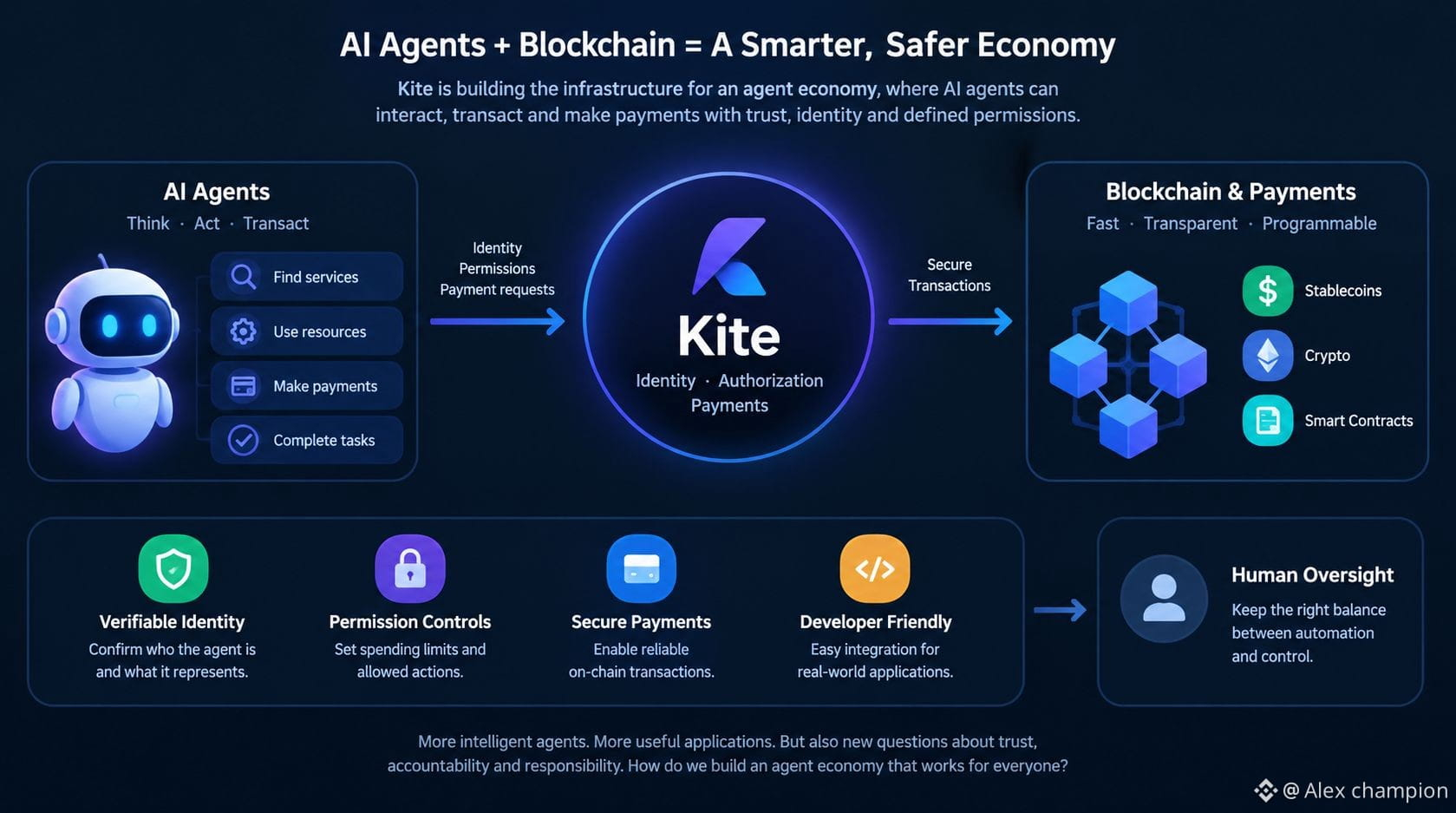
The crypto industry has spent years exploring how blockchain can move money without traditional intermediaries, while artificial intelligence is now changing how digital tasks are performed. What interests me about these two trends coming together is the possibility that AI agents may eventually do more than answer questions or automate simple tasks. They could interact with services, purchase resources, and manage payments with limited human involvement. This is where Kite caught my attention. When I started thinking about an economy where software agents can transact independently, I realized that intelligence alone is not enough. An agent also needs a verifiable identity, clearly defined permissions, and a reliable way to make payments within certain limits. Without these safeguards, automation could introduce new risks, especially when financial transactions happen faster than a person can review them. Kite is working on infrastructure designed to support an agent economy, with a focus on identity authorization, and payments for AI agents. I find this approach interesting because it addresses a practical question that could become increasingly important as AI systems gain more independence: how can we allow agents to act efficiently without giving them unrestricted control over financial resources? Still, the difficult part may be implementation rather than the concept itself. Identity systems must be reliable, payment permissions need to be enforceable, and developers must be able to integrate the infrastructure without unnecessary complexity. There are also unanswered questions around compromised agents, malicious instructions, accountability, and dispute resolution. I wonder how these systems will balance autonomous decision-making with meaningful human oversight as adoption grows. If AI agents become active participants in digital commerce, what level of trust should we give them, and who should ultimately remain responsible when something goes wrong?
@KITE AI 中文 #KiteBBW $KITE
@KITE AI 中文 #KiteBBW $KITE