

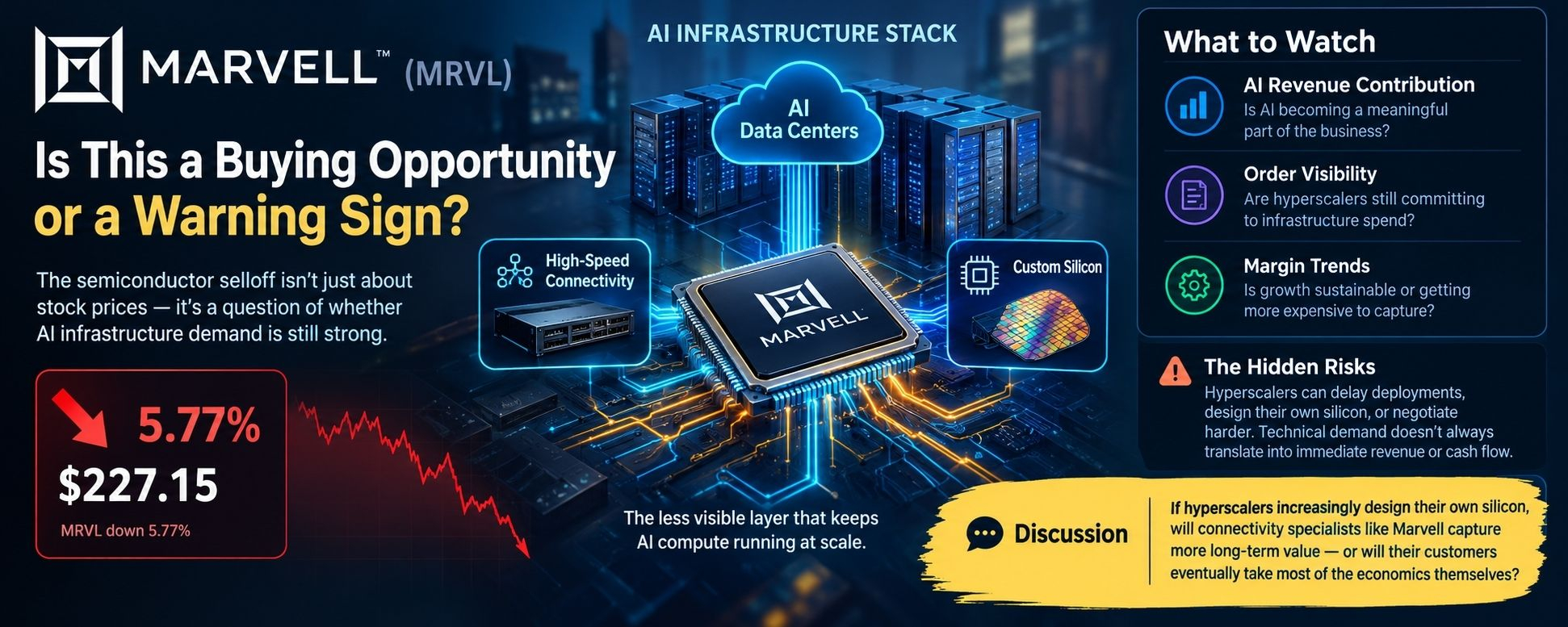


$MRVL.US Marvell’s Selloff Tests a Bigger Question: Is AI Infrastructure Demand Actually Weakening?
The semiconductor market is pricing risk across the AI supply chain. I think investors need to be more precise about what they are selling.
Marvell Technology ($MRVL) sits in an important part of the AI infrastructure stack: high-speed connectivity, data-center networking, and custom silicon. These components are less visible than GPUs, but they help determine whether expensive compute resources can operate efficiently at scale.
My central argument: a semiconductor selloff is not automatically a buying opportunity, even when the underlying technology remains strategically important.
Why does Marvell deserve closer examination?
AI infrastructure is a system-level investment. Accelerators need to exchange data, servers need high-bandwidth connections, and hyperscalers need architectures that balance performance, power consumption, and deployment cost. Networking bottlenecks can undermine the value of additional compute capacity. That creates a meaningful opportunity for companies supplying the connectivity layer.
But there is a less comfortable side to this thesis.
Marvell's opportunity depends partly on customers continuing to invest in infrastructure. A hyperscaler can believe in AI's long-term potential while delaying a deployment, redesigning its architecture, or negotiating aggressively with suppliers. Technical demand does not automatically translate into immediate revenue, stable margins, or predictable cash flow.
That distinction matters more than an analyst's bullish rating.
Marvell reported record fiscal 2026 revenue of $8.195 billion, with management attributing growth to robust AI demand. Its subsequent earnings and guidance remain important tests of whether that momentum can continue. "Official results" (https://investor.marvell.com/news-events/press-releases/detail/1011/marvell-technology-inc-reports-fourth-quarter-and-fiscal-year-2026-financial-results)
I would watch three signals closely: data-center revenue growth, management's visibility into customer orders, and gross-margin performance. Strong revenue accompanied by weakening margins could indicate that growth is becoming more expensive to capture. Conversely, sustained growth and healthy profitability would strengthen the argument that demand is translating into durable business value.
The key distinction is between a lower stock price and a better investment thesis. They are not the same thing.
I would not call MRVL a bargain simply because it falls alongside NVIDIA and other chipmakers. I would want evidence that customer demand, execution, and the economics of supplying AI infrastructure remain intact.
If AI infrastructure spending continues to grow but hyperscalers increasingly design their own silicon and optimize every dollar of capital expenditure, will connectivity specialists like Marvell capture more long-term value, or will their customers eventually capture most of the economics themselves?