

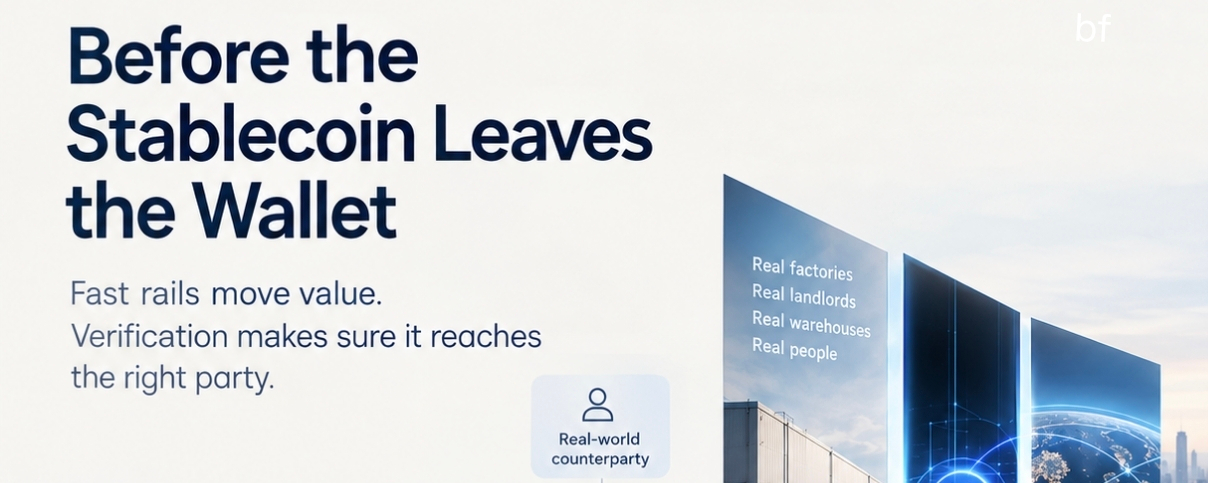


Stablecoins solved a real problem: moving value across borders in minutes instead of days, at a fraction of the cost, with a public record of every step.
They did not solve the question that comes right before the transfer: is the party on the other end real?
Onchain transfers are final. If a buyer sends funds to a supplier who turns out not to exist, the speed of the rail just delivers the loss faster. That is why we think cross-border settlement has two layers, and most of the industry has only built one.
Layer 1: verification. Is this factory real? Does its capacity match the claim? Is this landlord the actual owner? Is this warehouse registered and operating? These are questions about the physical world, and they get answered by people on the ground.
Layer 2: settlement. How does value move, under what conditions does it release, and who can audit it? This is where programmable money shines.
BorderFlow works on Layer 1 first. Here is what that looks like in practice today:
Settle: 40+ housing settlements for international professionals across six European city markets, 80% success rate.
Trade: verified sourcing across China, Southeast Asia, Africa and Brazil, with $280 flat-fee factory inspections in Guangzhou, Shanghai and Shenzhen. A Bolivian dealership had 20 BYD vehicles verified at the Shanghai factory in three days, before a payment was committed.
Invest: vetted Budapest property deals from €180,000.
Warehouse: free matching for Chinese sellers into vetted UK/EU/US warehouses, Companies House-verified.
Today that runs on fiat escrow with human-verified local partners. It works, and it is generating the one thing Layer 2 needs most: a record of who actually delivers.
Our roadmap has on-chain settlement as the planned next phase: stablecoin-first, programmable escrow, built to work with major exchange infrastructure, followed later by opening the verification and escrow layers as a protocol others can build on. We are not claiming that is live. We are sequencing it behind the real-world network on purpose, because a smart contract that releases funds on a condition is only as good as whoever confirms the condition was met.
So the order is: fundamental real-world structure first, rails when the operations underneath are ready to carry them.
If you build escrow protocols, stablecoin payment tooling, cross-chain settlement or identity and KYC layers and want to explore how verified counterparties could plug into your stack, the partner application is at getborderflow.com/infrastructure. It takes about three minutes, and every submission gets a personal reply within 48 hours.
What is the hardest part of verifying a counterparty before you send onchain? Tell us in the comments.
Not financial advice. This post describes a business roadmap, not an investment offer.