



Okay we seriously need to talk about something that's happening across the crypto market, because some investors are confusing massive price crashes with once-in-a-lifetime opportunities.
You've probably seen those coins that were trading at $10, $20, or even $100 during their glory days, only to collapse by 80%, 90%, or sometimes even more.
And the moment people see those numbers, their brains start doing some crazy calculations.
"This coin was $10 before, and now it's only $1. Imagine if it goes back!"
Bro, that sounds like an easy 10x, right?
But here's the uncomfortable question nobody wants to ask.
What if that coin isn't undervalued? What if the market simply doesn't think it's worth what it used to be?
Yeah, that's where things get interesting.
The 90% Discount Illusion
Let's imagine a cryptocurrency reached $100 during the previous bull market.
Today, it's trading at $10.
That's a 90% decline.
At first glance, it looks like someone just put the entire project on a massive clearance sale.
And honestly, who doesn't love a discount?
But crypto doesn't work like your favorite clothing store.
A coin losing 90% of its value doesn't automatically mean you're getting the same asset at a bargain price.
Its fundamentals might have changed.
Its community might have disappeared.
Its competitors might have become stronger.
And the demand that once pushed its price higher might no longer exist.
The biggest mistake is assuming that a previous all-time high represents a coin's true value.
It doesn't.
It simply represents the highest price buyers were once willing to pay.
And those buyers might never return.
Your Coin Doesn't Owe You a Comeback
This might sound harsh, but someone needs to say it.
Just because your favorite altcoin reached $50 in 2021 doesn't mean it has to reach $50 again.
The market doesn't remember your entry price.
It doesn't care how long you've been holding.
And it definitely doesn't care how many times you've told your friends that the project is underrated.
Price recovery requires real demand.
If investors aren't interested anymore, a token can remain far below its previous highs for years.
Some cryptocurrencies recover spectacularly.
Others slowly disappear from market conversations.
And plenty survive without ever revisiting their old records.
That's the part nobody includes in those exciting comeback predictions.
Wait… A 90% Crash Needs a 900% Recovery?
Here's where the math starts getting disrespectful.
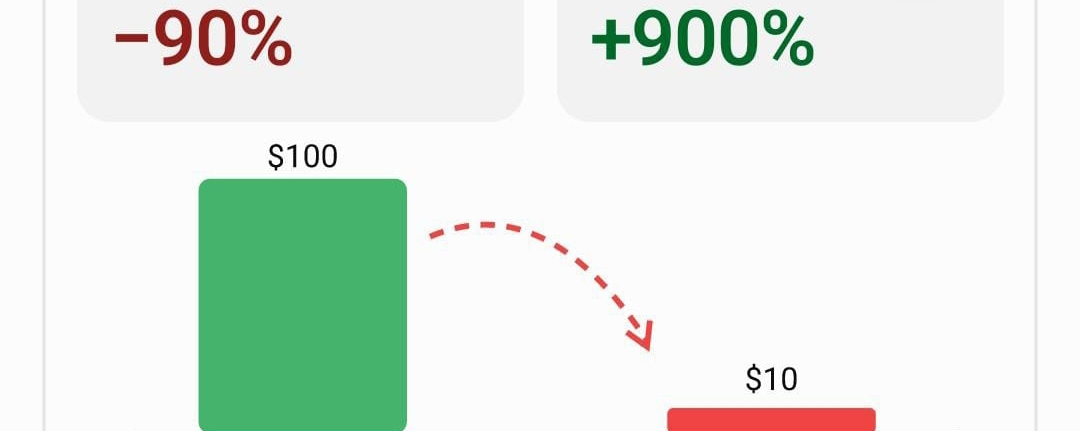
EXAMPLE: A COIN FALLS FROM $100 TO $10
Price decline
−90%
Gain needed to recover
+900%
That's right.
If a coin crashes from $100 to $10, it doesn't need a 90% gain to recover.
It needs a 900% gain.
And if a coin falls 99%, it needs an astonishing 9,900% increase to return to its previous price.
Suddenly, that easy comeback doesn't look so easy anymore.
This is why understanding percentage losses matters so much.
A massive decline can create an opportunity, but it also creates an enormous recovery challenge.
The Token Supply Plot Twist Nobody Talks About
Now here's something even more interesting.
Imagine a cryptocurrency reached $10 when only 100 million tokens were circulating.
That gives it a market capitalization of $1 billion.
A few years later, the token price falls to $1.
Sounds cheap, right?
But what if the circulating supply has increased to 1 billion tokens?
The market capitalization would still be $1 billion.
Same market value.
Completely different token price.
And for that token to return to $10 with 1 billion tokens circulating, its market capitalization would need to reach $10 billion.
That's ten times the previous market capitalization.
Bro, the token price looks discounted, but the valuation tells a completely different story.
This is why token unlocks, inflation, circulating supply, and fully diluted valuation deserve attention.
A low token price doesn't necessarily mean a low valuation.
Sometimes the supply has simply grown faster than demand.
Not Every Old Altcoin Deserves Another Bull Run
Let's talk about the uncomfortable truth of crypto cycles.
Every bull market introduces new narratives.
One cycle might focus on DeFi.
Another might revolve around gaming tokens, metaverse projects, artificial intelligence, or real-world asset tokenization.
Investors become excited about emerging technologies and new opportunities.
But when attention moves elsewhere, older projects can struggle to remain relevant.
That doesn't automatically mean those projects are worthless.
Some continue building useful technology and attracting developers.
Others lose activity, liquidity, and community interest.
And some simply fail to deliver what they originally promised.
The important question isn't whether a coin was popular three years ago.
It's whether the project still has a convincing reason to attract users and investors today.
Nostalgia isn't a fundamental.
And a previous bull-market chart isn't a business model.
But Wait, Some Crashed Coins Actually Recover
Now don't get me wrong.
Not every cryptocurrency that falls 90% is doomed.
Crypto is a volatile market, and even strong projects can experience enormous declines during difficult periods.
Sometimes prices fall much faster than the underlying technology or adoption deteriorates.
In those situations, patient investors may eventually benefit from a recovery.
But the difference is that a genuine recovery needs something stronger than hope.
It might involve growing network usage, improving revenue, meaningful technological progress, healthier token economics, or renewed demand.
A project that continues developing through difficult market conditions may deserve closer examination.
Still, even strong fundamentals don't guarantee a higher token price.
A good project and a good investment aren't always the same thing.
And that distinction matters more than people realize.
The Community Can Be Loud While the Project Is Quiet
We've all seen it.
A coin falls 90%.
Its community continues posting rocket emojis.
Every tiny bounce becomes the beginning of a new bull run.
Every announcement is described as a game changer.
And anyone questioning the project gets called a hater.
But hype isn't evidence.
A large online community doesn't necessarily mean the network has meaningful adoption.
Social media engagement can create temporary attention without creating sustainable demand.
That's why it's worth looking beyond trending hashtags.
Are developers still active?
Are people actually using the product?
Does the token have a meaningful role in the ecosystem?
Is the project generating genuine activity, or is everyone simply waiting for the price to pump?
Because there's a massive difference between a community supporting a useful project and a community waiting to recover its losses.
The Next Bull Run Might Leave Your Favorite Coin Behind
Here's a scenario many investors aren't emotionally prepared for.
Bitcoin starts rallying.
The broader market improves.
New crypto narratives begin attracting attention.
Several altcoins deliver impressive returns.
But your favorite token barely moves.
Sounds unfair?
Maybe.
But markets don't distribute gains equally.
Capital tends to follow changing expectations, liquidity, narratives, and perceived opportunities.
Some older cryptocurrencies may benefit from renewed interest.
Others may continue underperforming as investors focus on newer projects.
This is why assuming that every altcoin will revisit its previous all-time high can lead to unrealistic expectations.
The next bull run might create major winners.
But those winners won't necessarily be the same coins that dominated the previous cycle.
And holding a token purely because it used to be famous can become an expensive decision.
The Real Question Isn't How Far It Fell
Imagine you're researching two cryptocurrencies.
One has fallen 90% from its previous high.
The other has fallen only 30%.
Which one is the better opportunity?
You can't answer that from the percentages alone.
The first project might have declining adoption, aggressive token inflation, and weakening investor demand.
The second might have healthier fundamentals, stronger liquidity, and a more sustainable ecosystem.
Or the opposite could be true.
The point is that historical price declines tell you what happened.
They don't automatically tell you what happens next.
A meaningful evaluation requires understanding the project's current condition and future risks.
Cheap compared to yesterday doesn't always mean valuable compared to tomorrow.
Stop Falling in Love With Your Entry Price
This one is personal for a lot of crypto investors.
Sometimes people continue holding a cryptocurrency simply because they bought it at a much higher price.
They don't want to accept that their original expectations might have been wrong.
So they keep waiting.
And waiting.
And waiting.
Not necessarily because the project is improving, but because selling below their purchase price feels painful.
This is an example of how emotional attachment can influence financial decisions.
Your original entry price is important for understanding your own returns.
But it doesn't determine what the market will pay in the future.
A more useful question is whether the reasons for owning the asset still make sense based on current information.
Because the market doesn't know your personal break-even level.
And it isn't obligated to return there.
So, Is a 90% Crash an Opportunity or a Warning?
The answer is that it can be either.
A steep decline might create an attractive valuation when a project remains fundamentally strong.
But it can also signal serious problems that the market has already recognized.
The challenge is figuring out which situation you're looking at.
And that requires more than checking the distance from the all-time high.
It requires examining supply changes, adoption, liquidity, competition, project development, and overall market conditions.
Even after doing that research, uncertainty remains.
That's simply part of investing in an unpredictable market.
The goal isn't to find a coin that has fallen the most.
It's to understand whether the asset's potential justifies its risks at its current valuation.
Final Thoughts: Cheap or Just Forgotten?
I'm not saying every crashed altcoin is a bad investment.
And I'm definitely not saying that huge recoveries are impossible.
Crypto has surprised investors many times, and it probably will again.
But I think we need to stop treating every 90% decline like a guaranteed opportunity.
Some coins are genuinely undervalued.
Some are temporarily unpopular.
And others have lost the momentum, demand, or relevance that once supported their valuations.
The tricky part is that they can all look similar on a price chart.
A coin being 90% below its all-time high tells you how much it has fallen. It doesn't tell you how much it's worth.
That's the difference between looking for a discount and understanding value.
And in a market filled with thousands of competing tokens, that difference could matter more than ever.
So here's my question for the Binance Square community:
Are you holding an altcoin that's still 80–90% below its previous high? 👀
Do you believe it's genuinely undervalued, or are you simply hoping the next bull run brings it back?
Drop the coin name and your reasoning below. Let's have a real conversation.
This article is for educational purposes only and is not financial advice.