



#FedMinutesFocusOnOctoberPause
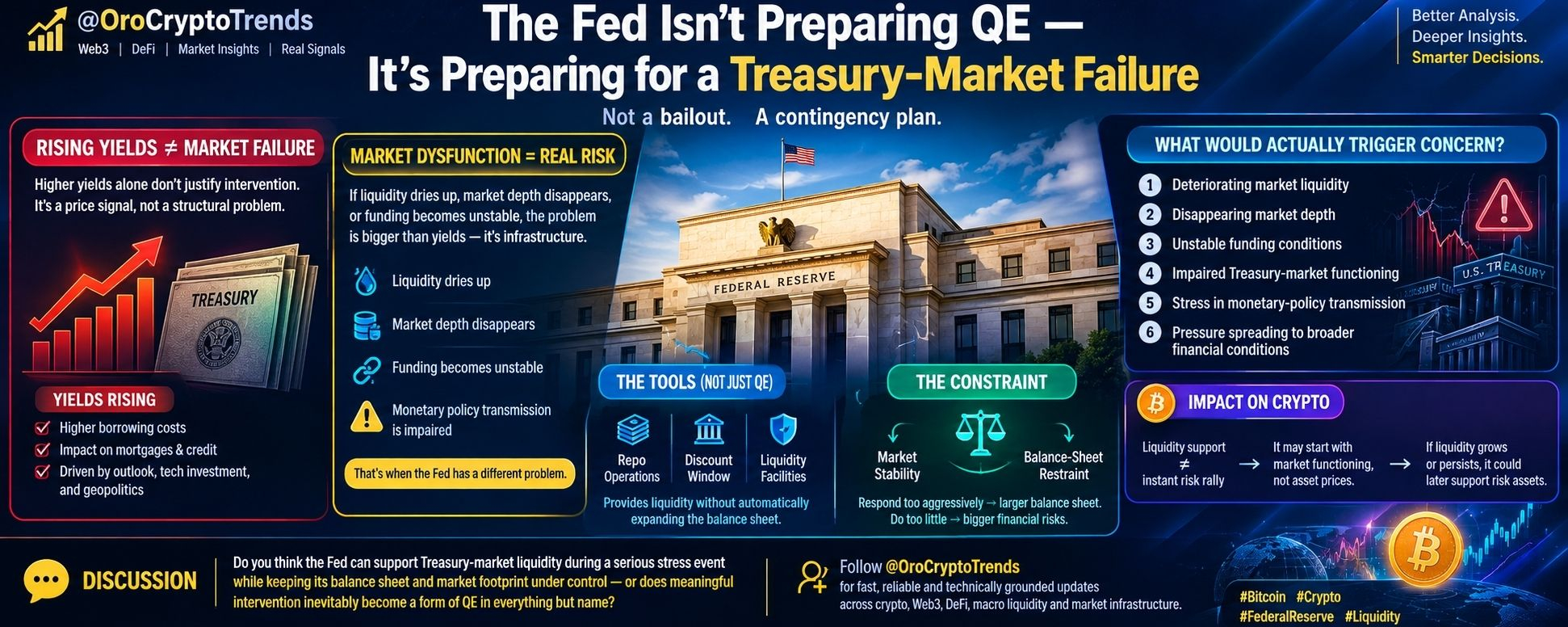
The Fed Isn’t Preparing QE — It’s Preparing for a Treasury-Market Failure
The most interesting part of the Fed’s latest minutes is not that officials discussed Treasury-market stress.
It is why they are thinking about the response before a full-blown dysfunction appears.
The Federal Reserve’s September 15–16 meeting minutes, released October 7, said a few participants believed it was important to plan for potential Treasury-market stress.
But there is a critical distinction here:
Planning for intervention is not the same as announcing intervention.
And I think that distinction is being missed.
The Infrastructure Problem Behind the Headlines
The Treasury market is not just another financial market.
It sits underneath a huge part of the global financial system.
Treasury securities influence funding costs, collateral, mortgages, derivatives, bank balance sheets and broader financial conditions.
So there is a significant difference between:
“Treasury yields are rising.”
and
“The Treasury market is no longer functioning properly.”
Higher yields alone don't automatically give the Fed a reason to intervene.
But if market depth deteriorates, liquidity disappears, funding becomes unstable, or dysfunction begins interfering with monetary-policy transmission, the problem changes.
At that point, the Fed isn't simply watching an interest-rate move.
It is dealing with market infrastructure risk.
That is why the language around strategy, communications and tools matters.
The Part I’m Watching Closely
The Fed appears to be thinking about how it could respond to market dysfunction while limiting its footprint in the Treasury market.
That creates a difficult policy trade-off:
Market stability ↔ Balance-sheet restraint
If the Fed responds aggressively through large-scale asset purchases, the balance sheet can expand substantially.
But if officials refuse to respond when Treasury-market dysfunction threatens broader financial stability, the consequences could become much larger.
So the first response doesn't necessarily have to look like classic quantitative easing.
Liquidity facilities and operations such as repo mechanisms or the discount window can address certain funding and liquidity problems without being equivalent to launching a new large-scale Treasury-purchase program.
That distinction matters.
The Contrarian Signal
My reading is that the bigger signal isn't:
“The Fed is preparing QE.”
There is no evidence in these minutes that the Fed has decided to restart quantitative easing or begin emergency Treasury purchases.
The more interesting signal is:
The Fed wants to know exactly where the intervention threshold is before that threshold is reached.
That's risk management.
Think of it like designing an emergency power system.
You don't need the electricity grid to have already collapsed before deciding where the backup generators are, who activates them, and how much capacity you are willing to deploy.
The Fed appears to be thinking about the equivalent problem for Treasury-market functioning.
And that tells me the response architecture deserves more attention than the headline.
What Would Actually Trigger Concern?
I would watch the plumbing rather than simply watching Treasury yields.
For example:
- deteriorating market liquidity
- disappearing market depth
- unstable funding conditions
- impaired Treasury-market functioning
- stress that begins interfering with monetary-policy transmission
- pressure that spreads into broader financial conditions
A higher yield is a market price.
Dysfunction is an infrastructure problem.
Those are not the same thing.
What This Does NOT Prove
Let's keep the analysis disciplined.
The minutes do not prove that:
❌ QE is coming.
❌ The Fed is preparing a Treasury-market bailout.
❌ A Treasury-market crisis has already started.
❌ Bitcoin must immediately rally.
❌ Risk assets are guaranteed to benefit.
❌ The Fed has abandoned its balance-sheet objectives.
Those conclusions would go beyond the available evidence.
Minneapolis Fed President Neel Kashkari also said he viewed the Treasury market as functioning normally and did not currently see a reason for Fed intervention.
That is important context.
There is a difference between contingency planning and active crisis response.
Why Crypto Should Care
This is where I think the crypto conversation becomes more interesting.
Crypto traders often reduce every central-bank liquidity discussion to:
Fed liquidity → more risk appetite → Bitcoin up.
That is too simplistic.
The transmission mechanism matters.
If the Fed eventually provides liquidity because of genuine market dysfunction, the initial objective could be market functioning, not stimulating asset prices.
But if liquidity support becomes sufficiently large or persistent, its broader financial effects could eventually become relevant for risk assets.
That is a second-order effect—not a guaranteed Bitcoin trade.
And that distinction is exactly where I think the better analysis begins.
The Real Question
The market shouldn't obsess over:
“Is the Fed going to print money?”
The better question is:
“At what point does Treasury-market dysfunction become serious enough to force the Fed to deploy its liquidity tools?”
That threshold is what I would watch.
Because once the world's most important bond market genuinely stops functioning smoothly, the policy conversation changes very quickly.
Do you think the Fed can support Treasury-market liquidity during a serious stress event while keeping its balance sheet and market footprint under control—or does meaningful intervention inevitably become a form of QE in everything but name?