#BTC
Why bitcoin is down 'just' 32% a year after its record high of $126,000
Yes, you read that right. A year after hitting a record high above $126,000 on Oct. 6, 2025, bitcoin is down just 32%, at $85,453.
In traditional markets, a drop that size would count as a crash. For bitcoin, that's a far gentler slide than in past bear markets.
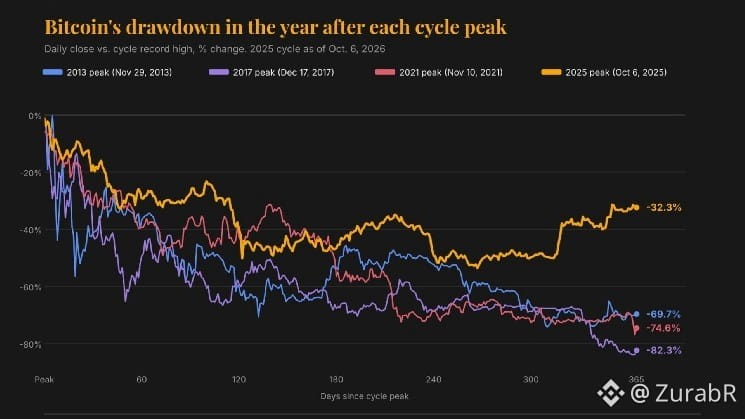
Exactly a year after the 2013 peak, bitcoin was down 69.7%. Similarly, it was down 82.3% following the December 2017 top. A year after the November 2021 high, it was down 74.6%, according to CoinDesk calculations.
This shallower decline isn’t limited to the one-year anniversary. The bear market itself has been milder. At its lowest, just below $59,000 on June 30, bitcoin was down more than 53% from its peak. Past bear markets saw prices plummet 77% to 85% from record highs.
Essentially, two things have changed. The bear market has been shallower, and its worst point arrived earlier. In previous cycles, the trough often came around the one-year mark or later; this time, it came after about nine months, and the subsequent recovery has been fast.
“The most notable changes are the significantly shortened duration of the drawdown and the reduced time spent at the bottom," Tim Sun, senior researcher at HashKey Group, told CoinDesk.
Market participants changed
The main reason previous bear markets saw prices fall much lower and for longer is who drove the preceding bull runs. Retail traders and their use of leverage often fueled those rallies, which frequently ended in crashes marked by fund blowups and exchange failures, as seen in 2022.
The 2023–25 uptrend, by contrast, was driven by institutional inflows through regulated investment vehicles such as ETFs, while the subsequent downturn reflected a macro-led reversal of those flows.
"While previous cycles were driven primarily by retail investors and leverage, buyers in this current cycle increasingly stem from outside the crypto market, including ETFs, asset management giants, family offices, and even corporations. #Write2Earn $BTC
Why bitcoin is down 'just' 32% a year after its record high of $126,000
Yes, you read that right. A year after hitting a record high above $126,000 on Oct. 6, 2025, bitcoin is down just 32%, at $85,453.
In traditional markets, a drop that size would count as a crash. For bitcoin, that's a far gentler slide than in past bear markets.
Exactly a year after the 2013 peak, bitcoin was down 69.7%. Similarly, it was down 82.3% following the December 2017 top. A year after the November 2021 high, it was down 74.6%, according to CoinDesk calculations.
This shallower decline isn’t limited to the one-year anniversary. The bear market itself has been milder. At its lowest, just below $59,000 on June 30, bitcoin was down more than 53% from its peak. Past bear markets saw prices plummet 77% to 85% from record highs.
Essentially, two things have changed. The bear market has been shallower, and its worst point arrived earlier. In previous cycles, the trough often came around the one-year mark or later; this time, it came after about nine months, and the subsequent recovery has been fast.
“The most notable changes are the significantly shortened duration of the drawdown and the reduced time spent at the bottom," Tim Sun, senior researcher at HashKey Group, told CoinDesk.
Market participants changed
The main reason previous bear markets saw prices fall much lower and for longer is who drove the preceding bull runs. Retail traders and their use of leverage often fueled those rallies, which frequently ended in crashes marked by fund blowups and exchange failures, as seen in 2022.
The 2023–25 uptrend, by contrast, was driven by institutional inflows through regulated investment vehicles such as ETFs, while the subsequent downturn reflected a macro-led reversal of those flows.
"While previous cycles were driven primarily by retail investors and leverage, buyers in this current cycle increasingly stem from outside the crypto market, including ETFs, asset management giants, family offices, and even corporations. #Write2Earn $BTC