

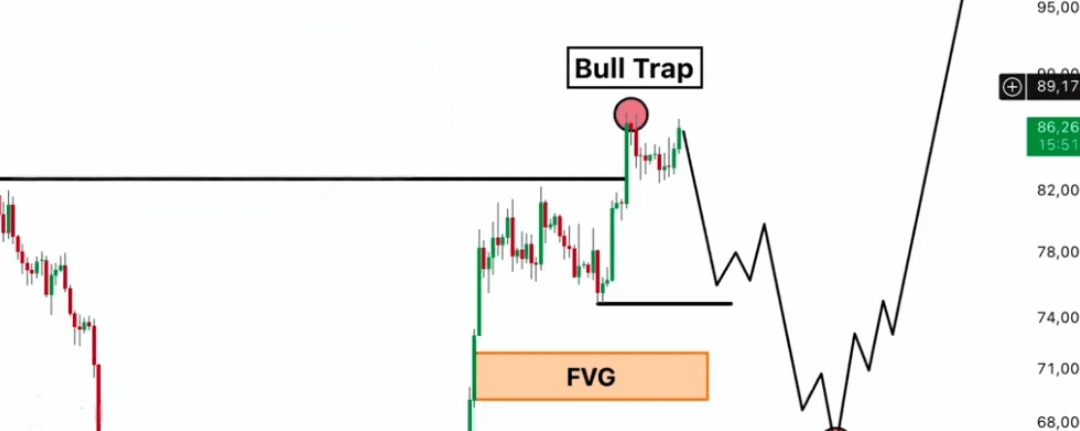


Bitcoin made another strong attempt to push through the $87,000 area, but sellers quickly stepped in. BTC crossed $87,000 on October 2 before pulling back, showing that this region remains a major resistance area.
The rejection matters because the $87K–$87.5K zone has repeatedly stopped Bitcoin’s recent rallies. Until buyers can break through this area and hold above it, the market may continue moving between support and resistance rather than entering a clean breakout.
But the more interesting level right now may actually be below the current price.
Why $82.5K Matters
The $82,000–$82,500 region has developed into an important support area. Bitcoin recently found buyers around $82,500 before recovering above $84,000, while market analysis has repeatedly identified roughly $81K–$83K as a significant support zone.
This makes $82.5K an important area to watch if another correction develops.
If Bitcoin revisits this region and buyers defend it again, it would show that demand remains present below the market. A recovery from there could put $84K–$85K back into focus before BTC gets another opportunity to challenge $87K.
The situation changes if $82.5K fails decisively.
A sustained move below the broader $81.5K–$83K support region would weaken the recent recovery structure. Analysts have also highlighted the psychological $80K region as an important deeper level if selling pressure increases.
Why Did Bitcoin Struggle at $87K?
Technical resistance is only one part of the story.
Bitcoin has been dealing with a difficult macro environment, particularly elevated U.S. Treasury yields. Higher bond yields can make risk assets less attractive and have contributed to pressure on crypto despite periods of improving monetary-policy expectations.
There are also signs that the rally has lost some short-term buying strength.
Recent CryptoQuant data cited by CoinDesk showed spot Bitcoin demand contracting by roughly 170,000 BTC over 30 days, while speculative futures-demand growth also slowed sharply. Increasing profit-taking added another reason for BTC to struggle near its recent highs.
That does not automatically make the broader structure bearish. It simply means buyers may need stronger demand to turn an intraday move above $87K into a sustained breakout.
The Bullish Scenario
For the bullish structure, defending the broader $82K area would be important.
If buyers hold that region and BTC begins forming higher lows again, attention could return to $85K and eventually the $87K–$87.5K resistance zone.
A convincing breakout above the recent highs would be more meaningful than another quick spike above $87K. Traders would generally want to see the price remain above the breakout area rather than immediately falling back underneath it.
Beyond that resistance, $90,000 becomes the next major psychological area watched by the market.
The Bearish Scenario
The opposite scenario begins if buyers cannot defend support.
A decisive loss of the $82K region could shift attention toward $80K–$81K. That would suggest the rejection around $87K was more than a small pullback and that Bitcoin may need a deeper reset before attempting another breakout.
The reaction around support therefore matters almost as much as the rejection itself.
The Bigger Picture
Bitcoin currently appears caught between two important areas.
Above, $87K–$87.5K remains the wall buyers need to overcome.
Below, approximately $82K–$82.5K is one of the main areas where buyers have recently appeared.
That creates a relatively simple market structure to monitor: holding support keeps the possibility of another resistance test alive, while losing support would weaken the short-term recovery.
So, is $82.5K the most important Bitcoin level right now?
It is certainly one of the key short-term levels. Instead of focusing only on whether Bitcoin can immediately reach $90K, the next reaction around $82K–$82.5K could provide useful information about whether buyers still have enough strength for another attempt at the $87K ceiling.
For now, $82.5K is the floor to watch, while $87K remains the wall to break.
This article is for educational and market-analysis purposes only and is not financial advice.