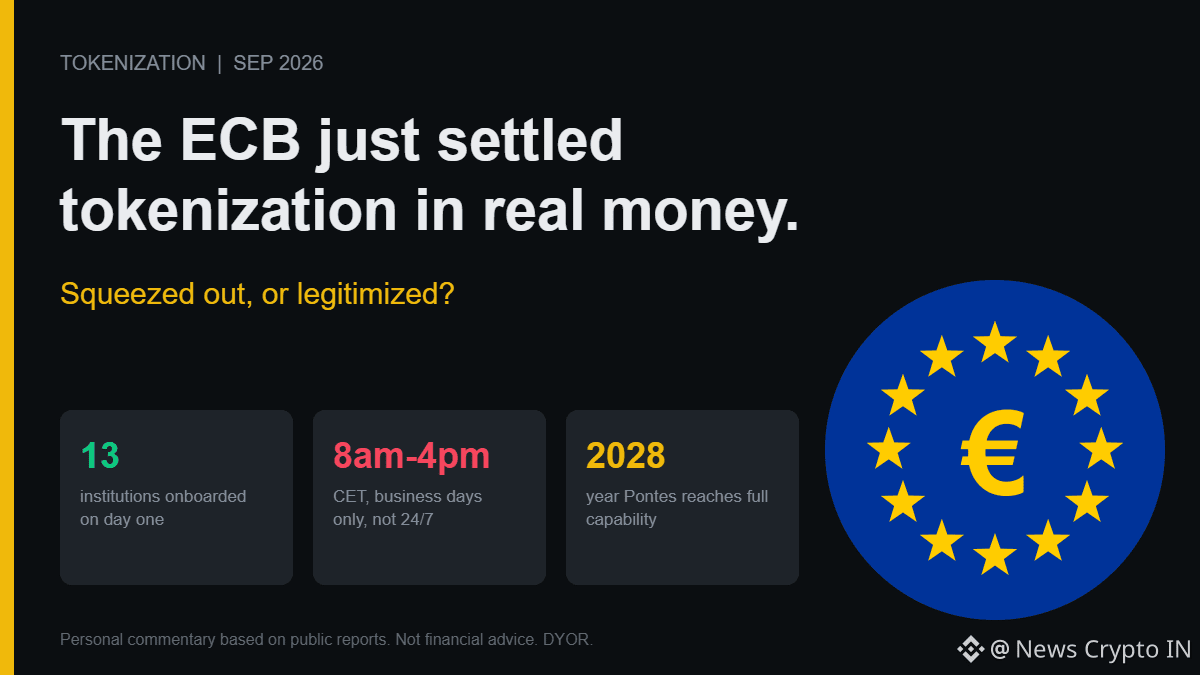
The ECB just switched on Pontes, a bridge that lets tokenized securities settle in actual central bank money. It went live Sept 21 with 13 institutions onboarded, including Deutsche Bank, Santander, Société Générale, KfW and the European Investment Bank, plus four ledger operators such as Clearstream. The ECB has also started preparing to invest a small part of its own funds in tokenized securities, settled through Pontes.
Why it matters: tokenized trades have mostly settled in commercial bank money or stablecoins, which carry credit risk big institutions dislike. A risk-free settlement asset was one of the biggest blockers. Pontes removes it, at least for wholesale players.
Now the caveats crypto Twitter will skip:
- It runs 8am to 4pm CET on business days. Not 24/7.
- Cash-leg finality is still anchored in the existing TARGET2 system.
- It's wholesale only, for banks and market infrastructure, not for retail.
- Full capability, with longer hours and more features, is targeted for 2028.
So this isn't "blockchain replaces banks." It's banks adopting blockchain on their own terms, with the central bank as the settlement layer.
The open question for stablecoins: if institutions can settle tokenized assets in central bank money, what is the wholesale use case for a private stablecoin? Retail and 24/7 still look like stablecoin territory (my read), but the institutional slice just got narrower.
Does central bank settlement squeeze stablecoins out of institutional finance, or does it legitimize the tokenization trade crypto has been selling?
#ECB #Tokenization
Why it matters: tokenized trades have mostly settled in commercial bank money or stablecoins, which carry credit risk big institutions dislike. A risk-free settlement asset was one of the biggest blockers. Pontes removes it, at least for wholesale players.
Now the caveats crypto Twitter will skip:
- It runs 8am to 4pm CET on business days. Not 24/7.
- Cash-leg finality is still anchored in the existing TARGET2 system.
- It's wholesale only, for banks and market infrastructure, not for retail.
- Full capability, with longer hours and more features, is targeted for 2028.
So this isn't "blockchain replaces banks." It's banks adopting blockchain on their own terms, with the central bank as the settlement layer.
The open question for stablecoins: if institutions can settle tokenized assets in central bank money, what is the wholesale use case for a private stablecoin? Retail and 24/7 still look like stablecoin territory (my read), but the institutional slice just got narrower.
Does central bank settlement squeeze stablecoins out of institutional finance, or does it legitimize the tokenization trade crypto has been selling?
#ECB #Tokenization