$TAO moving higher is interesting, but Bittensor’s revenue story is the part I’m watching.
For a long time, decentralized AI projects were mostly valued on what their networks could become. Bittensor is beginning to produce something more measurable: paying customers.
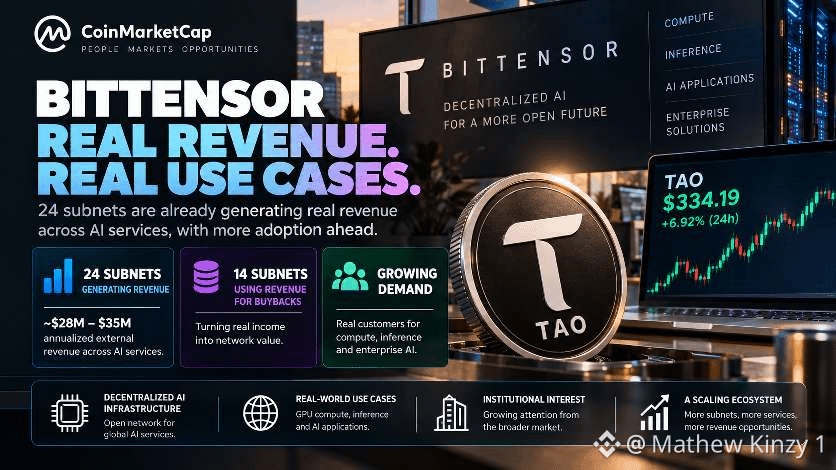
A recent Bittensor Revenue Index estimates that 24 subnets are generating roughly $28M–$35M in annualized external revenue, across services such as GPU compute, inference and enterprise AI. Fourteen reportedly use customer revenue for Alpha-token buybacks.
That makes the recent $TAO momentum more interesting than another AI-sector pump.
The $100M figure circulating around the market is a projection, not current revenue, so there is still plenty to prove.
For me, the metric to watch isn't simply how high $TAO trades next.
It’s whether more Bittensor subnets can turn decentralized AI infrastructure into businesses people actually pay to use.
If revenue keeps replacing narrative with measurable demand, does that change how the market should value $TAO?
For a long time, decentralized AI projects were mostly valued on what their networks could become. Bittensor is beginning to produce something more measurable: paying customers.
A recent Bittensor Revenue Index estimates that 24 subnets are generating roughly $28M–$35M in annualized external revenue, across services such as GPU compute, inference and enterprise AI. Fourteen reportedly use customer revenue for Alpha-token buybacks.
That makes the recent $TAO momentum more interesting than another AI-sector pump.
The $100M figure circulating around the market is a projection, not current revenue, so there is still plenty to prove.
For me, the metric to watch isn't simply how high $TAO trades next.
It’s whether more Bittensor subnets can turn decentralized AI infrastructure into businesses people actually pay to use.
If revenue keeps replacing narrative with measurable demand, does that change how the market should value $TAO?