Everyone’s been talking about bringing real-world assets on-chain, but what happens once they get there?
That’s where things are starting to get interesting.
According to Binance Research, the tokenized RWA market has reached $34.18B, up 85.2% YTD. Tokenized equities alone have grown 390.4%, while bond and money-market funds now account for $18.29B.
And despite all that growth, only around 0.01% of the underlying traditional markets have been tokenized.
But putting more assets on-chain is only half the story. The other half is getting people to actually use them.
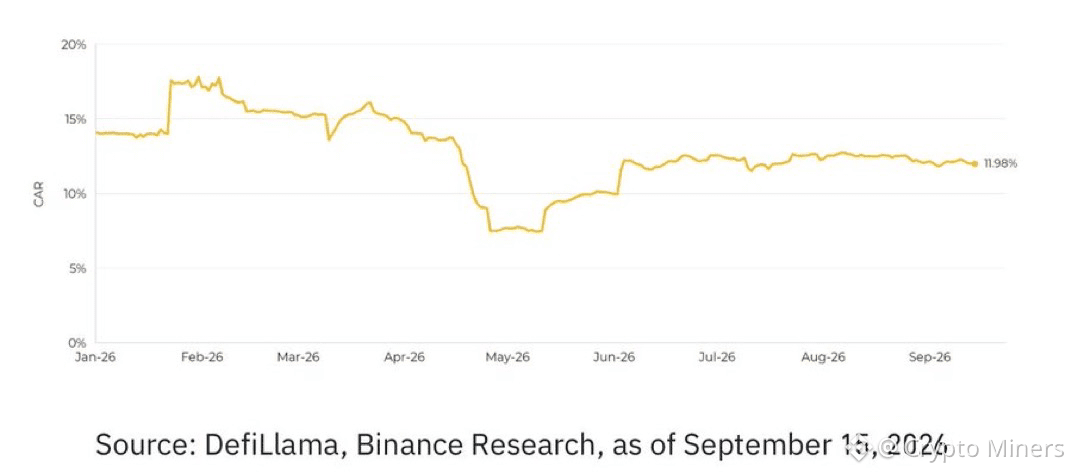
Binance Research introduces two metrics to track this shift. PAR measures how much of a market has been tokenized, while CAR measures how much of that capital is being used in on-chain financial applications.
Right now, the overall capital activation rate is around 12%. In other words, only about $12 out of every $100 in tracked tokenized assets is being put to work.
Tokenized equities are already showing signs of change.
Their activation rate has risen from 1.95% to 7.54% YTD. Of the equity value deployed in DeFi, 65.4% is in liquidity pools and another 28.1% is in lending.
And the potential impact of higher utilization is worth looking at.
Under Binance Research’s base scenario for 2030, around $349B in equities could be tokenized. At a 10% activation rate, that translates to $34.94B in deployed capital.
Increase that rate to 20%, and deployed capital nearly doubles to $69.87B without bringing any additional assets on-chain.
That’s what makes this next phase of RWA interesting.
It’s no longer just about how many assets can be tokenized. It’s about how much of that capital can actually be used for trading, lending, liquidity and collateral.
The assets are coming on-chain. Now the focus is shifting to what people can do with them.
Worth reading the full @BinanceResearch report for a closer look at the numbers and what this activation phase could mean for RWA.
That’s where things are starting to get interesting.
According to Binance Research, the tokenized RWA market has reached $34.18B, up 85.2% YTD. Tokenized equities alone have grown 390.4%, while bond and money-market funds now account for $18.29B.
And despite all that growth, only around 0.01% of the underlying traditional markets have been tokenized.
But putting more assets on-chain is only half the story. The other half is getting people to actually use them.
Binance Research introduces two metrics to track this shift. PAR measures how much of a market has been tokenized, while CAR measures how much of that capital is being used in on-chain financial applications.
Right now, the overall capital activation rate is around 12%. In other words, only about $12 out of every $100 in tracked tokenized assets is being put to work.
Tokenized equities are already showing signs of change.
Their activation rate has risen from 1.95% to 7.54% YTD. Of the equity value deployed in DeFi, 65.4% is in liquidity pools and another 28.1% is in lending.
And the potential impact of higher utilization is worth looking at.
Under Binance Research’s base scenario for 2030, around $349B in equities could be tokenized. At a 10% activation rate, that translates to $34.94B in deployed capital.
Increase that rate to 20%, and deployed capital nearly doubles to $69.87B without bringing any additional assets on-chain.
That’s what makes this next phase of RWA interesting.
It’s no longer just about how many assets can be tokenized. It’s about how much of that capital can actually be used for trading, lending, liquidity and collateral.
The assets are coming on-chain. Now the focus is shifting to what people can do with them.
Worth reading the full @BinanceResearch report for a closer look at the numbers and what this activation phase could mean for RWA.