

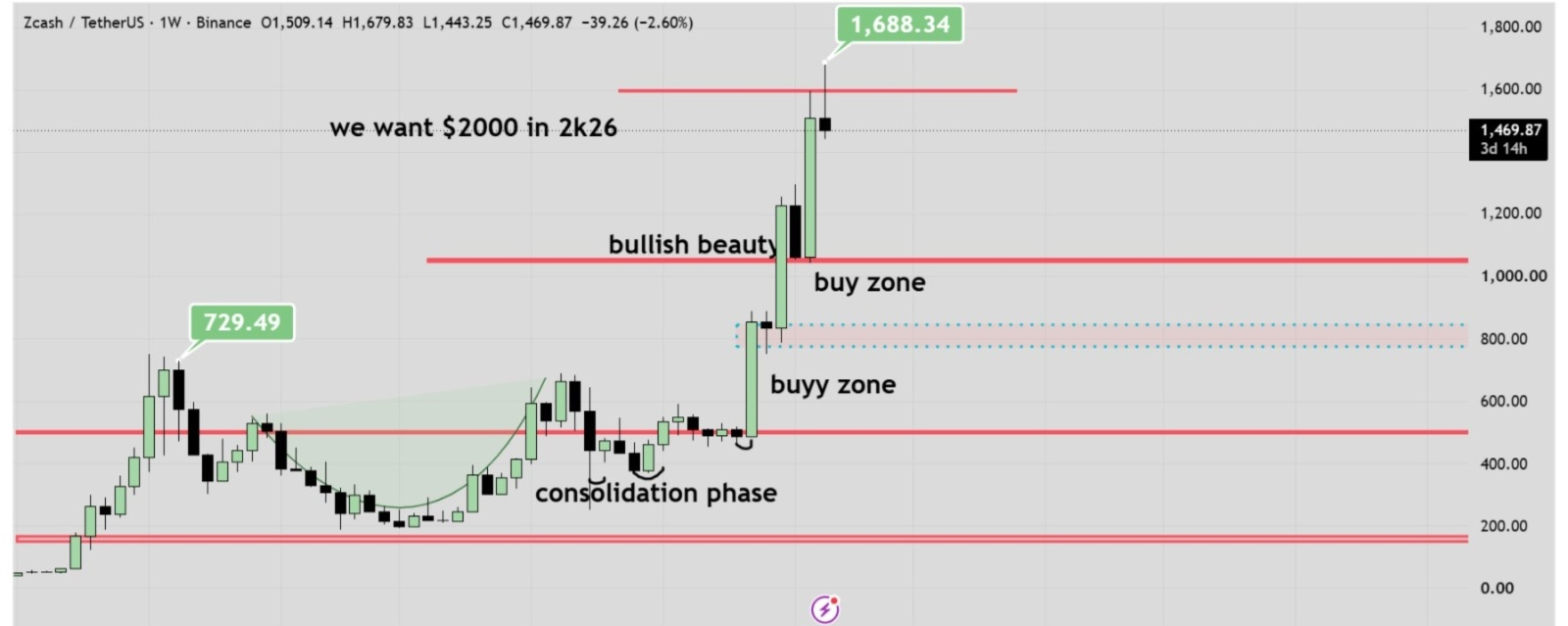


Zcash has suddenly become one of crypto’s biggest stories again.
After spending years outside the spotlight, $ZEC has staged an extraordinary comeback. The token briefly moved above $1,600 on September 23, and Fortune reported that it had gained roughly 88% over the previous month.
But this isn’t simply another old altcoin pumping.
Several things have changed around Zcash at the same time.
The biggest story is the return of the privacy narrative.
Bitcoin gives users a decentralized monetary network, but its blockchain is transparent. Transactions can be followed publicly. Zcash takes a different approach by allowing users to make shielded transactions using zero-knowledge cryptography.
That idea is getting fresh attention as more money, financial assets and everyday activity move digitally.
The argument is simple: if blockchain becomes part of mainstream finance, users and institutions may not want every transaction, balance and financial relationship permanently visible to everyone.
And Zcash is starting to show actual growth in private usage.
Recent data showed nearly 5 million ZEC sitting inside shielded pools, representing roughly 23% of supply at the time measured. Users have also been migrating funds into Ironwood, Zcash’s newer privacy pool.
Shielded transaction activity has accelerated too.
The week ending September 24 reportedly recorded 62,375 shielded transactions, the highest weekly figure since 2022. That makes the current privacy narrative more interesting because attention isn't coming from price alone; network usage is changing as well.
Then came another major catalyst: regulated investment products.
Grayscale's spot Zcash ETF began trading on NYSE Arca in late August. By September 4, The Block reported that the product had already attracted at least $34.4 million in net inflows.
Europe has now joined the story.
On September 22, 21Shares launched a Zcash exchange-traded product on Euronext Paris and Euronext Amsterdam, providing another regulated route for investors seeking ZEC exposure.
That changes the ZEC story significantly.
Previously, Zcash was largely viewed as a niche privacy cryptocurrency. Now it is gaining easier access through traditional investment infrastructure while privacy itself is becoming a larger discussion.
Institutional attention has also increased.
Paradigm co-founder Matt Huang recently disclosed that Paradigm owns ZEC and described Zcash as a private complement to Bitcoin. ZEC jumped sharply during the broader market rally around the same period.
There is also technical progress happening underneath the price.
Zcash introduced the Ironwood shielded pool in July after a vulnerability was identified in the previous Orchard system. Users subsequently migrated significant amounts of shielded ZEC into the new pool.
Hardware-wallet support is improving as well.
Ledger recently added native support for private Zcash balances in its desktop wallet, allowing users to manage Ironwood shielded ZEC without relying on the previous third-party setup.
Development hasn’t stopped there.
The Zcash Foundation is working on changes involving lower transaction fees and improvements to its Zebra node software. The community has also been discussing the scope of the upcoming NU7 network upgrade, including proposals around faster block times and ZEC issuance mechanics.
But traders should also understand why ZEC can become extremely volatile.
When ZEC first broke through $1,000 earlier this month, roughly $36.6 million of leveraged positions were liquidated within 24 hours, with around $34.5 million coming from shorts. Futures open interest had climbed to approximately $2.3 billion.
That means fundamental interest and speculative leverage have been operating at the same time.
A strong narrative can attract buyers.
Institutional products can improve accessibility.
Growing shielded activity can strengthen the network story.
But heavy leverage can also exaggerate moves in both directions.
That is why the most interesting question around ZEC isn't simply “How high can it go?”
The better question is whether the changes underneath the rally continue.
Watch shielded adoption.
Watch institutional products.
Watch network development.
And watch whether privacy remains an important crypto narrative after the excitement around price cools.
Zcash has moved from outside the top 80 cryptocurrencies by market capitalization into the top 10 during 2026, according to Anchorage Digital research cited by Fortune.
That is a remarkable transformation.
$ZEC is back on traders’ screens because the market isn't only rediscovering an old coin it is rediscovering the question Zcash was built around: how important will financial privacy become in an increasingly on-chain world?