

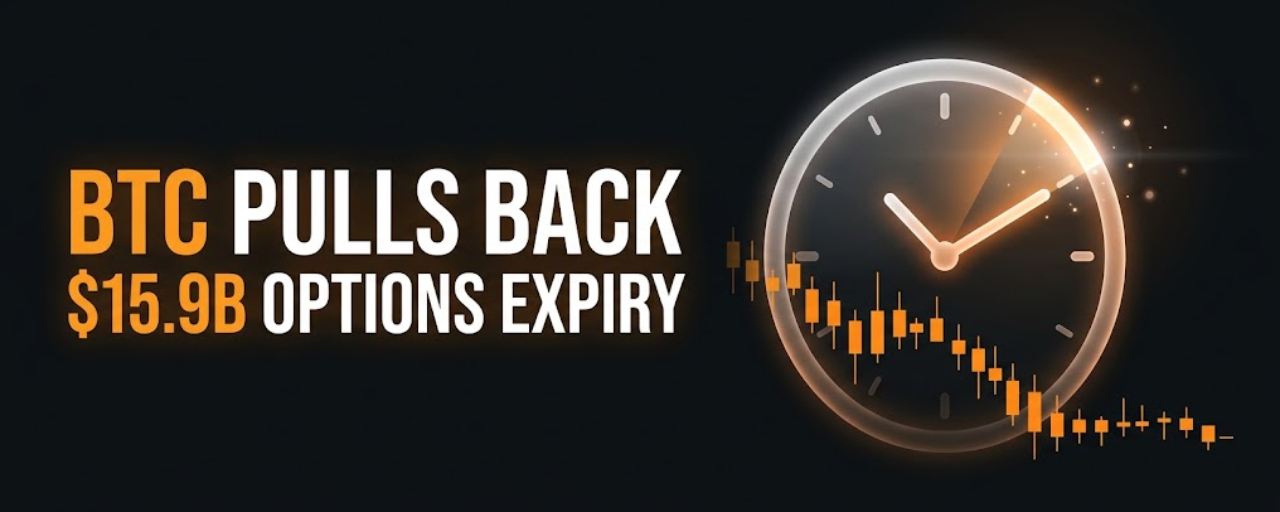

BTC slipped from $87K as traders took profits ahead of Friday's massive Deribit expiry. Here's how to read this kind of pullback.
📉 Red candle after a strong rally always feels worse than it is. Here's the context that actually matters before you react to it.
Bitcoin pulled back roughly 2% to around $84,400 this week, retreating from a run that had taken it above $87,000. The trigger wasn't panic selling; it was traders locking in profits ahead of Friday's $15.9 billion Bitcoin options expiry on Deribit.
📊 Here's why an options expiry this size actually moves price.
When billions of dollars in options contracts approach expiration, market makers and large traders often adjust their positions beforehand to manage risk, a process that can create real selling or buying pressure independent of any new fundamental news. This is a routine, recurring feature of crypto markets, not a signal that something has gone wrong.
⚖️ Regulatory uncertainty added extra weight this time.
The Senate's inability to advance the CLARITY Act, a bill meant to bring clearer rules for digital assets, kept a cautious tone across the market, hitting altcoins like XRP particularly hard. Combined with profit-taking, that created a pullback that looks sharper than a simple options expiry alone would typically cause.
🧠 Here's the part that actually helps you make sense of this.
Pullbacks tied to options expiries are one of the most predictable, recurring patterns in crypto markets. Traders de-risk beforehand, volatility often spikes briefly around the expiry itself, and price frequently stabilizes once the contracts actually settle and that overhang clears.
That's a very different situation from a pullback caused by a negative fundamental shift, bad news about an asset itself, a hack, a regulatory crackdown, or a loss of confidence in a project. This one is mechanical, driven by how derivatives markets function, not by anything wrong with Bitcoin's underlying demand story.
✅ What this means for you
If you're holding, a pullback like this, tied to a known, recurring event rather than new bad news, is generally not a reason to panic. Understanding the mechanical cause behind a price move is far more useful than reacting to the red candle alone.
If you're on the sidelines, options expiry days can actually create short-term opportunities, price sometimes overshoots to the downside heading into expiry and then stabilizes once the contracts settle. That's not a guarantee, but it's a pattern worth knowing rather than assuming every dip means something has fundamentally changed.
If you're actively trading, expect volatility to remain elevated through Friday's settlement, then watch closely how price behaves in the days immediately after. That post-expiry behavior tells you far more about real sentiment than the pre-expiry pullback does.
🟢 Bullish scenario
The expiry settles in an orderly fashion, the options overhang clears, and Bitcoin resumes its prior uptrend once profit-taking pressure fades.
🔴 Risk scenario
Regulatory uncertainty around the CLARITY Act's failure compounds with expiry-related volatility, and the pullback extends further than a typical post-expiry correction.
👀 Three things to watch
1️⃣ Friday's settlement
Does the expiry pass in an orderly fashion, or does it trigger outsized volatility?
2️⃣ post-expiry price action
Does Bitcoin stabilize and resume its prior trend once the options overhang clears, historically the more telling signal?
3️⃣ CLARITY Act developments
Does regulatory clarity progress resume, or does continued uncertainty keep weighing on sentiment beyond just this week?
💡 The key takeaway
Not every red candle means something is wrong. This pullback has a clear, mechanical explanation, profit-taking ahead of a large, routine options expiry, compounded by regulatory uncertainty, not a breakdown in Bitcoin's underlying demand.
The real signal worth watching isn't this week's dip, it's how price behaves once Friday's expiry actually clears.
That is the part worth watching.
This post is for informational and educational purposes only and is not financial advice. Crypto markets are volatile. Always conduct your own research before making financial decisions.