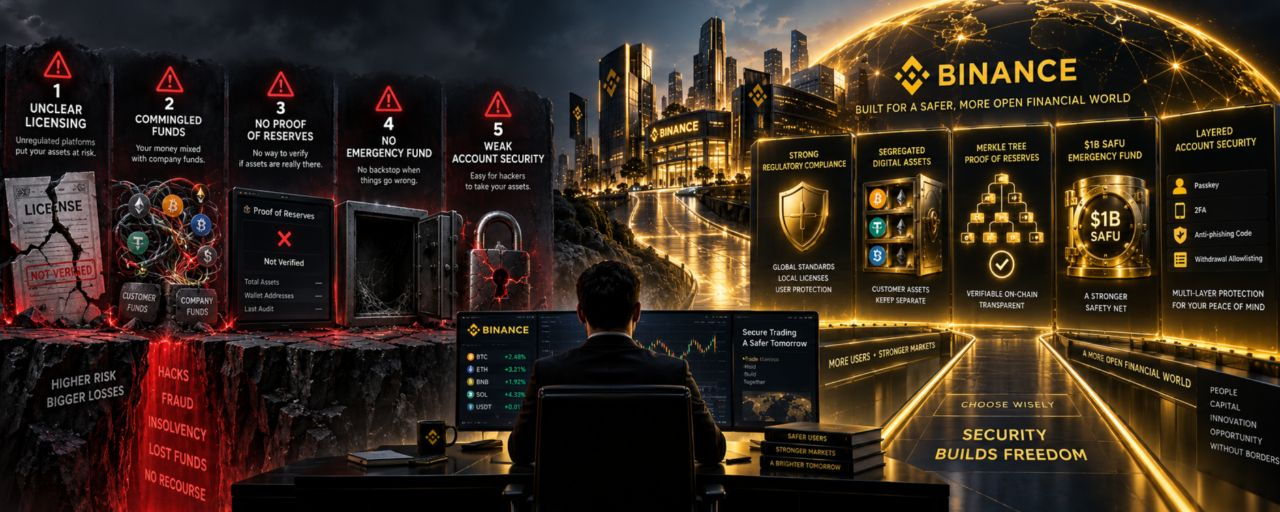

Choosing a crypto exchange or financial platform is about more than trading fees, available assets, or a polished mobile app. You are trusting the platform with your money, personal information, and potentially your long-term financial assets.
Before depositing funds, check these five red flags.
1. Unclear or Weak Licensing
A legitimate financial platform should clearly explain which entities operate its services, where they are licensed or regulated, and which regulators oversee them.
If a platform avoids publishing this information, or its legal structure is difficult to understand, treat that lack of transparency as a warning sign.
Binance, for example, has entities operating under regulatory frameworks in different jurisdictions. In January 2026, Binance announced that its global platform transitioned to an ADGM-regulated structure, with three entities operating under the supervision of the Financial Services Regulatory Authority (FSRA).
Always check whether the specific product and service you want is covered by the relevant entity in your jurisdiction.
2. Commingled Customer Funds
One critical question is: Are customer assets clearly separated from the platform's own assets?
If customer and company funds are mixed together without clear accounting and custody arrangements, users may face additional risks during financial stress or insolvency.
Binance has stated that customer crypto-assets are held in segregated accounts, separately identified from Binance's own crypto-assets, with daily reconciliation of assets held for customers.
3. No Proof of Reserves
A platform asking you to trust its reserves without providing meaningful evidence deserves scrutiny.
Proof of Reserves (PoR) provides a way to verify whether a custodian's on-chain assets correspond to customer balances. Binance's PoR system uses Merkle Trees and zk-SNARKs, allowing users to independently verify that their account is included in the reported liabilities.
But remember: PoR is a point-in-time transparency mechanism and does not by itself prove every aspect of a company's financial health.
4. No Emergency Protection Fund
Even strong security systems cannot eliminate every risk. Ask whether the platform has a dedicated fund designed to respond to extreme incidents.
Binance's Secure Asset Fund for Users (SAFU) was established in 2018 as an emergency fund for extreme situations. Binance reported the SAFU fund at approximately $1 billion as of February 2026.
The existence, size, structure, and terms of any protection fund should always be independently reviewed rather than assumed to be equivalent to insurance or guaranteed compensation.
5. Weak Account Security Controls
Finally, look at what protection exists between your account and an attacker.
Strong platforms should offer multiple layers of protection, such as passkeys, two-factor authentication (2FA), anti-phishing codes, and withdrawal address allowlisting.
These controls can reduce the risk of unauthorized account access and fraudulent withdrawals. Users should also enable the strongest available security features and protect their recovery credentials.
Why Binance Addresses These Five Red Flags
These five checks are not just theoretical—they are areas where Binance has built specific safeguards for users:
Regulated entities: Binance operates through entities subject to regulatory frameworks in multiple jurisdictions.
Segregated custody: Customer assets are held separately from Binance's corporate assets.
Proof of Reserves: Binance provides PoR with Merkle Tree verification, allowing users to verify their inclusion in reported reserves.
$1B SAFU: Binance maintains the Secure Asset Fund for Users (SAFU) as an emergency protection fund, reported at approximately $1 billion.
Multi-layer account security: Users can strengthen their accounts with passkeys, 2FA, anti-phishing codes, and withdrawal address allowlisting.
The Bottom Line
Before choosing a crypto exchange, cryptocurrency platform, or financial app, don't focus only on fees and features.
Check five fundamentals:
Licensing. Funds segregation. Proof of Reserves. Emergency protection. Account security.
These checks won't eliminate every risk, but they can help you make a more informed decision about where you place your assets.
For Binance users, these areas are supported by regulatory structures, segregated customer-asset arrangements, cryptographic Proof of Reserves, the SAFU emergency fund, and multiple account-security controls.
Your Money Deserves More Than a Login Screen
Before choosing a crypto or financial platform, look beyond the interface and trading fees. Ask how the platform handles regulation, custody, reserves, emergencies, and account security.
Ready to take a closer look? Explore Binance and review the security and transparency tools available to you before putting your assets to work.
#safu #ProofOfReserves #security #Accounts