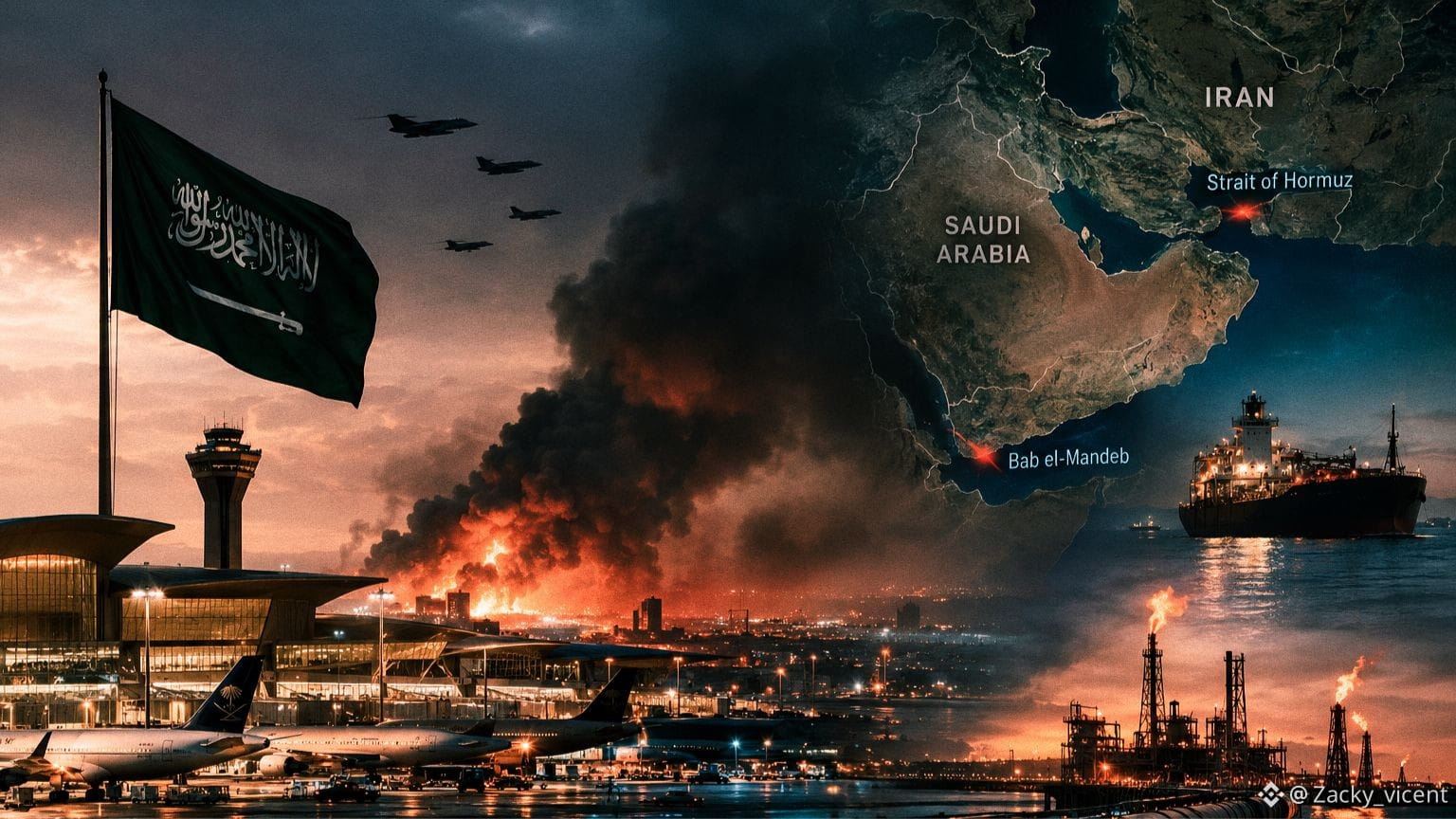
RIYADH ON FIRE: THE MIDDLE EAST CONFLICT IS CLOSING IN ON GLOBAL ENERGY
Riyadh was placed under an air-raid warning on Saturday as reports emerged of explosions, thick smoke and a major fire near King Khalid International Airport.
The cause of the fire remained unclear.
But the timing is impossible to ignore.
Saudi Arabia is facing increasing security pressure as Houthi attacks intensify, shipping routes come under threat and the wider Middle East conflict continues to disrupt the global energy system.
This is no longer just another story about missiles and explosions.
The bigger story is oil, shipping, pipelines and the strategic chokepoints that keep the global economy moving.
RIYADH UNDER PRESSURE
Saudi authorities issued an early air-raid warning for Riyadh and Al-Kharj after reports of explosions in the capital.
Reuters later reported that smoke and flames could be seen near King Khalid International Airport.
Authorities subsequently said the situation was safe, while the exact cause of the fire was not immediately established.
That uncertainty matters.
Saudi Arabia sits at the center of the global oil market. Any threat to its energy infrastructure, export capacity or shipping routes can quickly become a global economic concern.
THE STRAIT OF HORMUZ
One of the biggest pressure points is the Strait of Hormuz.
The narrow waterway between Iran and Oman is one of the world's most important energy chokepoints.
When shipping through Hormuz becomes dangerous or unreliable, the consequences can spread rapidly through global markets.
Shipping companies reassess routes.
Insurance costs can rise.
Cargo deliveries can be delayed.
And oil prices can begin pricing in a larger geopolitical risk premium.
The world does not need to lose all of its oil for an energy crisis to develop.
The transportation system only needs to become unreliable.
BAB EL-MANDEB IS ANOTHER FLASHPOINT
At the other end of the region, the Bab el-Mandeb Strait is becoming increasingly important.
$BTC
Riyadh was placed under an air-raid warning on Saturday as reports emerged of explosions, thick smoke and a major fire near King Khalid International Airport.
The cause of the fire remained unclear.
But the timing is impossible to ignore.
Saudi Arabia is facing increasing security pressure as Houthi attacks intensify, shipping routes come under threat and the wider Middle East conflict continues to disrupt the global energy system.
This is no longer just another story about missiles and explosions.
The bigger story is oil, shipping, pipelines and the strategic chokepoints that keep the global economy moving.
RIYADH UNDER PRESSURE
Saudi authorities issued an early air-raid warning for Riyadh and Al-Kharj after reports of explosions in the capital.
Reuters later reported that smoke and flames could be seen near King Khalid International Airport.
Authorities subsequently said the situation was safe, while the exact cause of the fire was not immediately established.
That uncertainty matters.
Saudi Arabia sits at the center of the global oil market. Any threat to its energy infrastructure, export capacity or shipping routes can quickly become a global economic concern.
THE STRAIT OF HORMUZ
One of the biggest pressure points is the Strait of Hormuz.
The narrow waterway between Iran and Oman is one of the world's most important energy chokepoints.
When shipping through Hormuz becomes dangerous or unreliable, the consequences can spread rapidly through global markets.
Shipping companies reassess routes.
Insurance costs can rise.
Cargo deliveries can be delayed.
And oil prices can begin pricing in a larger geopolitical risk premium.
The world does not need to lose all of its oil for an energy crisis to develop.
The transportation system only needs to become unreliable.
BAB EL-MANDEB IS ANOTHER FLASHPOINT
At the other end of the region, the Bab el-Mandeb Strait is becoming increasingly important.
$BTC