
#buffettstepsdownasberkshirechairman
Warren Buffett Steps Down as Berkshire Hathaway Chairman: What Changes Now
Warren Buffett has officially stepped away from the chairmanship of Berkshire Hathaway, marking another major step in the company’s long-planned succession.
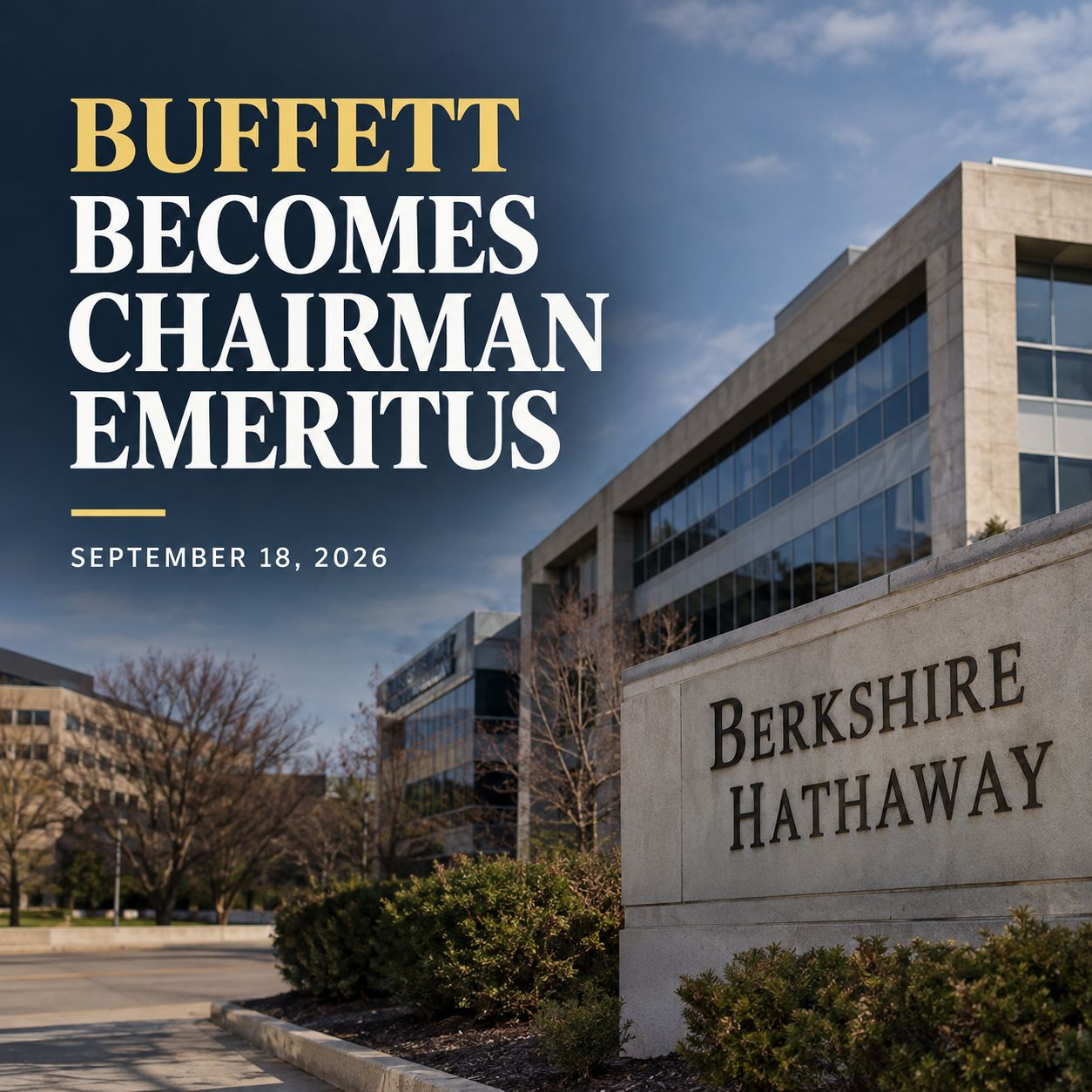
On September 18, Berkshire Hathaway announced that Buffett had become Chairman Emeritus, effective immediately. He will remain a member of Berkshire’s board and continue to provide his judgment and perspective.
Howard G. Buffett, Warren Buffett’s son and a Berkshire director since 1993, was elected Chairman of the Board.
But there’s an important distinction in how Berkshire is now structured.
Greg Abel Is Still Running Berkshire
The latest announcement does not mean another change in Berkshire’s day-to-day leadership.
Greg Abel became Berkshire Hathaway’s CEO at the beginning of 2026, taking over the executive role previously held by Warren Buffett. Reuters reported that the CEO transition had already transferred operational responsibility to Abel before Buffett’s latest move.
That leaves Berkshire with a clearer separation of responsibilities.
Greg Abel runs the company.
Howard Buffett chairs the board.
Warren Buffett remains a director.
The arrangement represents another stage in a succession process that has been developing for years rather than a sudden change in Berkshire’s operating structure.
Why Howard Buffett’s Role Matters
Howard G. Buffett has been a Berkshire director since 1993 and is now taking the non-executive chairmanship.
According to Berkshire’s announcement, the company views Howard as a guardian of the culture and values established under Warren Buffett. Reuters similarly reported that preserving Berkshire’s distinctive culture is expected to be an important part of the new chairman’s role.
That distinction matters because Berkshire’s identity has been closely associated with Buffett’s approach to capital allocation, decentralized management and long-term decision-making.
The question now is not whether Berkshire suddenly changes overnight. It is how those principles evolve as a new leadership structure becomes established.
Buffett’s Influence Hasn’t Completely Disappeared
Although Buffett is no longer chairman, he has not completely left Berkshire’s governance structure.
He remains on the board, meaning his experience and perspective are still formally available to the company.
That makes the September announcement different from a complete departure.
It is better understood as another step in moving Berkshire from a company dominated by one long-serving leader toward a structure designed to function under the next generation of management.
What It Could Mean for Markets
For investors, the interesting part is less about an immediate market shock and more about what happens over time.
Berkshire’s investment decisions, capital allocation and corporate disclosures have historically attracted enormous attention from financial markets. The transition therefore puts more focus on how Abel approaches those responsibilities and how closely Berkshire’s established culture is maintained.
There is also no direct reason to assume that Buffett becoming Chairman Emeritus creates an immediate signal for Bitcoin or other cryptocurrencies.
For crypto traders, the more relevant connection is broader: Berkshire remains an important participant in global financial markets, and changes in its investment philosophy or capital-allocation strategy could become part of the wider market narrative.
But any direct effect on $BTC, $ETH or $BNB would need to be demonstrated by actual market data rather than assumed from the leadership change.
Berkshire’s Next Chapter
Warren Buffett spent decades turning Berkshire Hathaway from a struggling textile business into one of the world's most closely watched conglomerates.
Now, the company enters a different phase.
Buffett remains a director. Howard Buffett takes the chair. Greg Abel leads the company as CEO.
The immediate structure is clear. What remains to be seen is how Berkshire’s investment culture and capital-allocation approach develop under that structure over the coming years.
For markets, that long-term evolution may ultimately matter more than the title change itself.