

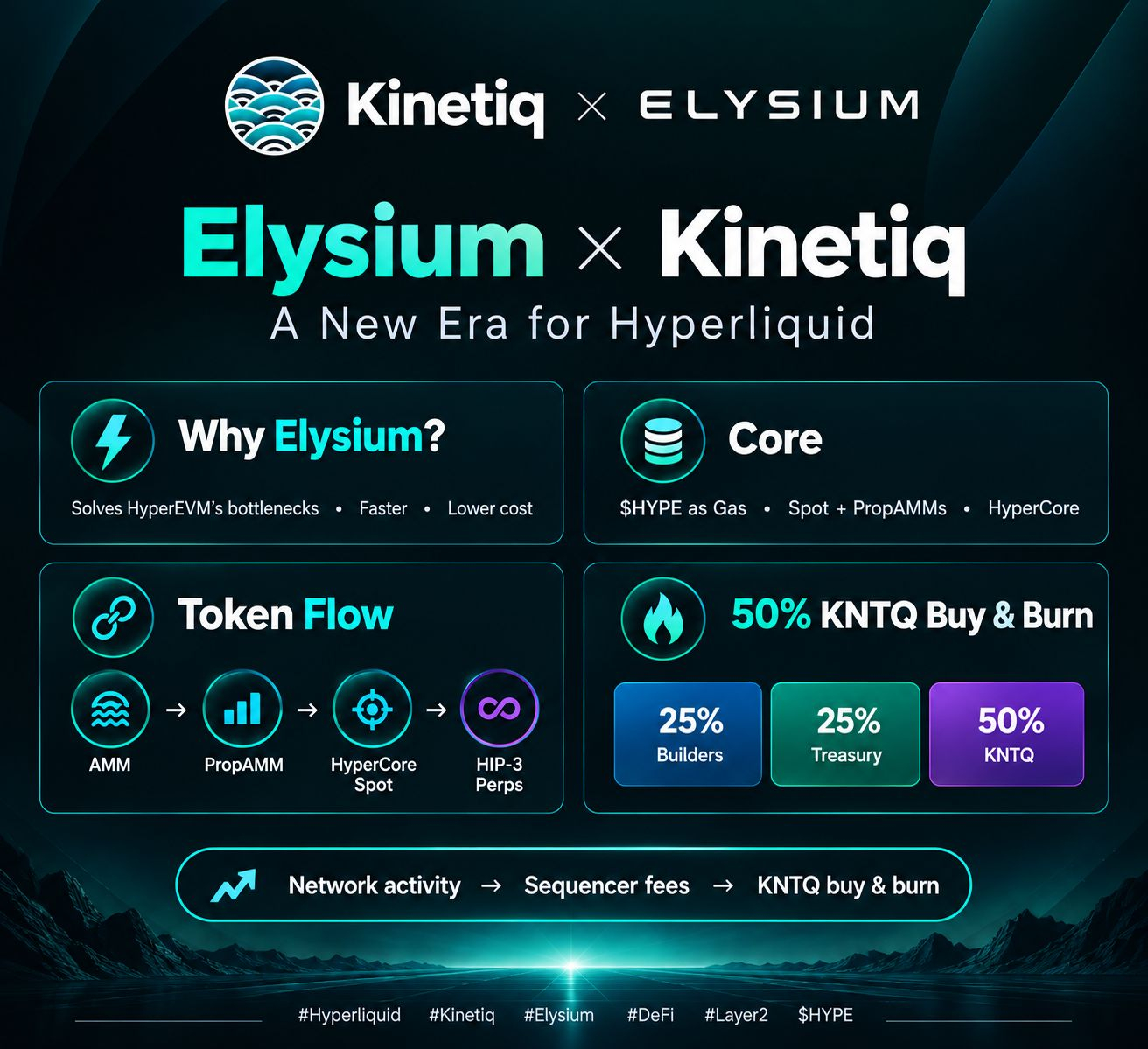
This is where #Elysium enters the picture.
Proposed by Kinetiq, Elysium is a purpose-built Layer 2 designed specifically around the Hyperliquid ecosystem. Rather than functioning as an isolated chain, Elysium aims to connect execution, liquidity, token creation, and trading more closely with HyperCore.
For the #DeFi ecosystem, this presents an interesting question: can an L2 create value for the ecosystem it is built around instead of simply extracting value from it?
Why Does Hyperliquid Need Elysium?
Hyperliquid has built a powerful on-chain trading ecosystem, but increasing activity also exposes infrastructure limitations.
The current HyperEVM environment faces challenges involving its dual-block architecture, throughput, and transaction costs. These issues become particularly relevant for applications that require frequent transactions, such as automated market makers, spot trading platforms, and token-launch infrastructure.
Elysium is designed to address these bottlenecks with a dedicated execution environment optimized for high-performance applications.
One of its most notable design choices is using $HYPE as gas.
Instead of introducing another gas token, Elysium keeps its execution environment economically connected to Hyperliquid. This can simplify the user experience while giving $HYPE additional utility as activity expands.
Supercharging Spot Trading
Elysium is also designed with trading applications in mind.
Its architecture aims to support faster spot trading and specialized liquidity systems such as PropAMMs. This could give builders more flexibility when creating markets and financial applications within the Hyperliquid ecosystem.The potential benefit is not only speed.
By connecting Elysium with HyperCore, applications can potentially access infrastructure that would otherwise require separate systems and liquidity environments.
For traders, this could mean a more connected experience between applications and Hyperliquid's native trading infrastructure.
Of course, these are architectural goals. Their actual impact will depend on adoption, liquidity, execution quality, and real-world usage.
The Token Generation Lifecycle
Another major concept behind Elysium is its approach to token creation and market development.
The proposed lifecycle can be summarized as: AMM → PropAMM → HyperCore Spot → HIP-3 Perps
A new project can begin with an AMM-based market, progress toward a PropAMM structure, and potentially move into HyperCore spot markets as liquidity and demand develop. From there, projects can potentially expand into perpetual markets through HIP-3.
This creates a more connected path for projects moving from initial liquidity toward more advanced markets.
Instead of treating token creation, spot trading, and derivatives as completely separate stages, Elysium attempts to bring them into one ecosystem.
The 50% KNTQ Buy-and-Burn Mechanism
The most interesting part of the #Kinetiq thesis is arguably Elysium's proposed sequencer fee distribution.
The model allocates:
25% → Builders
25% → Treasury
50% → KNTQ Buy & Burn
That final 50% is particularly important.
If Elysium generates sequencer fees, half of those fees are intended to fund purchases of KNTQ, with the purchased tokens then burned.
The theoretical cycle is simple:
More Elysium activity → More sequencer fees → More KNTQ purchases → More KNTQ burned
This creates a direct connection between network activity and KNTQ's supply.
The builder allocation is also significant because applications contributing to the ecosystem receive a portion of the generated fees. Meanwhile, the treasury receives another 25%, creating funding for the broader Kinetiq ecosystem.
Why This Could Be Different From Traditional L2s
Many L2 models primarily focus on increasing transaction capacity while capturing economic activity within their own ecosystems.
Elysium takes a different approach by attempting to align several participants at the same time.
Builders receive 25% of sequencer fees.
The Treasury receives another 25%.
KNTQ holders are connected to the remaining 50% through buybacks and burns.
At the same time, Elysium is designed to remain connected to Hyperliquid through $HYPE, HyperCore, and its trading infrastructure.
This is where the idea of a “value-accretive L2” comes from.
But There Is an Important Reality Check
The mechanism itself does not guarantee value creation.
A 50% buy-and-burn allocation only becomes meaningful if Elysium generates substantial and sustainable sequencer revenue.
Likewise, better infrastructure only matters if developers actually build on it and users actually use it.
This is why I think Elysium should be evaluated not just through its tokenomics, but through actual adoption.
Will builders migrate?
•Will traders use the new infrastructure?
•Will PropAMMs create meaningful liquidity?
•Will projects successfully move through the token-generation lifecycle?
•And can Elysium generate enough economic activity to make the KNTQ buy-and-burn mechanism significant?
These are the questions that will ultimately determine whether the value-accrual thesis works in practice.
My Perspective:
Elysium is an interesting technical and economic experiment for #Web3.
Its biggest difference is not simply that it wants to make transactions faster or cheaper. Its broader objective is to create an execution layer that connects builders, traders, token launches, HyperCore, and Kinetiq's token economics.
If the network succeeds in generating real activity, the proposed sequencer model creates a feedback loop where ecosystem usage can potentially contribute to KNTQ supply reduction.
That makes Elysium worth watching as a #Layer2 designed around a financial ecosystem rather than simply operating alongside one.
For me, the real test is not the narrative. It is execution, adoption, liquidity, and sustainable revenue.
If Elysium can deliver those four things, its impact on the Hyperliquid ecosystem could be much larger than simply providing another place to execute transactions.