
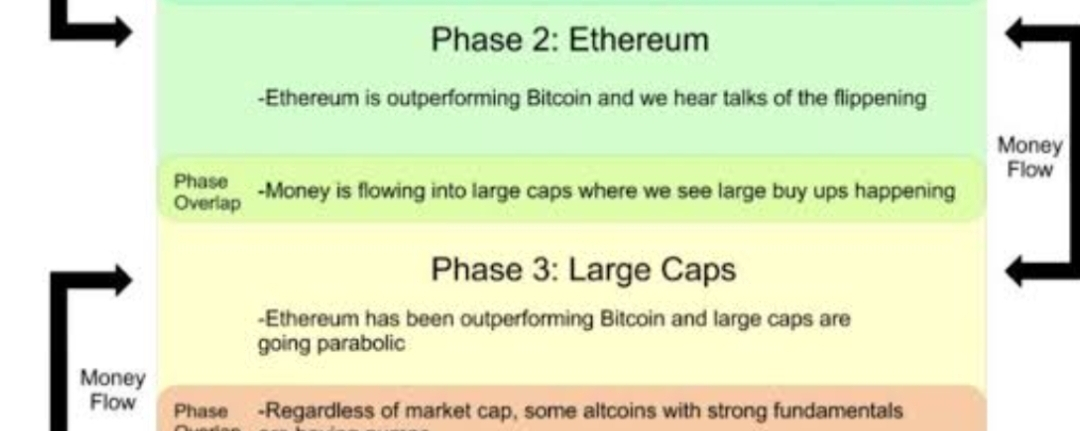


For months, crypto traders have been waiting for the same thing.
Bitcoin runs first.
Ethereum follows.
Then large-cap altcoins start moving.
Finally, almost everything begins pumping and everyone calls it altseason.
But 2026 may be showing us a different version of that cycle.
Instead of the entire altcoin market exploding together, money appears to be moving between specific narratives, sectors and individual coins.
And that difference could be what many traders are missing.
The Numbers Don't Say Full Altseason Yet
Let's start with the important part.
By traditional measurements, we are not in a confirmed broad altseason yet.
Recent Altcoin Season Index data has been sitting around the 30s, while the commonly used threshold for altseason is 75 — meaning 75% of the tracked major altcoins would need to outperform Bitcoin over the measurement period.
Bitcoin dominance also remains high.
Recent readings have placed BTC dominance around 58–59%, meaning Bitcoin still controls a very large portion of total crypto market value.
If we only look at those traditional indicators, the answer seems simple.
Altseason isn't here.
But look underneath those numbers and the picture becomes much more interesting.
Some Altcoins Are Already Acting Like It's Altseason
While the broad indexes remain weak, individual altcoins have been producing enormous moves.
ZEC is one of the clearest examples.
Recent 90-day data showed ZEC up more than 130% against its earlier level, while assets such as PUMP and RAY also posted triple-digit gains over the measurement window.
That is happening while many other altcoins remain far behind Bitcoin.
So we're seeing two markets at the same time.
One group of traders looks at the Altcoin Season Index and says nothing is happening.
Another looks at individual sectors and sees some coins already behaving as if altseason has arrived.
Both observations can be true.
This Time Rotation May Matter More Than the Index
That could be the biggest difference.
The old idea of altseason was simple.
Bitcoin profits moved into Ethereum.
Ethereum profits moved into large caps.
Then money eventually reached smaller coins.
Everything became green.
The current market looks more selective.
Capital can move into privacy coins for a few days.
Then attention shifts toward AI.
Then DeFi starts moving.
Then traders rotate toward Solana-related assets or another emerging narrative.
Instead of one giant altseason, we may be getting multiple smaller narrative seasons happening inside the same market cycle.
September Is Already Showing Signs of Rotation
There is some evidence supporting that idea.
At the beginning of September, the total market capitalization of crypto assets outside the top 10 increased by more than 10%, while Bitcoin dominance faced resistance around the 60% area.
More recently, market breadth improved dramatically.
One September 17 snapshot showed 89 of 100 tracked crypto assets advancing, compared with only 12 a week earlier. Every major sector in that dataset was positive, with meme-related assets and DeFi among the strongest groups.
That doesn't prove a full altseason.
But it does show participation beginning to broaden.
And that's usually more interesting than watching Bitcoin alone.
Derivatives Are Showing Something Too
There is another unusual development.
Altcoin perpetual-futures open interest recently moved above Bitcoin's for the first time since December 2024.
On September 6, altcoin perpetual open interest was reported around $40 billion, compared with roughly $23.9 billion for Bitcoin.
That tells us traders are paying much more attention to altcoins.
But there is an important warning here.
More derivatives activity doesn't automatically mean healthier demand.
It can also mean leverage and speculation are building.
That's why spot-market participation and broader market breadth matter alongside futures positioning.
Bitcoin Doesn't Have to Crash for Alts to Move
This is another misunderstanding around altseason.
Some traders wait for Bitcoin to become weak before expecting altcoins to outperform.
That isn't necessary.
Bitcoin dominance is a ratio.
BTC can continue rising while dominance falls if the rest of the crypto market simply rises faster. CoinGecko notes that falling BTC dominance while Bitcoin itself rises can indicate increasing interest in other cryptocurrencies.
In fact, a relatively stable Bitcoin can sometimes create a better environment for rotation.
Bitcoin provides confidence.
Then traders start looking for higher percentage moves elsewhere.
That's when capital can begin spreading across the market.
Ethereum Still Matters
There is one piece of the traditional altseason puzzle that shouldn't be ignored.
Earlier this month, ETH/BTC reached a seven-month high after breaking out of a longer-term declining structure.
But at the same time, Bitcoin dominance remained strong, creating conflicting signals.
That's exactly why calling a full altseason right now would be premature.
If ETH begins consistently outperforming BTC while Bitcoin dominance falls and broader altcoin market capitalization rises, the traditional altseason argument becomes much stronger.
Until then, we're somewhere in between.
The Biggest Change Could Be Selectivity
There are thousands of crypto assets now competing for the same attention and liquidity.
That changes the mathematics of altseason.
Money doesn't necessarily have to spread evenly across everything.
It can concentrate in projects connected to whatever narrative traders currently care about.
That could mean privacy one week.
AI the next.
DeFi after that.
Then Layer 1s, DePIN, RWA or something completely different.
This creates a market where the right sector can feel like altseason while the rest of the altcoin market barely moves.
That's What Traders May Be Missing
Everyone keeps asking one question:
"When does altseason start?"
Maybe the better question is:
Where is altseason already happening?
The broad indicators still don't confirm a classic market-wide altseason.
Bitcoin dominance remains elevated.
The Altcoin Season Index remains relatively low.
And many altcoins are still struggling.
But underneath those headline numbers, capital is clearly moving.
Certain sectors are outperforming.
Individual altcoins are breaking away from the broader market.
And participation has recently started expanding.
Maybe this cycle doesn't begin with one giant switch from Bitcoin season to altcoin season.
Maybe it begins with small rotations that gradually become larger ones.
If that continues, traders waiting for every altcoin to turn green before calling it altseason may recognize the shift much later than the market itself.