
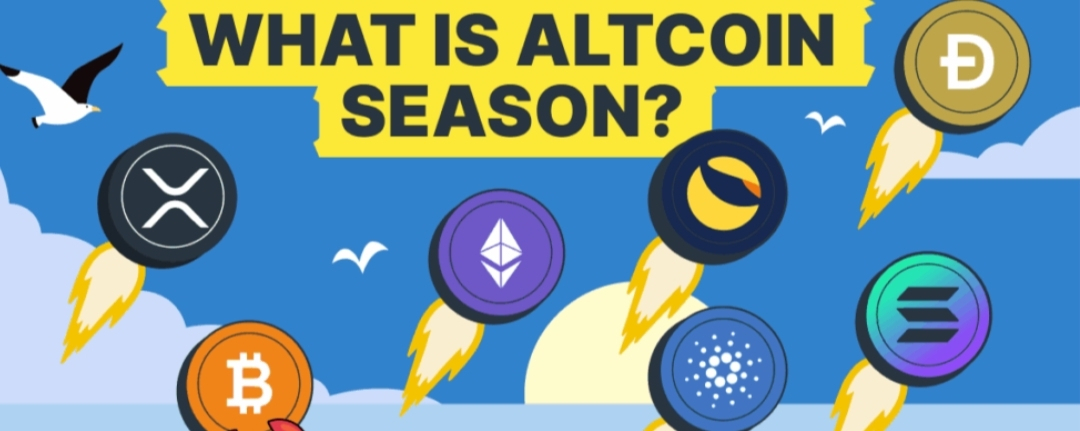


Everyone in crypto seems to be asking the same question.
When will altseason finally start?
Traders are watching Bitcoin dominance, ETH/BTC and every altcoin index they can find, waiting for one clear signal that says the entire altcoin market is ready to run.
But while everyone waits for the official confirmation, something interesting is already happening.
Money is moving.
Just not everywhere at once.
This Doesn't Look Like the Old Altseason Yet
A traditional altseason is easy to imagine.
Bitcoin rallies first. BTC eventually slows down. Ethereum begins outperforming. Large-cap altcoins follow, and eventually capital reaches smaller and more speculative tokens.
Suddenly almost everything seems to be green.
That broad move hasn't clearly arrived in 2026.
Bitcoin dominance was still around 59% in mid-September, showing that BTC continued to control a large share of the crypto market. Several altseason indicators also remained well below levels normally associated with a broad altcoin season.
So calling the current market a full altseason would be premature.
But that doesn't mean nothing is happening underneath Bitcoin.
The Rotation Is Becoming More Selective
Look deeper into the market and the picture changes.
Instead of money flowing into almost every altcoin, traders appear to be concentrating on specific sectors and individual tokens showing momentum.
Recent market-breadth data illustrates this clearly. On September 17, 89 of the 100 assets in KuCoin's QC100 index were advancing, while only 10 were declining. Meme-related assets and DeFi were among the strongest sectors in that snapshot, while Bitcoin's gain was much smaller.
Another market-breadth tracker showed strong recent performance across Layer 2, DeFi, meme, AI, RWA and Layer 1 categories, although methodologies differ between indexes and these short-term readings shouldn't be treated as proof of a lasting trend.
That's an important change.
The market may not be experiencing the classic "everything pumps" altseason.
Instead, it may be experiencing a rotation market.
Bitcoin Doesn't Need to Crash for Alts to Move
This is where many traders misunderstand rotation.
Money moving toward altcoins doesn't necessarily require Bitcoin to dump.
In fact, a sharp BTC decline can be bad for altcoins because fear spreads across the entire crypto market.
A more supportive environment can occur when Bitcoin becomes relatively stable.
If BTC holds its structure without absorbing all of the market's attention, traders may become more willing to look elsewhere for stronger percentage moves.
Bitcoin was around $76,000 on September 17 despite the Fed's latest rate increase and recent regulatory uncertainty.
That relative stability gives other parts of the market room to attract attention.
Follow Strength, Not the Word "Altseason"
This may be the biggest lesson from the current market.
Traders can become so focused on waiting for an official altseason that they miss the rotations happening directly in front of them.
One week, privacy coins may attract attention.
Another week, it could be DeFi.
Then Layer 1s, AI-related tokens, meme coins or another narrative could suddenly become the strongest part of the market.
That doesn't mean every narrative will continue rising.
It means capital is becoming selective.
Instead of asking only, "Has altseason started?", another useful question is:
"Where is the market showing relative strength right now?"
Bitcoin Dominance Still Matters
There is still one major obstacle to the classic altseason argument.
Bitcoin dominance remains elevated.
On September 13, one market tracker put BTC dominance at roughly 58.8%. Earlier September readings were around 59%.
For a much broader rotation, traders would generally want to see Bitcoin's share of the crypto market decline while altcoins consistently outperform BTC.
Ethereum is also important.
ETH/BTC strengthened substantially from its June lows and reached a seven-month high in August, an early indication that Ethereum had started gaining relative strength against Bitcoin. But Bitcoin dominance remained high at the same time, creating a mixed picture rather than a clean altseason signal.
That's why today's market needs more nuance than simply calling it Bitcoin season or altseason.
Not Every Altcoin Will Benefit
There is another major difference between today's market and older crypto cycles.
There are thousands of tokens competing for the same pool of attention and liquidity.
That makes it increasingly difficult for capital to lift the entire altcoin market equally.
Money can concentrate around a few strong narratives while hundreds of weaker tokens barely move.
This could make future rotations shorter and more aggressive.
A token can suddenly become the center of attention, move quickly, and then lose momentum as traders shift toward the next narrative.
That means simply owning an altcoin may not be enough to benefit from an altcoin rotation.
The market increasingly rewards attention, liquidity and relative strength.
The Real Signal Could Be Market Breadth
One giant altcoin candle isn't altseason.
Ten random coins pumping isn't necessarily altseason either.
What matters is whether strength begins spreading.
If more large-cap and mid-cap altcoins consistently outperform Bitcoin, market breadth continues improving and BTC dominance begins falling, the argument for a broader rotation becomes stronger.
Today's market is showing hints of that process, but the evidence remains mixed.
Bitcoin still controls a large portion of crypto's market value.
At the same time, capital is clearly finding opportunities below BTC.
Those two things can happen together.
The Bigger Picture
Maybe traders are waiting for altseason because they're expecting it to look exactly like previous cycles.
This cycle might be different.
Instead of one giant wave lifting almost every altcoin, we could see multiple smaller rotations moving through different narratives.
Privacy today.
DeFi tomorrow.
Layer 1s next.
Then perhaps another sector nobody is paying attention to yet.
The important thing isn't predicting which narrative comes next.
It's recognizing that the market doesn't have to declare "ALTSEASON" before capital starts moving.
Everyone is waiting for the rotation to begin.
The interesting part is that some of the money may already be rotating just not into everything at once.