
Moving USDT from TON to another network usually sounds more complicated than it needs to be.
You have to think about the source chain, destination chain, asset, wallet and execution route. When the destination is a newer network like Robinhood Chain, there is another question I want to answer first:
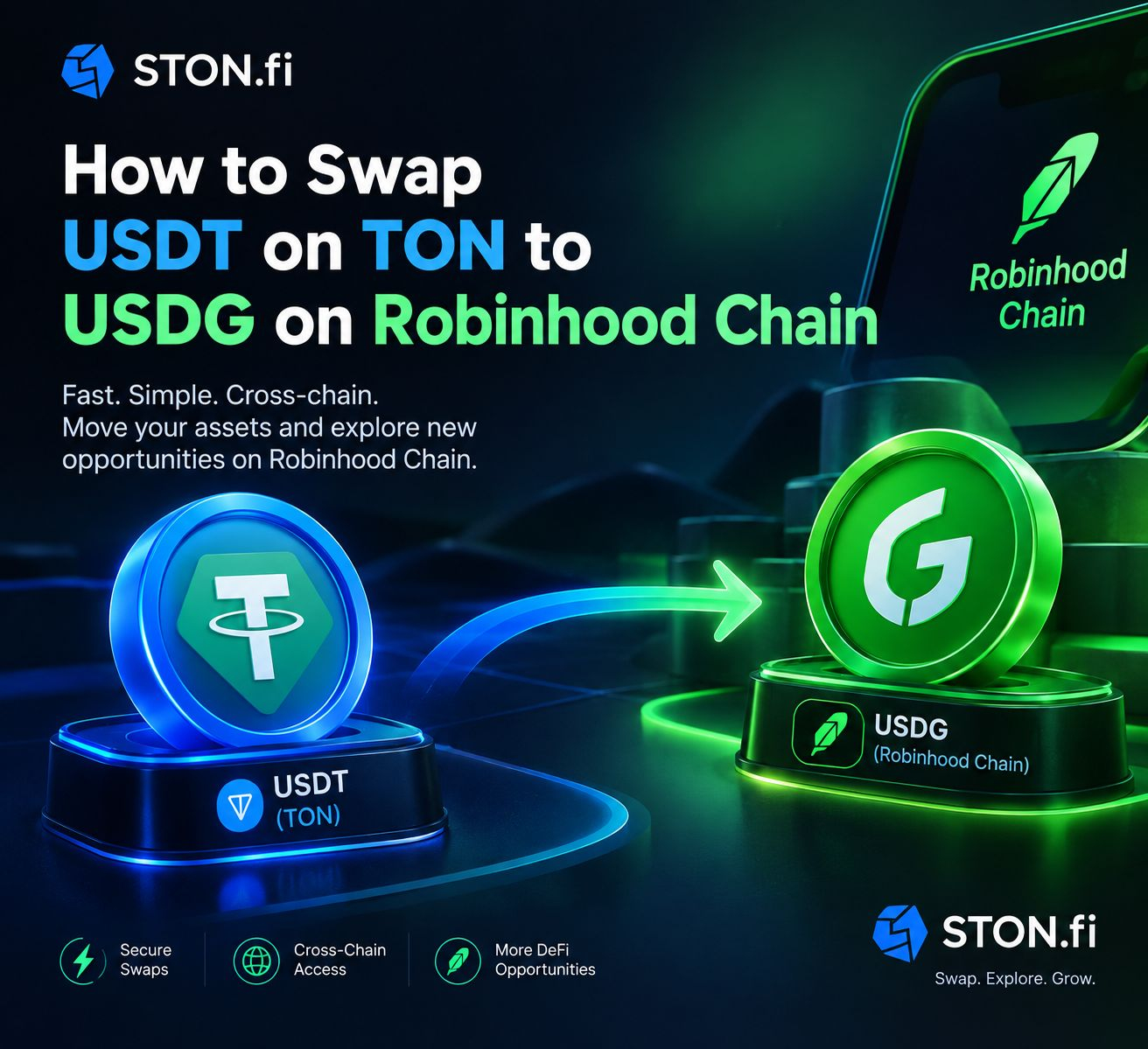
What asset will I actually receive there?
For the current STON.fi cross-chain flow into Robinhood Chain, that destination asset is USDG on Robinhood Chain.
So the route we're looking at is:
TON / USDT → Robinhood Chain / USDG
I checked the dedicated STON.fi guide for Robinhood Chain, and this is how I would approach the swap.
First, what is Robinhood Chain?
Robinhood Chain is an Ethereum-compatible Layer 2 designed around onchain financial infrastructure.
It is built to support things like tokenized financial products, crypto and broader onchain finance. Because it is EVM-compatible, it uses familiar Ethereum-style infrastructure, while ETH serves as its native gas token.
For a TON user, the interesting part is access.
Instead of already holding assets on Robinhood Chain, STON.fi provides a cross-chain route from supported networks into the network.
And for this particular flow, USDG is the destination stablecoin currently supported on Robinhood Chain through STON.fi's cross-chain interface.
That distinction matters.
I'm not treating this as general support for every Robinhood Chain asset. The route I'm looking at is specifically:
USDT on TON → USDG on Robinhood Chain.
Step 1: Choose the source and destination
Open the STON.fi app and set the swap up as:
From: USDT
Network: TON
To: USDG
Network: Robinhood Chain
This is different from a normal swap where both assets exist on the same network.
Here, I'm changing both the network and the stablecoin.
I'm starting with USDT on TON and ending with USDG on Robinhood Chain.
That means the destination details deserve just as much attention as the amount I'm sending.
Step 2: Review the live quote
Before signing anything, I would stop and inspect the quote shown by the STON.fi interface.
The important numbers are:
- Amount of USDT I'm sending
- Amount of USDG I'm expected to receive
- Destination network
- Fees
- Price impact
- Transaction details
- Wallet receiving the USDG
I wouldn't rely on an estimated number from an article or screenshot because cross-chain quotes can change.
The live quote in the STON.fi interface is the number that matters when I'm actually making the swap.
STON.fi's Robinhood Chain guide also advises users to check the source network, destination network, token, final amount, fees, price impact and transaction limit before confirming.
At the current initial stage, STON.fi states that cross-chain swap volume is temporarily limited to $1,000 per transaction.
Step 3: Check the wallet carefully
This is one of the easiest things to overlook.
I'm not just checking that the wallet address looks familiar.
I'm checking that:
The destination wallet is the wallet where I actually want to receive USDG on Robinhood Chain.
A cross-chain transaction has two important sides:
Source: TON / USDT
Destination: Robinhood Chain / USDG
Before confirming, I want those details to match exactly.
Especially when interacting with a newer network or asset, I don't want to assume that selecting the right token name automatically means everything else is correct.
Step 4: What Omniston does behind the scenes
This is where the process becomes interesting.
The cross-chain execution is powered by Omniston by STON.fi.
Instead of asking me to manually bridge USDT, switch networks, find the correct destination asset and coordinate multiple transactions myself, Omniston coordinates the cross-chain execution as one swap flow.
The basic user experience is:
I provide USDT on TON → STON.fi shows the expected USDG outcome → I confirm → Omniston coordinates the execution across the networks.
STON.fi describes Omniston as the execution layer behind its cross-chain swaps. The system coordinates the process so the user can focus on the asset they want to send and the asset they expect to receive rather than manually managing every step of the route.
STON.fi also says that, with its cross-chain flow, users receive the exact amount shown in the interface; otherwise, the swap does not execute and the funds are returned in full.
That gives the process an important condition:
Don't just look at the route. Look at the agreed outcome.
Why this route is useful
Imagine I already hold USDT on TON.
My goal isn't necessarily to acquire another TON token.
I want value on Robinhood Chain, specifically as USDG.
The traditional approach could involve figuring out how to move assets between networks, understanding the destination ecosystem and making sure I end up holding the correct asset.
The STON.fi approach puts the desired outcome at the center:
USDT on TON → USDG on Robinhood Chain
I don't have to manually construct every step of the cross-chain journey.
The infrastructure handles the coordination while I review the transaction before signing.
One important distinction
I wouldn't describe this as:
“USDT on TON is being bridged into Robinhood Chain.”
That can give the wrong impression about what arrives at the destination.
The destination here is USDG on Robinhood Chain.
That's the asset I should verify in the interface before confirming.
This is especially important because moving value across chains isn't simply about changing the network. The destination asset matters too.
My checklist for newer networks and assets
Whenever I'm interacting with a newer network or an asset I haven't used before, I keep the checklist simple:
1. Source asset
Am I actually sending USDT on TON?
2. Destination network
Does the interface clearly show Robinhood Chain?
3. Destination asset
Am I receiving USDG on Robinhood Chain?
4. Live quote
How much USDG will I actually receive?
5. Fees
What will the complete transaction cost?
6. Price impact
Is the quoted execution reasonable?
7. Wallet
Is the destination wallet correct?
8. Transaction limit
Does the amount I'm sending fall within the current limit?
Only after checking these details would I sign the transaction.
The bigger picture
What interests me about this flow isn't simply that another chain has been added to a swap interface.
It's the reduction in cross-chain friction.
I can start with an asset I already hold on TON and target a specific stablecoin on another network without manually piecing together every stage of the journey.
The important part is still doing the checks.
Cross-chain doesn't mean “click and forget.”
It means I should understand:
What am I sending?
Where is it going?
What am I receiving?
How much will I receive?
For this specific STON.fi route, the answer is straightforward:
TON / USDT → Robinhood Chain / USDG.
That's the flow I'd verify in the live interface before signing.
🌐 STON.fi App