


Users of blockchains are frequently trained to believe that the idea of decentralization consists of sharing computation and storage. However, in the case of actual financial markets, the information will have to be credible in a manner that extends much further than the standard oracle feeds. Markets require more than prices but official data that has been validated and audited that can be trusted by institutions, exchanges and regulators as a source of truth. In 2025 -2026, Dusk Network is unobtrusively being used as one of the rare protocols where regulated market data is being published on -chain as a first-class infrastructure component. It is an in-depth examination of how that is occurring, why it is important and what it means to the future of capital markets on blockchains.
Converting formal Market Data into Programmable Infrastructure.
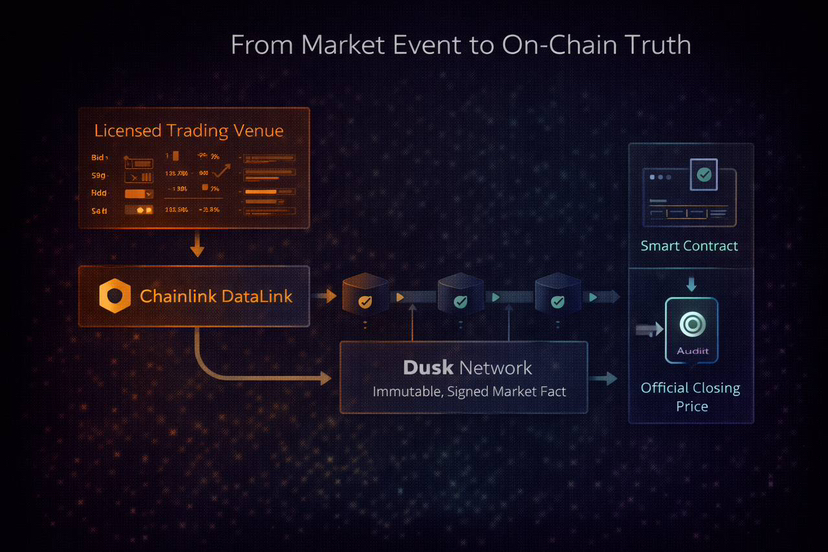
In the majority of blockchains, data oracles are used as external utilities. Their pricing is based on a combination of crowd source and consumer API, which is acceptable when it comes to DeFi tokens or price aggregators. However, institutional markets need another type of data high- integrity feeds of authorized venues, which can withstand compliance and audit requirements. Dusk, working with NPEX (a regulated exchange with licence), has now passed through mere price oracles. They are officializing exchange grade financial data on-chain in real time by adopting Chainlink DataLink and Chainlink Data Streams standards. This data is provable, unlike generic crowdsourced feeds, in that a smart contract can use it with the same degree of confidence as a settlement system in TradFi would. It is not simply putting money into a contract. It implies that a smart contract on Dusk may call on verified trade data published directly by a regulated venue, and reference is as strong, auditable and authoritative as the conventional market infrastructure.
The need to use official data in the real markets.
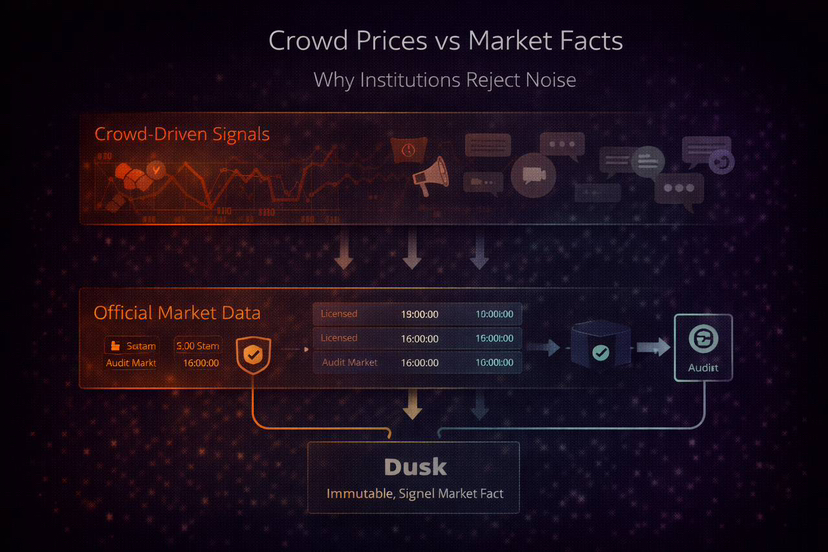
Suppose there is a situation when an institutional investor wishes to redeem a bond on -chain. It should be more than merely a price expressed in the oracle, it should be the official closing price of a regulated market or exchange. Any imbalance would lead to compliance breakdowns or worst, litigations. The fact that Dusk has adopted institutional data standards implies:
1. Exchange level price feeds with low-latency are accessible on-chain.
2. The end to end regulatory provenance is established.
3. Smart contracts are able to operate on data with the same confidence that institutions in off-chain systems have. With this type of model the blockchain is no longer a settlement layer but rather a trusted data surface on which regulated financial activity can be carried out, such as derivatives settlement, auditing ready trade execution, and time stamped transaction history that can be trusted by institutions without needing third party mediators.
Where Dusk Compares with the Typical Oracle Models.
An oracle, in the majority of blockchain ecosystems, retrieves aggregate prices of a combination of exchanges. This is okay with decentralized markets where rough data is not expensive. However, in institutional markets, the price of mistake is high: a mispriced security may create legal liability, false valuations, and infractions. The entry of Dusk is different since it considers official exchange data to be a first-class asset. The network does not only consume information in the form of oracles but rather it is evolving into a data publisher. Dusk and NPEX have also indicated they will publish regulated market data on the exchange directly on-chain using Chainlink DataLink standard. This has the effect of ensuring that the exchange itself is a certified source of data on the blockchain not merely an issuer of market prices through an intermediary. In practice, smart contract data is not only good enough to support DeFi, but it reflects the data used in institutional systems in their respective settlement engines and databases that determine prices.
Why On-Chain Official Data is a breakthrough in tokenized financial products.
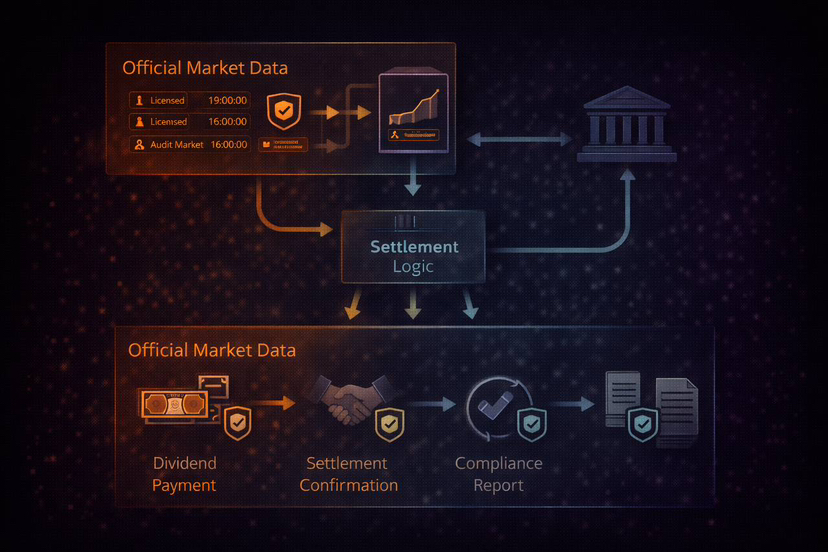
This needs high-integrity data to Regulated financial assets (i.e. tokenized bonds, securities and institutional funds) need high integrity data.
– The identification of settlement value,
Calculation of dividends and yield,
Through instigating business behavior,
– Facilitating the reporting of compliance and audit logs.
Dusk incorporates official data streams in such a way that smart contracts will execute all these functions automatically and the regulators can check the process.
The data in the regulatory contracts can be integrated rather than reconciled post factum. This transformation transforms the processes of the market:
1- Settlement is both automated and valid jurisdictionally.
The audit trails are verifiable and coded.
2- Pricing can be checked all the way to licensed exchanges.
This bridges an enormous credibility divide between conventional finance and decentralized settlement layers.
Not Crypto Hype Only but Institutional Confidence.
In a world where institutions are doubtful of blockchain data sources, the move by Dusk to adopt regulated data feeds is timely since many of these data sources lack the reliability to be subject to regulatory abuse or litigation. Published on-chain data that is issued by a licensed exchange has legal implications. Most blockchain oracles are concerned mostly with decentralisation and redundancy, whereas Dusk is concerned with provenance, auditability, and source integrity, the same criteria applied by auditors, regulators, and custodians in the conventional finance.
Due to this, Dusk goes beyond being a private blockchain; it is a protocol where official financial data is a first-class asset class, which goes beyond generic oracle solutions.
Interoperable Markets and the Future of Cross-Chain Data.
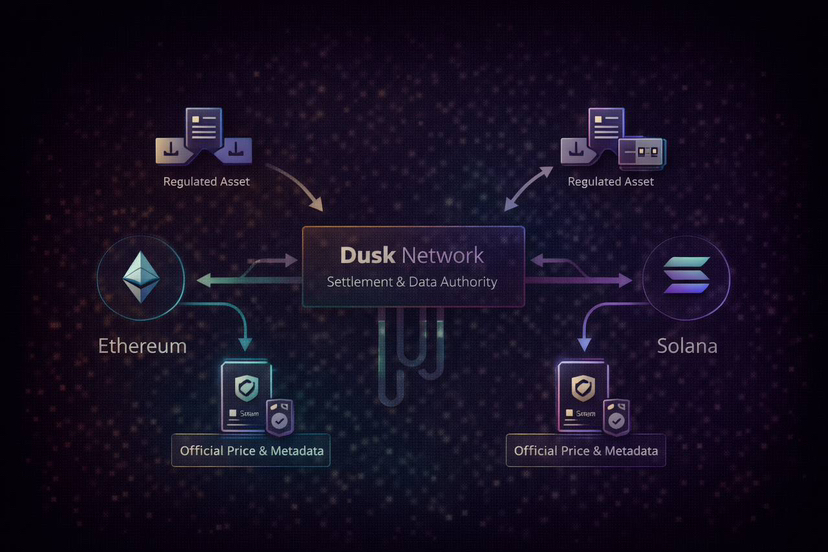
Chainlink CCIP (Cross-Chain Interoperability Protocol) is also applied in Dusk along with DataLink. It enables the publication of official prices on Dusk and spreading it to several blockchains, viz. Ethanol, Solana, etc. and maintaining the regulatory signature through which credibility can be ensured.
As an example, a tokenized security on Dusk which must be cleared on Ethereum and would require price data can use CCIP+ DataLink to access the same proven feed everywhere in the ecosystems so that the provenance is the same everywhere. This tendency might also create a strong trend in the regulated on-chain markets, where reliable data that can be audited is moved with assets, not only tokens.
The impact of this on the story of Oracles.
Conventionally, oracles connect blockchains and external data. They have to go beyond bridging in regulated markets, which they have to anchor data to reflect the authority of centralised sources like exchanges, clearinghouses, or custodians. The integration of Dusk and Chainlink makes the oracle an on-chain authoritative data publisher, as opposed to its use as a consumer of data.
It is not a technical gimmick, but the foundation of automation in finance that is legally permissible. A trade that is settled by a contract using on-chain data must stand up to legal standards: that is, it must be not only decentralised but also defensible.
Another New Type of Blockchain Infrastructure.
The effect of this approach is a novel form of blockchain infrastructure in which:
1- High integrity, official information is not a second-hand citizen.
2- Smart contracts are capable of doing what the law considers as true, rather than technically being certain.
3- Regulated markets and auditors are ultimately both operating on one, on-chain source of truth.
Settlement and custody have long been considered the subject of blockchains and traditional finance debate. The actual point of bottleneck is confidence data. It is the only way that smart contracts can be able to completely replace legacy systems. The most recent work of Dusk suggests the direction of filling in that gap.
Conclusion: The Data as Infrastructure.
The initial blockchain wave had been the decentralisation of computation and custody. The following wave will be decentralisation of truth- verifiable, official data, data that institutions can trust. Dusk is also designed with a special place to place official market data as a protocol-level resource, as opposed to an optional add-on.
This not just allows regulated DeFi but it also provides regulated, auditable, legally defendable on-chain finance.
Statements that real markets and not crypto theorists alone can now take seriously.
