

Ethereum’s rollup centric Layer2 strategy did not fail because of technology, but because decentralization incentives never aligned with Layer2 business models.
As Ethereum begins to scale Layer1 directly, general purpose Layer2 networks lose their core justification and face a structural relevance crisis.
Only specialized Layer2s that offer clear differentiation such as privacy, ultra low latency, or application specific execution can survive in a post rollup narrative era.

HOW THE ROLLUP CENTRIC ROADMAP BECAME ETHEREUM’S ONLY CHOICE AND ITS BIGGEST BET
To understand why Vitalik Buterin’s recent article matters, it is necessary to go back to the moment when Ethereum first committed itself to a rollup centric future. This decision did not come from theoretical preference. It came from pressure.
Between 2018 and 2021, Ethereum faced a growing contradiction. On one side, demand for block space was rising rapidly due to DeFi NFTs and on chain speculation. On the other side, the cost of running a full node was increasing, and the community was deeply resistant to any solution that would significantly raise hardware requirements. Scaling the base layer directly was politically difficult and socially risky.
Rollups appeared as a compromise that satisfied everyone on paper. Ethereum Layer1 could remain conservative and secure. Layer2 networks would handle execution and scale. In theory, these Layer2 systems would eventually inherit Ethereum’s security model and decentralize over time. The idea of rollups as “Ethereum’s shards” became the dominant narrative.
This roadmap was not only a technical plan. It became a social contract. Developers built around it. Investors funded it. Media reinforced it. Layer2 was not just a scaling method. It was framed as Ethereum’s destiny.
At the time, the bet made sense. Ethereum could not scale quickly without risking fragmentation. Competing Layer1s were emerging with higher throughput and simpler user experiences. The rollup centric roadmap allowed Ethereum to delay hard choices while preserving its ideological core.
But embedded in this choice was an assumption that would later prove fragile. It assumed that Layer2 projects would voluntarily move toward deep decentralization even when doing so conflicted with their business incentives. It assumed that time alone would solve governance concentration. It assumed alignment where alignment was never enforced.
This was the original strategic gamble. Ethereum outsourced execution complexity to external networks while trusting that long term values would guide their evolution. In hindsight, this was less a technical plan and more an act of faith.
WHY LAYER2 DECENTRALIZATION STALLED AND WHY IT WAS NEVER JUST A TECHNICAL ISSUE
For years, slow decentralization on Layer2 was explained as a matter of maturity. Teams argued that early centralization was necessary for safety and efficiency. Critics were told to be patient. Stage based frameworks were introduced to signal progress.
Yet the uncomfortable reality is that decentralization stalled not because of technical difficulty alone, but because of incentive misalignment. Control over sequencers means control over transaction ordering and fee revenue. Governance authority provides regulatory flexibility. Multisig systems reduce operational risk.
Moving toward full trust minimization removes these advantages. It introduces uncertainty and reduces optionality. From the perspective of a Layer2 operator, decentralization is not an upgrade. It is a tradeoff.

This is why many Layer2 networks remained structurally centralized long after their early phase ended. Not temporarily centralized, but intentionally so. The system rewarded control, not relinquishment.
Ethereum tolerated this because the alternative felt worse. As long as Layer2 networks delivered lower fees and higher throughput, the ecosystem accepted the gap between theory and reality. The narrative of future decentralization acted as a shield against deeper scrutiny.
Vitalik’s recent article breaks this shield. By stating plainly that Layer2 decentralization has progressed far slower than expected, he reframes the issue as a strategic failure rather than a temporary delay. This distinction matters.
Once decentralization is acknowledged as a choice rather than a milestone, the entire rollup centric justification weakens. Layer2 networks stop looking like Ethereum’s extensions and start looking like independent systems borrowing Ethereum’s credibility.
At that point, the question changes. It is no longer whether Layer2 can decentralize someday. It is whether Ethereum should continue to grant them the status of official scaling layers while absorbing the risks of their design decisions.
WHEN ETHEREUM CHOOSES TO SCALE ITSELF THE ORIGINAL LAYER2 PROMISE COLLAPSES
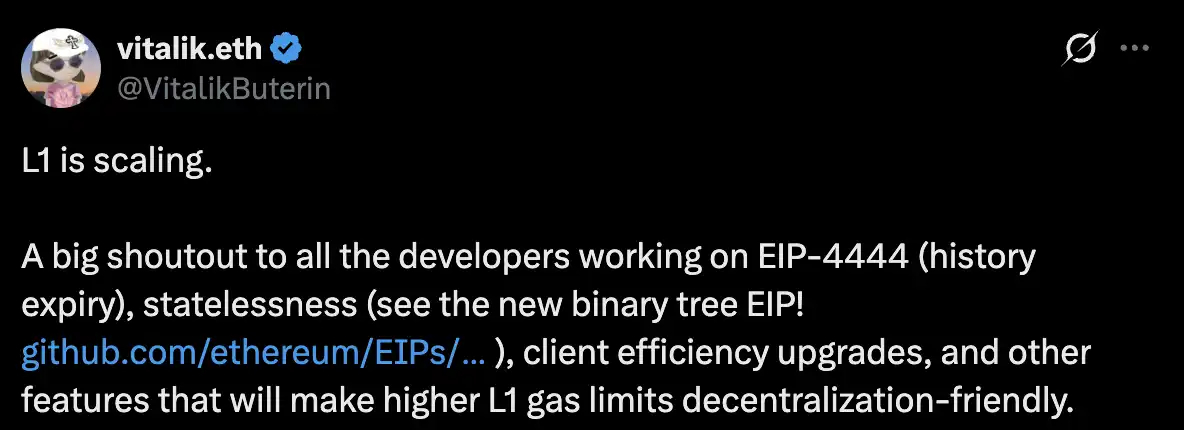
Over the past year, Ethereum’s actions have quietly signaled a shift long before the words arrived. Incremental increases to the gas limit. Execution layer optimizations. The gradual movement of zero knowledge proving closer to the base layer. These are not cosmetic changes.
They represent a reversal of the earlier assumption that Layer1 must remain minimal at all costs. Ethereum is now willing to accept more responsibility at the base layer in order to regain coherence and control.
This shift fundamentally changes the value proposition of general purpose Layer2 networks. If Layer1 transaction costs approach those of Layer2, and if performance gaps continue to narrow, then the primary justification for Layer2 disappears.
Users do not choose architectures. They choose experiences. If the base layer becomes cheap and fast enough, few users will tolerate the added complexity of bridging fragmented liquidity and multiple execution environments.
Developers face the same calculus. Building on Layer2 only makes sense if it offers something meaningfully different. If it merely replicates Ethereum with extra steps, it becomes a liability rather than an advantage.
Vitalik’s article can be read as an official acknowledgment that the original role assigned to Layer2 is complete. Rollups served as a bridge during a period when Ethereum could not scale directly. That period is ending.
This does not mean that all Layer2 networks will disappear. It means that their legitimacy must now be earned through differentiation rather than inherited through association.
The implication is uncomfortable but clear. Ethereum no longer sees Layer2 as the future of its execution layer. It sees them as optional environments with varying degrees of trust and relevance.
WHAT SURVIVES AND WHAT DOES NOT IN THE POST ROLLUP NARRATIVE
If the rollup centric roadmap is no longer the backbone of Ethereum’s future, then the ecosystem must sort itself accordingly. Not all Layer2 networks face the same fate.
General purpose Layer2s that exist primarily to offer cheaper Ethereum transactions face the most existential risk. Their value proposition erodes as Layer1 improves. Their decentralization remains incomplete. Their economic models depend on sustained traffic that may not materialize.
In contrast, specialized Layer2s still have a path forward. Networks that focus on privacy, ultra low latency, non financial applications, or application specific execution can justify their existence. They provide capabilities that Ethereum Layer1 is not designed to optimize for in the near term.
The key difference is intent. Surviving Layer2s will not position themselves as Ethereum’s future. They will position themselves as Ethereum’s complements.
This transition also forces a reassessment for investors. Many Layer2 valuations were built on the assumption of permanent structural relevance. That assumption no longer holds. What remains is execution quality, differentiation, and real demand.
Vitalik did not declare the end of Layer2. He removed their default legitimacy. The market will do the rest.
In the long run, this correction may strengthen Ethereum. By reclaiming its core scaling path and clarifying the role of external networks, Ethereum reduces systemic ambiguity. It trades short term discomfort for long term coherence.
The uncomfortable truth is that Ethereum’s greatest mistake was not choosing Layer2. It was assuming that outsourcing its future would preserve its values. That assumption has now been abandoned.
For participants in the ecosystem, the question is no longer theoretical. It is practical. Which networks offer real value beyond borrowed security. And which ones were only ever sustained by a narrative that has now reached its end.
〈Vitalik Admits a Strategic Misjudgment as Ethereum Begins to End the Layer2 Narrative〉這篇文章最早發佈於《CoinRank》。
