
@Dusk #dusk $DUSK
I used to think privacy and compliance were basically opposites in crypto.
If you hide the data, regulators can't see it.
If you expose everything, you lose the privacy institutions actually need.
Looking deeper into Dusk, I think that framing is too simple.
What caught my attention is Citadel 2.
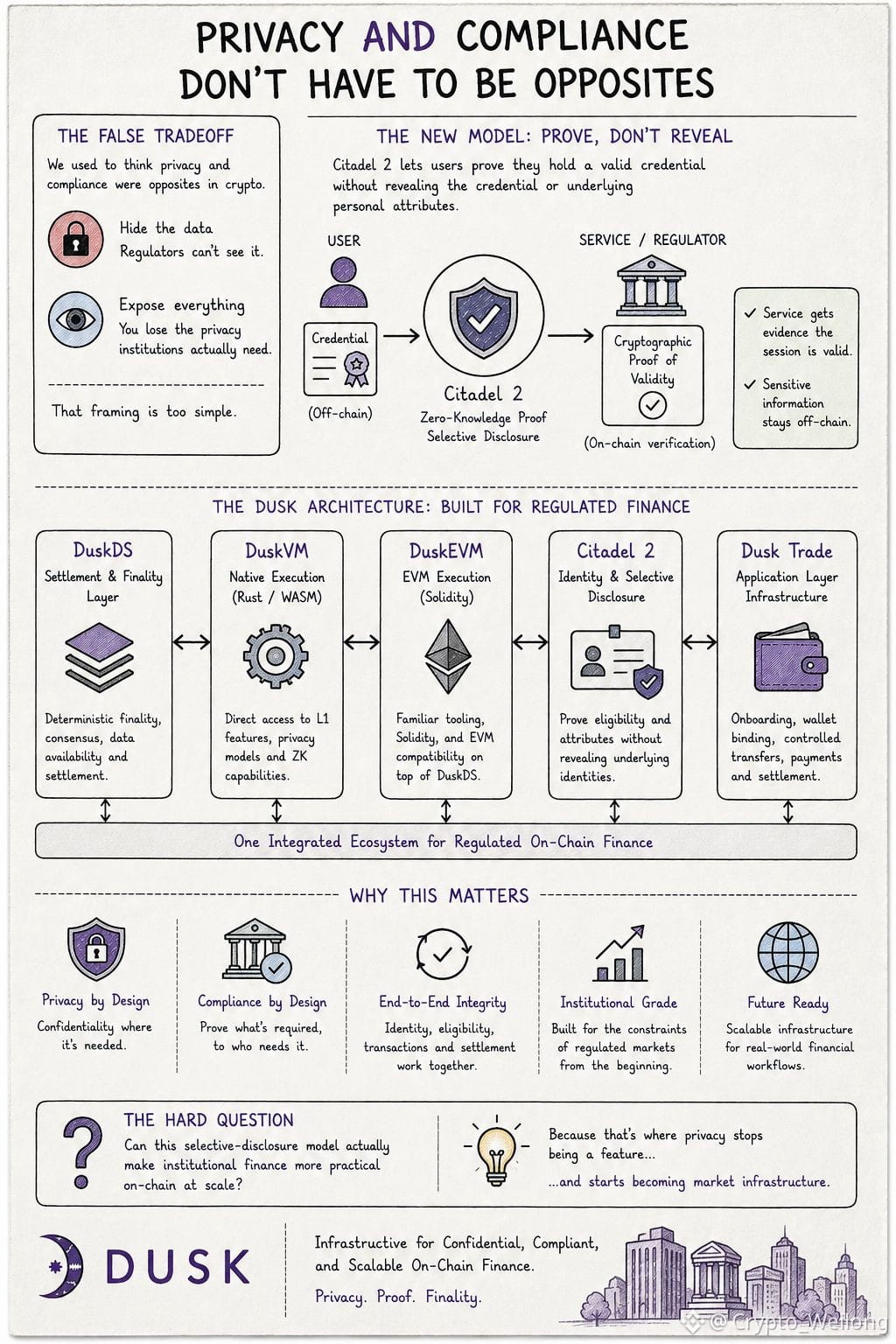
Instead of putting someone's personal credentials directly on-chain, Citadel lets a user prove they hold a valid credential without revealing the exact credential or the underlying personal attributes. The service still gets cryptographic evidence that the session is valid, while the sensitive information stays off-chain.
That changes how I think about "privacy" for regulated finance.
It doesn't necessarily mean making everything invisible.
It can mean proving exactly what needs to be proven, to exactly the party that needs to know it.
And that fits surprisingly well with the rest of Dusk.
DuskDS handles settlement and finality.
DuskVM and DuskEVM provide different execution paths.
Citadel handles identity and selective disclosure.
Dusk Trade brings onboarding, wallet binding, controlled transfers, payment coordination and settlement into the application layer.
So the interesting part isn't any single privacy feature.
It's the possibility of making identity, eligibility, confidentiality and settlement work together without turning the entire financial workflow into a public database.
That's where Dusk starts looking less like a blockchain adding compliance after the fact, and more like infrastructure designed around the constraints of regulated markets from the beginning.
The architecture makes sense to me.
Now I'm watching the harder question:
Can this selective-disclosure model actually make institutional finance more practical on-chain at scale?
Because that's where privacy stops being a feature and starts becoming market infrastructure.
I used to think privacy and compliance were basically opposites in crypto.
If you hide the data, regulators can't see it.
If you expose everything, you lose the privacy institutions actually need.
Looking deeper into Dusk, I think that framing is too simple.
What caught my attention is Citadel 2.
Instead of putting someone's personal credentials directly on-chain, Citadel lets a user prove they hold a valid credential without revealing the exact credential or the underlying personal attributes. The service still gets cryptographic evidence that the session is valid, while the sensitive information stays off-chain.
That changes how I think about "privacy" for regulated finance.
It doesn't necessarily mean making everything invisible.
It can mean proving exactly what needs to be proven, to exactly the party that needs to know it.
And that fits surprisingly well with the rest of Dusk.
DuskDS handles settlement and finality.
DuskVM and DuskEVM provide different execution paths.
Citadel handles identity and selective disclosure.
Dusk Trade brings onboarding, wallet binding, controlled transfers, payment coordination and settlement into the application layer.
So the interesting part isn't any single privacy feature.
It's the possibility of making identity, eligibility, confidentiality and settlement work together without turning the entire financial workflow into a public database.
That's where Dusk starts looking less like a blockchain adding compliance after the fact, and more like infrastructure designed around the constraints of regulated markets from the beginning.
The architecture makes sense to me.
Now I'm watching the harder question:
Can this selective-disclosure model actually make institutional finance more practical on-chain at scale?
Because that's where privacy stops being a feature and starts becoming market infrastructure.