#dusk @Dusk $DUSK
Dusk describes itself as offering deterministic settlement. That word does a lot of work in a sentence, so over the past few days I tried to measure whether the clock underneath it actually holds.
Two samples, taken three days apart, both from the mainnet explorer block list.
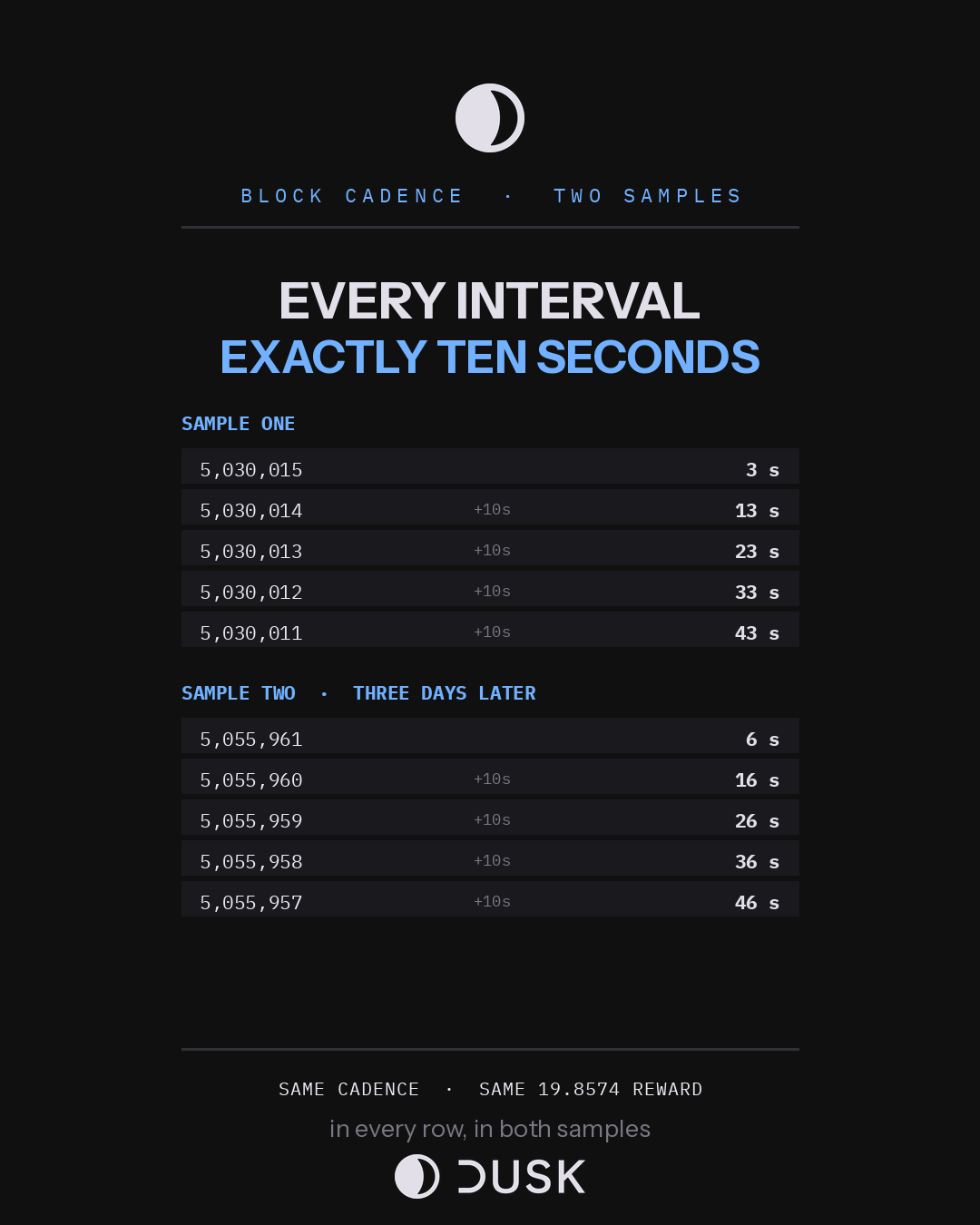
First sample, six consecutive blocks. The explorer showed them at 3, 13, 23, 33, 43 and 53 seconds old. Every interval exactly ten seconds. Second sample, three days later, five consecutive blocks: 6, 16, 26, 36 and 46 seconds. Every interval exactly ten seconds again.
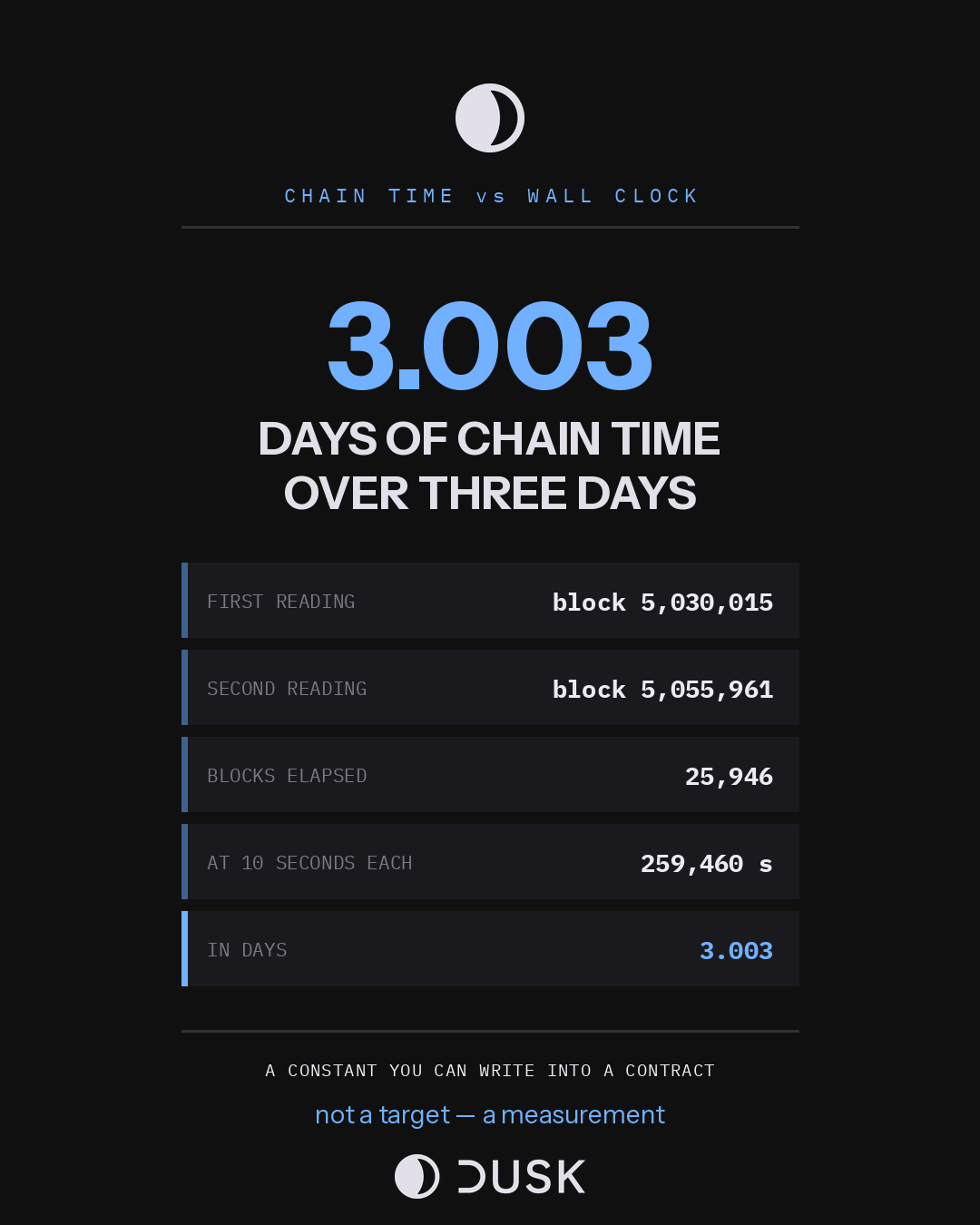
Then the same question at three days of scale. My first reading was block 5,030,015 and my second was 5,055,961, a difference of 25,946 blocks. At ten seconds each that is 259,460 seconds, or 3.003 days of chain time against three days of wall clock. The drift over a quarter of a million seconds is small enough that I cannot separate it from my own imprecision about when I loaded the pages.
Every block in both samples paid exactly 19.8574 DUSK. Not approximately, not on average across the window - the same four decimal places in every row, three days apart.
This is the least dramatic thing I have measured on this chain and probably the most consequential. T+2 in traditional markets was never two days of computation. It was two days of institutional slack, and every downstream promise had to be written loosely enough to survive it. When the interval is the same number every single time, the guarantee stops needing that slack. You can put the settlement window in a contract instead of an estimate.
The limit is honest: I sampled two windows of five or six blocks. That is evidence of a steady cadence under normal conditions, not a proof of it under adversarial ones. What it does show is that the constant is real enough to build against today.
If you were writing the settlement clause, would you rather cite a target, or a measurement?
Dusk describes itself as offering deterministic settlement. That word does a lot of work in a sentence, so over the past few days I tried to measure whether the clock underneath it actually holds.
Two samples, taken three days apart, both from the mainnet explorer block list.
First sample, six consecutive blocks. The explorer showed them at 3, 13, 23, 33, 43 and 53 seconds old. Every interval exactly ten seconds. Second sample, three days later, five consecutive blocks: 6, 16, 26, 36 and 46 seconds. Every interval exactly ten seconds again.
Then the same question at three days of scale. My first reading was block 5,030,015 and my second was 5,055,961, a difference of 25,946 blocks. At ten seconds each that is 259,460 seconds, or 3.003 days of chain time against three days of wall clock. The drift over a quarter of a million seconds is small enough that I cannot separate it from my own imprecision about when I loaded the pages.
Every block in both samples paid exactly 19.8574 DUSK. Not approximately, not on average across the window - the same four decimal places in every row, three days apart.
This is the least dramatic thing I have measured on this chain and probably the most consequential. T+2 in traditional markets was never two days of computation. It was two days of institutional slack, and every downstream promise had to be written loosely enough to survive it. When the interval is the same number every single time, the guarantee stops needing that slack. You can put the settlement window in a contract instead of an estimate.
The limit is honest: I sampled two windows of five or six blocks. That is evidence of a steady cadence under normal conditions, not a proof of it under adversarial ones. What it does show is that the constant is real enough to build against today.
If you were writing the settlement clause, would you rather cite a target, or a measurement?