I’ve been looking more closely at how @Dusk handles consensus, and one detail I find easy to overlook is that the process isn’t treated as one single decision.
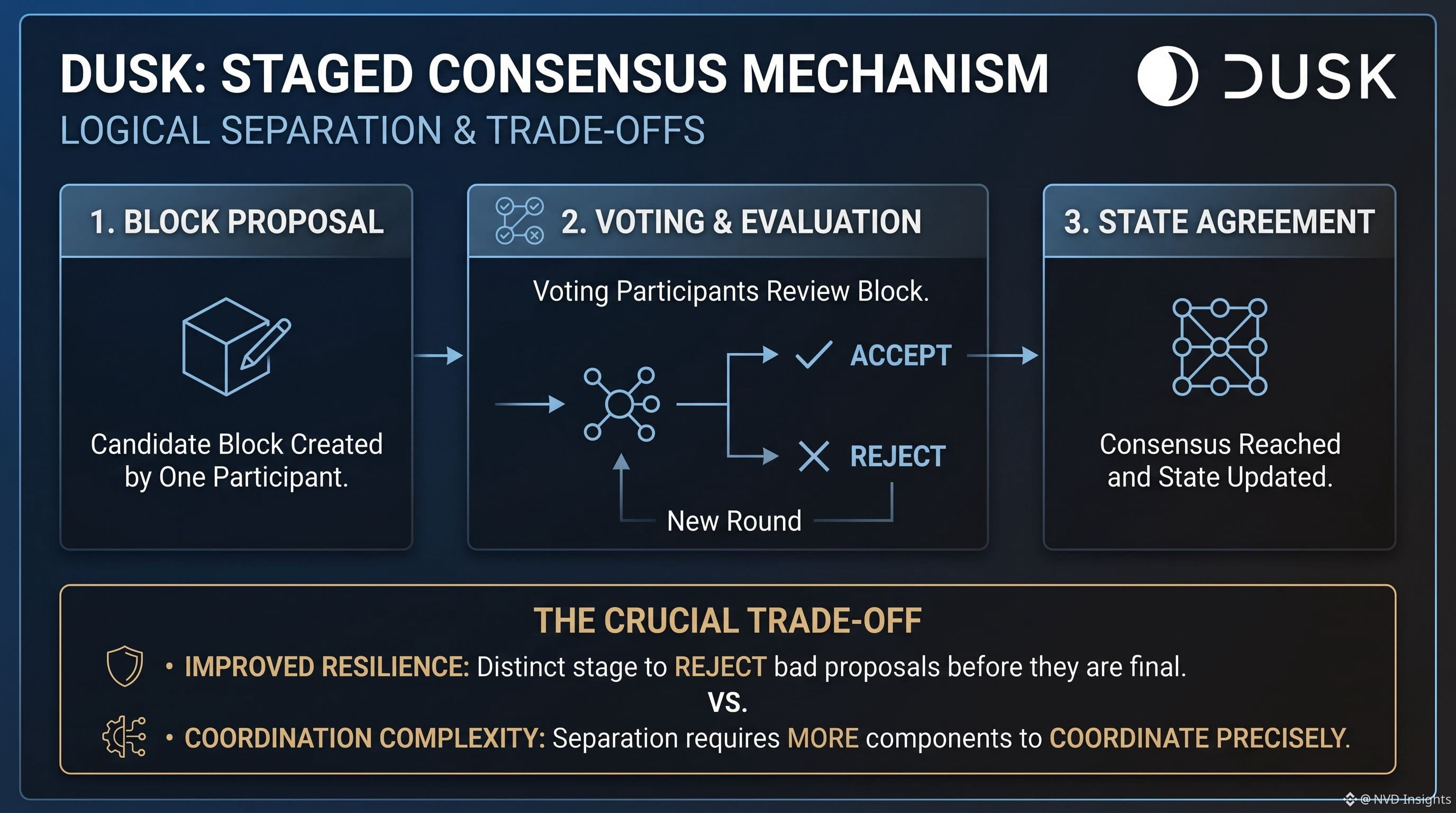
Ama block is first prepared and proposed. Then voting participants evaluate it before the network agrees on the resulting state.
that separation matters to me because producing a candidate block and accepting that block are not the same thing. If a proposal is wrong, the voting stage provides a distinct point where participants can reject it rather than treating block production itself as acceptance.
i like that design from a systems perspective. It makes the logic easier t0 separate: propose first, reach agreement second.
but there is another side I keep thinking about. More explicit stages also mean more coordination between the components. If those stages depend on each other, additional structure can introduce additional places where coordination needs to work correctly.
my take is that the interesting question is not whether the design looks sophisticated. It’s whether that separation actually improves resilience without creating unnecessary complexity.
does staged consensus make Dusk more robust to bad proposals? Or does the added coordination create a new trade off?
#dusk $DUSK
Ama block is first prepared and proposed. Then voting participants evaluate it before the network agrees on the resulting state.
that separation matters to me because producing a candidate block and accepting that block are not the same thing. If a proposal is wrong, the voting stage provides a distinct point where participants can reject it rather than treating block production itself as acceptance.
i like that design from a systems perspective. It makes the logic easier t0 separate: propose first, reach agreement second.
but there is another side I keep thinking about. More explicit stages also mean more coordination between the components. If those stages depend on each other, additional structure can introduce additional places where coordination needs to work correctly.
my take is that the interesting question is not whether the design looks sophisticated. It’s whether that separation actually improves resilience without creating unnecessary complexity.
does staged consensus make Dusk more robust to bad proposals? Or does the added coordination create a new trade off?
#dusk $DUSK