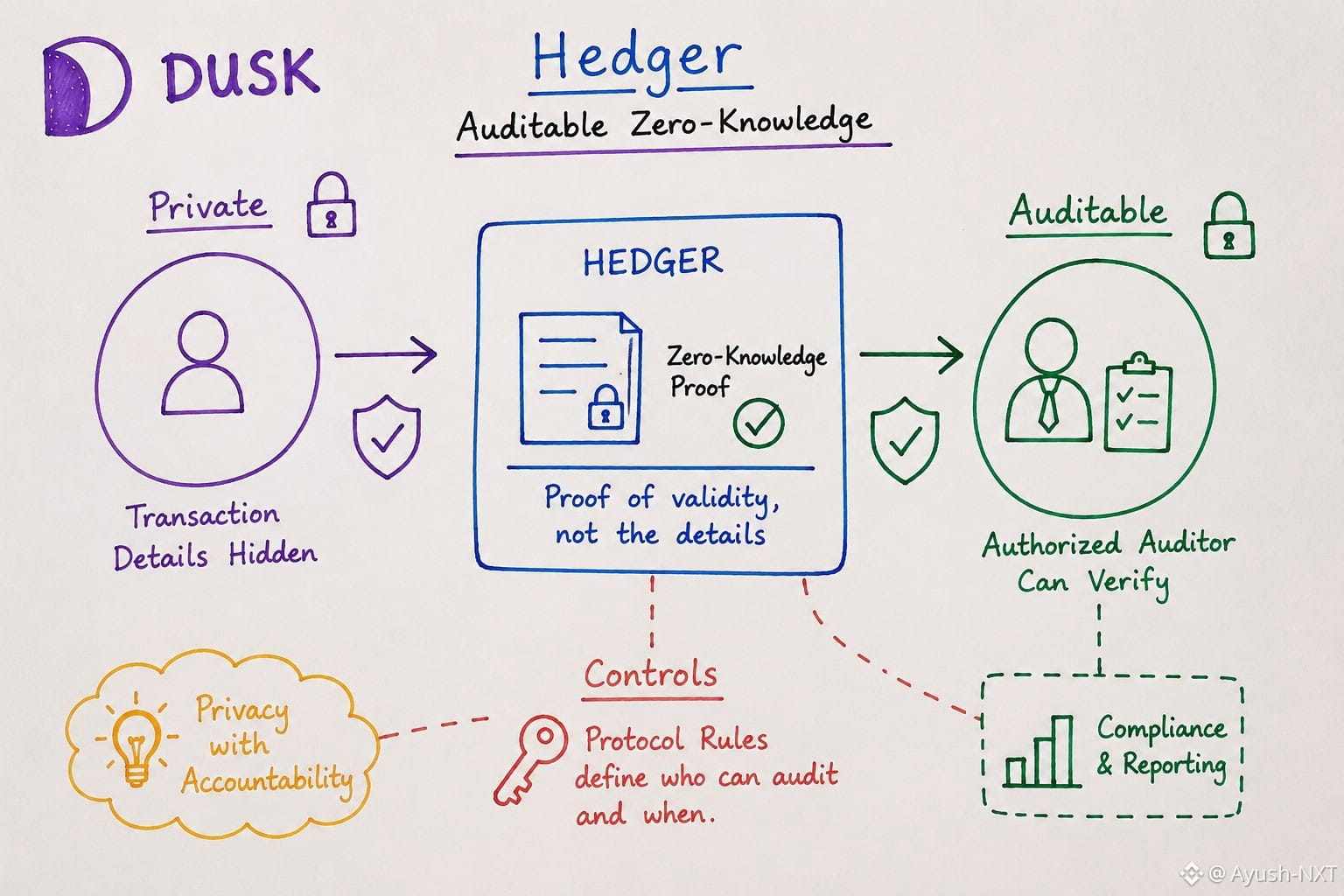
I was reading about Hedger, the mechanism Dusk describes for enabling auditable zero-knowledge transactions, and it made me pause on how much weight that single word "auditable" carries when paired with something typically associated with concealment. I noticed the framing seems deliberate, positioning this not as privacy for its own sake but as a tool specifically shaped to satisfy auditors or regulators without exposing full transaction details to the public at large.
What seems interesting is the idea that a transaction can remain shielded from general visibility while still producing something an authorized party can verify against. It makes me think this could be the practical bridge between zero-knowledge cryptography and the kind of documentation regulated institutions are legally required to produce, which is a very different bar than most privacy tools are built to clear.
The question that comes to mind is who actually controls the audit trigger in practice. Is it something baked into protocol rules automatically, or does it depend on discretionary access granted case by case? I'm not completely sure where that line sits, and it feels like the answer probably determines whether institutions view this as genuinely decentralized or just privacy with an administrative backdoor dressed differently.
Looking from the outside, Hedger feels like one of those features that sounds reassuring in a whitepaper but really only proves itself once real auditors, real regulators, and real disputes test it under pressure. The concept is coherent, yet coherence and real-world resilience aren't the same thing... anyway, time will tell👍
#dusk $DUSK @Dusk
What seems interesting is the idea that a transaction can remain shielded from general visibility while still producing something an authorized party can verify against. It makes me think this could be the practical bridge between zero-knowledge cryptography and the kind of documentation regulated institutions are legally required to produce, which is a very different bar than most privacy tools are built to clear.
The question that comes to mind is who actually controls the audit trigger in practice. Is it something baked into protocol rules automatically, or does it depend on discretionary access granted case by case? I'm not completely sure where that line sits, and it feels like the answer probably determines whether institutions view this as genuinely decentralized or just privacy with an administrative backdoor dressed differently.
Looking from the outside, Hedger feels like one of those features that sounds reassuring in a whitepaper but really only proves itself once real auditors, real regulators, and real disputes test it under pressure. The concept is coherent, yet coherence and real-world resilience aren't the same thing... anyway, time will tell👍
#dusk $DUSK @Dusk