


Retail-linked coins are moving back to Binance, but the most relevant signal is not simply the size of the latest print, but the persistence of the move.
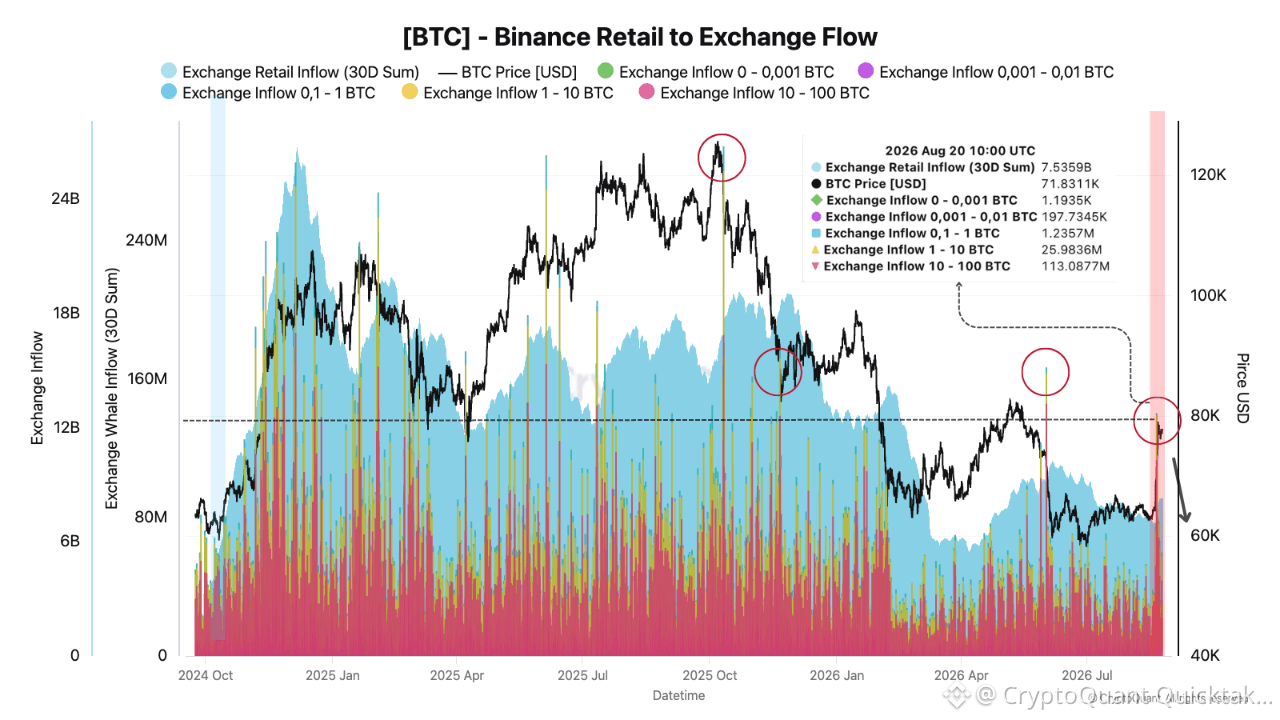
As of August 20, Binance Retail Inflow reached $7.54B on a 30-day rolling basis.
At the latest observation, component flows totalled roughly $140.5M. Of that amount, $113.1M (80.5%) came from the 10–100 BTC band and another $26.0M (18.5%) from the 1–10 BTC band. Together, these two cohorts represented 99.0% of the observed flow, while transfers below 1 BTC contributed only about $1.4M.
This is not primarily a “small-wallet panic” signal. It points instead to the upper end of the retail-labelled cohort moving meaningful inventory toward Binance.
The timing adds another layer. Inflows accelerated after BTC’s recent rally toward $80K, suggesting that renewed price strength may have encouraged holders to move coins that are potentially in profit. Rather than capitulating into weakness, some investors may be using the rebound to secure gains, or positioning inventory on Binance in preparation to do so.
Exchange inflows alone cannot confirm this because the metric does not reveal each coin’s acquisition price. Exchange Inflow SOPR, realised price by cohort and coin-age data would be needed to establish whether profits are actually being realised. Still, rising prices combined with persistent exchange-bound flows make profit-taking a credible explanation.
Unlike the June 1 sell-off, when inflows appeared as a sharp, isolated spike, the latest move has extended across several consecutive sessions. That persistence is more consistent with an ongoing shift in holder behaviour than with a single reactive event.
What to watch:
If these flows persist while BTC struggles around $80K, profit-taking could cap rebounds and reinforce short-term downside pressure. If inflows fade and price absorbs the available supply, the bearish interpretation would weaken.
Written by MorenoDV_