Network Fees vs DEX Fees on STON.fi Explained
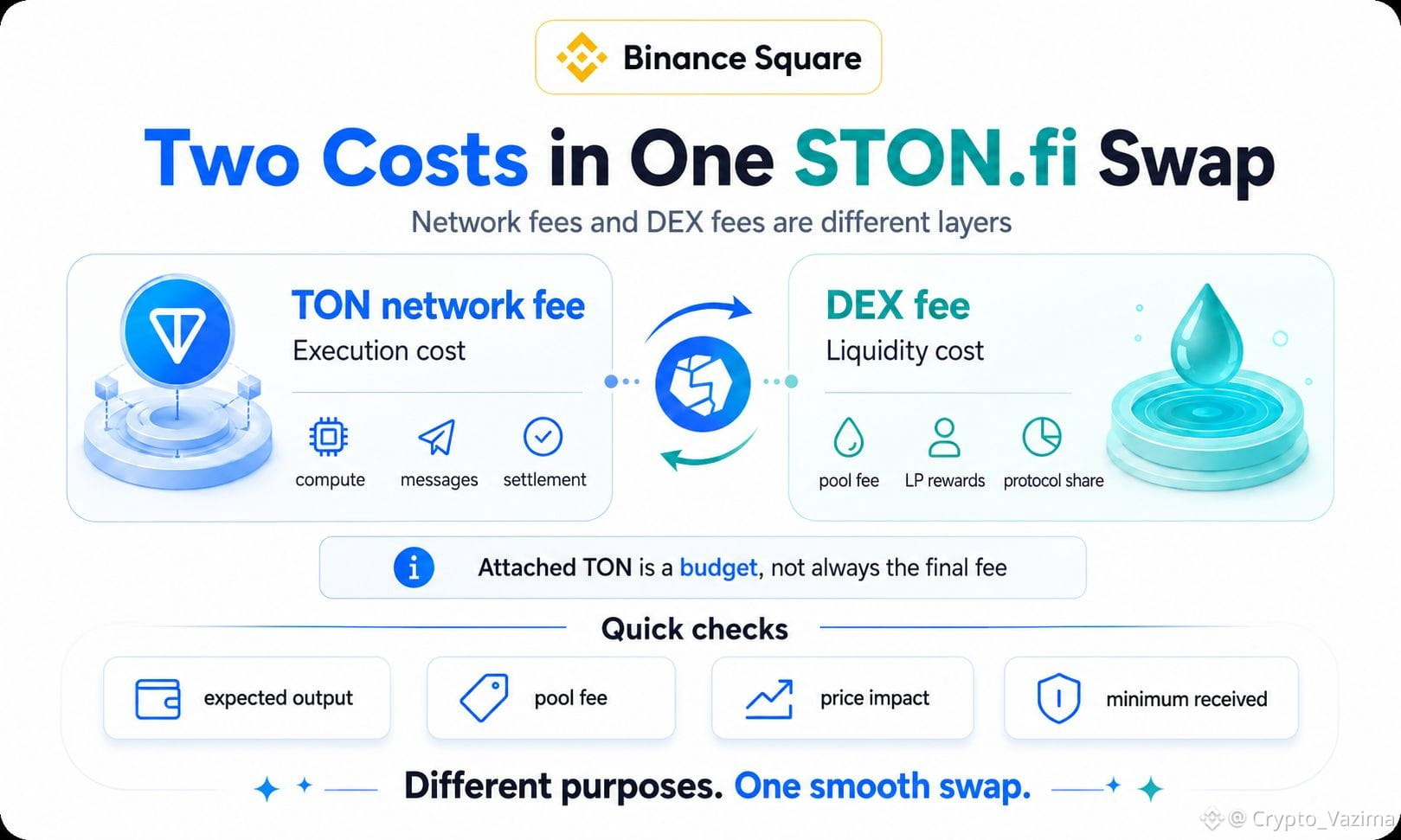
Swapping on STON.fi means facing two distinct costs: the network fee for TON blockchain work and the DEX fee inside the liquidity pool. One pays for execution, the other for the trade itself.
🔥 What the Two Costs Actually Are
- Network fee handles TON storage, gas, action and message forwarding.
- DEX fee is the configurable pool trading rate applied to the swap.
- Default total is 0.3 percent: 0.2 percent for LPs and 0.1 percent for the protocol.
🚀 Why Network Cost Is Not Trade-Size Driven
TON charges follow transaction complexity and message flow, not the value being swapped. A $20 trade and a $2,000 trade on the same path do not automatically cost 100 times more in network fees. The TON you attach is often a budget that can return excess after execution.
⚡ How the STON.fi DEX Fee Lands
- Each pool sets its own rate inside the 0-1 percent range.
- The fee shapes the quote and final output rather than appearing as an extra TON send.
- Check the live pool page or API for the exact percentage every time.
💬 Practical Takeaway for Users
Price impact and slippage are separate from both fees. A shallow pool can move the rate more than the 0.3 percent charge. Before signing, separate the pool economics from the TON execution budget so the real cost stays clear.
The clean mental model stays simple: network fees buy blockchain work, DEX fees buy liquidity.
Do you look at the pool fee or the TON attachment first when checking a STON.fi swap? 👇
Drop the fee question that still trips you up in the comments.
Not investment advice - research on your own! 🚀
$GRAM @STONfi DEX
Swapping on STON.fi means facing two distinct costs: the network fee for TON blockchain work and the DEX fee inside the liquidity pool. One pays for execution, the other for the trade itself.
🔥 What the Two Costs Actually Are
- Network fee handles TON storage, gas, action and message forwarding.
- DEX fee is the configurable pool trading rate applied to the swap.
- Default total is 0.3 percent: 0.2 percent for LPs and 0.1 percent for the protocol.
🚀 Why Network Cost Is Not Trade-Size Driven
TON charges follow transaction complexity and message flow, not the value being swapped. A $20 trade and a $2,000 trade on the same path do not automatically cost 100 times more in network fees. The TON you attach is often a budget that can return excess after execution.
⚡ How the STON.fi DEX Fee Lands
- Each pool sets its own rate inside the 0-1 percent range.
- The fee shapes the quote and final output rather than appearing as an extra TON send.
- Check the live pool page or API for the exact percentage every time.
💬 Practical Takeaway for Users
Price impact and slippage are separate from both fees. A shallow pool can move the rate more than the 0.3 percent charge. Before signing, separate the pool economics from the TON execution budget so the real cost stays clear.
The clean mental model stays simple: network fees buy blockchain work, DEX fees buy liquidity.
Do you look at the pool fee or the TON attachment first when checking a STON.fi swap? 👇
Drop the fee question that still trips you up in the comments.
Not investment advice - research on your own! 🚀
$GRAM @STONfi DEX