
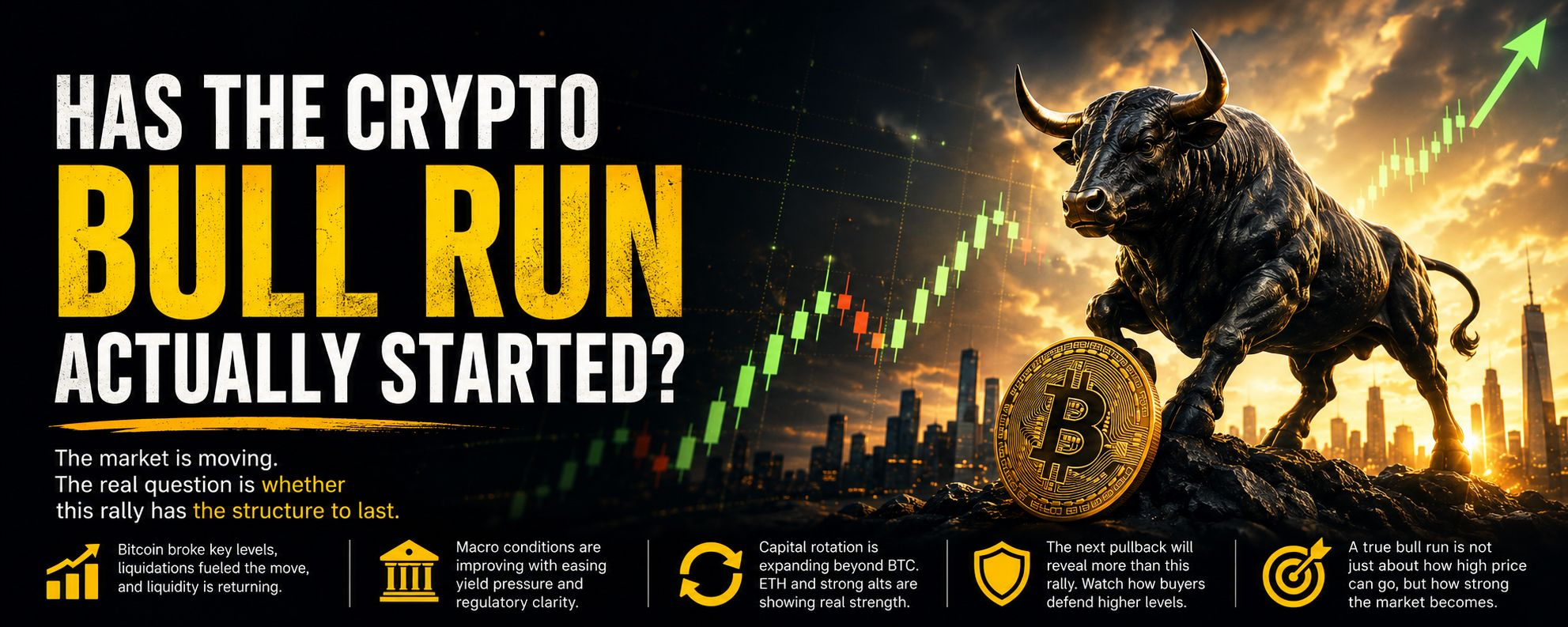

Whenever crypto moves this quickly, I notice the conversation changes almost overnight.
A few weeks ago, people were questioning whether Bitcoin could hold together at all. Now the same market is asking whether a new bull run has already started.
I think that is the wrong question.
The more useful question is whether the structure underneath this rally is becoming strong enough to survive after the excitement disappears.
Bitcoin’s recent recovery has certainly been difficult to ignore. After trading below $60,000 in June, BTC pushed through $70,000 and eventually traded above $79,000 during the latest surge. At the same time, the strength began spreading beyond Bitcoin. XRP, HYPE, ZEC, LINK and other large altcoins produced much stronger moves.
That matters to me because market cycles rarely reveal themselves through Bitcoin alone.
Bitcoin normally absorbs liquidity first. If confidence continues improving, capital gradually becomes willing to move further out on the risk curve. Ethereum strengthens. Large-cap altcoins begin outperforming. Eventually traders start taking risks in smaller assets.
We have started seeing pieces of that behavior.
But I am still careful about calling it a full bull market.
One reason is how violently leverage contributed to the move.
The rally triggered billions of dollars in liquidations, with short positions taking much of the damage. Once Bitcoin began moving higher, traders betting against the market were forced to close positions. Closing a short requires buying the asset back, which creates additional demand.
That can produce a powerful feedback loop.
Price rises, shorts get liquidated, forced buying pushes price higher, another group of shorts gets liquidated, and suddenly a normal recovery begins looking like an explosive breakout.
There is nothing inherently bearish about that. Short squeezes can become the beginning of much larger trends.
But forced buying and patient investment capital are not the same thing.
That distinction is probably the most important thing I am watching now.
If Bitcoin remains strong after the liquidation pressure disappears, the rally becomes much more interesting. If spot demand continues absorbing supply without needing excessive leverage, I would have considerably more confidence that something structural has changed.
The macro environment is also becoming difficult to separate from the crypto story.
The U.S. Treasury’s decision to increase long-duration bond buybacks helped calm pressure in the bond market and contributed to expectations of easier financial conditions. Falling yield pressure and a weaker dollar naturally make scarce or risk-sensitive assets more attractive.
That is why I find the simultaneous strength in Bitcoin and gold particularly interesting.
They are completely different assets, but sometimes they respond to the same underlying concern: what happens when investors become uncomfortable holding too much exposure to currencies and government debt?
Bitcoin does not need to replace the dollar for that argument to matter.
It only needs a relatively small percentage of global capital to treat it as an alternative monetary asset.
At the same time, the regulatory environment appears less hostile than it has during several previous phases of the cycle. That changes something important psychologically.
Large investors usually dislike uncertainty more than they dislike regulation itself. If institutions understand the rules, they can price the risks. When the rules are unclear, many simply stay away.
That is why regulatory clarity can affect price without changing Bitcoin’s code, block production or supply schedule.
It changes who feels comfortable owning it.
Still, I would not interpret every positive development as confirmation that the next vertical phase has begun.
Crypto markets are extremely good at making investors feel late.
A large green candle appears. Social media becomes optimistic. Altcoins suddenly move 20%, 30% or 40%. People who ignored the market at lower prices begin feeling uncomfortable holding cash.
That psychological transition creates FOMO.
And ironically, some of the worst entries happen precisely when investors become most convinced that waiting is dangerous.
I prefer watching how the market behaves during the next pullback.
A healthy market does not need to rise every day.
In fact, I would learn more from Bitcoin falling 8–12% and finding strong demand than I would from another straight vertical move.
The reaction to weakness tells me who actually wants exposure.
If buyers aggressively defend higher levels, exchange selling remains controlled and altcoins hold meaningful portions of their gains, that would suggest investors are treating dips as opportunities rather than exits.
I am also watching Bitcoin dominance.
If Bitcoin continues climbing while dominance remains high, the market may still be in the Bitcoin-led stage of the cycle.
If Bitcoin stabilizes and capital begins rotating consistently into Ethereum and stronger large-cap altcoins, the character of the market changes.
That is when the phrase “altcoin season” starts becoming more interesting to me.
Not because every token suddenly deserves a higher valuation, but because liquidity is becoming less selective.
There is an uncomfortable truth here that gets forgotten during every strong cycle.
A bull market does not make every project valuable.
It temporarily makes capital less discriminating.
Weak projects can outperform excellent ones for weeks. Narratives can dominate fundamentals. Tokens with questionable economics can produce extraordinary returns simply because liquidity is moving faster than investors can evaluate it.
Eventually that reverses.
This is why I separate the question “Can this token go higher?” from “Would I want to own this after the excitement disappears?”
Those are completely different questions.
For Bitcoin itself, I think the current situation is becoming much more interesting than it was several weeks ago.
The market has recovered important technical territory. Institutional flows have returned. Macro liquidity expectations have improved. Regulatory sentiment has become more constructive, and strength has started spreading beyond BTC.
Those are meaningful developments.
But markets rarely give confirmation without charging investors for it.
By the time every indicator clearly says “bull market,” much of the easiest upside has usually already happened. Enter too early and you risk sitting through another major drawdown. Wait for perfect certainty and you risk buying after everyone else has reached the same conclusion.
That tension cannot be eliminated.
It can only be managed.
Personally, I am less interested in predicting whether Bitcoin reaches some dramatic number next and more interested in whether the market can build a higher floor after this move.
If Bitcoin can absorb profit-taking, leverage cools down without destroying price, spot demand remains strong and capital continues rotating through the broader market, I would become increasingly comfortable describing this as the early stages of a larger cycle.
If instead the rally depends on permanent leverage expansion and increasingly emotional buying, I would become more cautious regardless of how impressive the candles look.
Right now, I see evidence that the environment is improving.
I do not see enough evidence to treat the outcome as guaranteed.
And perhaps that uncertainty is exactly what makes this stage important.
The most interesting part of a market cycle is rarely the moment when everyone agrees the bull run has started. It is the period before that consensus exists, when the evidence is becoming stronger but doubt is still rational.
I think that is where crypto may be sitting today.
The next major signal will not necessarily come from how high Bitcoin can climb.
It may come from how stubbornly the market refuses to return to where it came from.
