
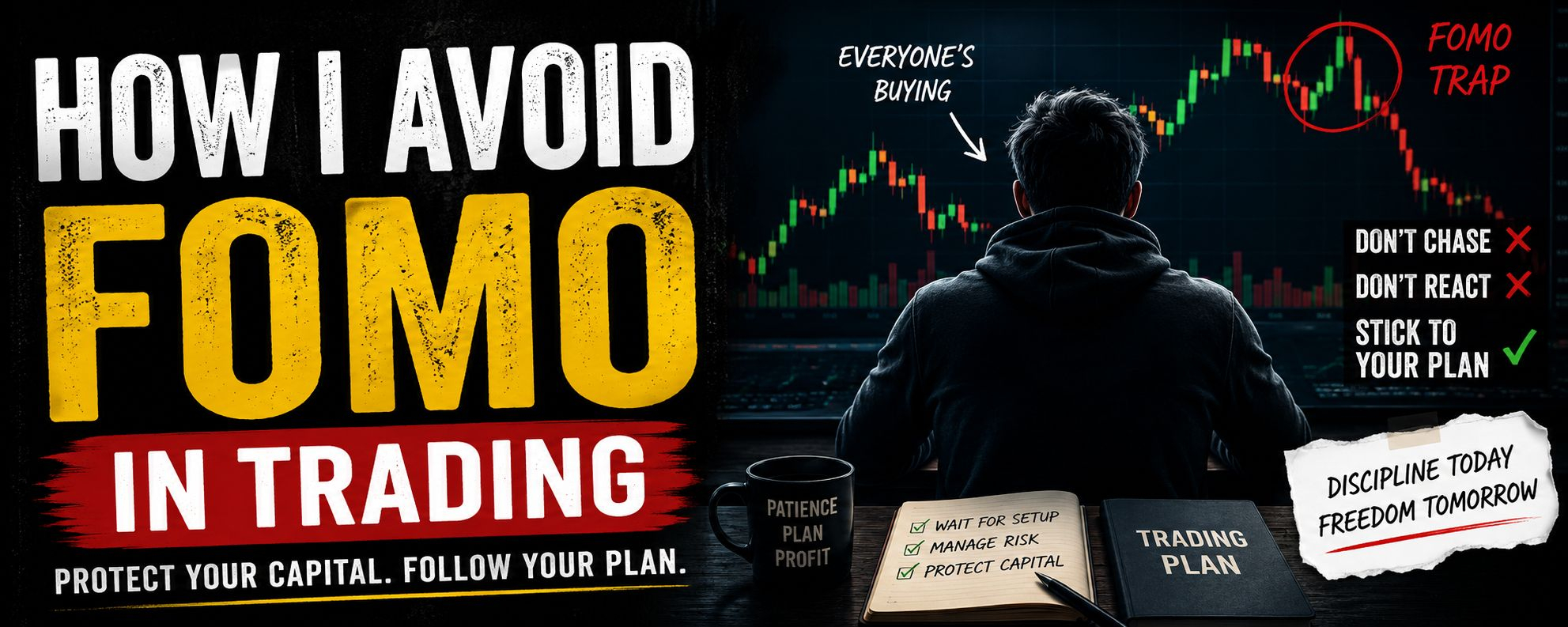


I’ve noticed that some of my worst trading decisions rarely begin with a bad chart. They begin with a feeling.
Price starts moving quickly. A breakout candle appears. The market keeps pushing without giving the clean entry I was waiting for. Suddenly, instead of analyzing the trade, I’m calculating how much money I could have made if I had entered five minutes earlier.
That is usually where FOMO begins.
Fear of missing out sounds simple, but in trading it can completely change the way I process information. A setup that I would normally reject suddenly looks acceptable because price is moving. A stop that would normally seem too wide becomes “necessary.” I start finding reasons why the market has to continue rather than asking whether the trade still makes sense.
The dangerous part is that FOMO occasionally works.
Sometimes I chase a breakout and price continues higher. Sometimes I enter late and still make money. Those trades can be more damaging psychologically than an immediate loss because they teach the wrong lesson. I start believing that chasing movement is acceptable simply because I was rewarded once.
Markets don't punish every bad decision immediately.
That is something I try to remember.
For me, the first defense against FOMO is separating a good trade from a profitable trade. They are not necessarily the same thing.
I can follow my setup perfectly and lose. I can also make an impulsive entry and win. If I judge myself entirely by the outcome of one trade, eventually my process disappears.
So I try to judge the decision first.
Was the setup actually there?
Was my entry planned?
Did I know where the trade was invalidated?
Was the potential reward still worth the risk?
Would I have taken exactly the same trade if the previous candle had not moved aggressively?
That last question is especially useful. If the answer is no, there is a good chance I am reacting to price rather than reading it.
Another thing that changed my thinking was accepting that I am supposed to miss trades.
There are thousands of candles printed across markets every year. I don't need to participate in all of them. I don't even need to catch every major move in the market I trade.
My job isn't to capture the entire move.
My job is to capture the part of the move where my edge exists.
Imagine price moves from 100 to 120. I might have a strategy that only gives me a high-quality entry around 108. If price jumps directly from 100 to 115 without giving that setup, the fact that a large move occurred doesn't mean I made a mistake.
There was movement, but there wasn't necessarily opportunity according to my system.
That distinction matters.
FOMO becomes much stronger when I mentally convert every missed price move into lost money. If I see a rally and think, “I missed $500,” I create emotional pressure to catch the next move.
But that $500 was never mine.
There was no position. There was no realized profit. There was only a chart showing what happened after the fact.
Once I understand this, missed trades become much easier to accept.
I also think FOMO is often a symptom of uncertainty rather than greed.
When I don't have clearly defined entry conditions, almost anything can look like an opportunity. Price rises and I want to buy. Price falls and suddenly I want to short. A candle breaks resistance and I enter. Then it retraces and I question everything.
A clear trading framework reduces the number of decisions I have to make while emotional.
Before entering, I want to know what I need to see, approximately where I want to participate, where my idea becomes wrong, and whether the available reward justifies the risk.
If price doesn't give me those conditions, I don't have to predict what happens next.
I simply don't have a trade.
That mindset is surprisingly powerful because traders often feel that staying out requires a bearish or bullish opinion. It doesn't. I can believe Bitcoin, gold, or another market may continue higher and still decide that the current entry is poor.
Direction and entry are different questions.
I also pay attention to candle expansion.
Large impulsive candles create psychological urgency because the market visually appears to be escaping. But the further price travels before I enter, the more difficult risk management can become. My logical invalidation point may remain far behind while my entry becomes progressively worse.
Suppose the original setup offered 1% downside risk for roughly 3% potential upside. After a strong move, I might be entering so late that I am risking 2% to realistically make another 1%.
The market may still be bullish.
The trade can still be bad.
This is why I try not to ask only, “Will price go higher?”
I ask, “Is this still a good place to express that idea?”
There is another uncomfortable source of FOMO: position size.
When I am trying to make too much money from a single trade, every market movement becomes important. Missing one setup feels expensive because I have attached financial expectations to it.
Smaller, predefined risk changes the emotional environment.
If one trade is simply one event in a long sequence of trades, missing it becomes less significant. There will be another setup. There will be another session. There will be another week.
But if I subconsciously expect one trade to change my account, missing that trade feels like missing my future.
That is where discipline becomes extremely difficult.
Social media can make this worse.
After a large market move, screenshots appear everywhere. People post entries near the exact bottom and exits near the exact top. Whether those trades are genuine isn't even the important issue. Seeing them after I missed the move can create the illusion that everyone understood what was happening except me.
Markets look obvious in hindsight.
Real-time trading is different.
Before the breakout, there are competing scenarios. Before the reversal, nobody knows which swing will become the final low. Before the winning trade, there is still uncertainty.
I try to compare my decisions with my own trading plan rather than somebody else's screenshot.
One practical rule I like is refusing to “repair” a missed trade.
If my planned entry was missed and price has already expanded significantly, I don't automatically search for another reason to enter. I wait for the market to create a genuinely new setup.
That might be a retracement, consolidation, retest, liquidity event, or whatever structure fits the strategy I am using.
The important point is that the next entry needs its own justification.
“I missed the first one” is not a trading signal.
There is also a difference between patience and hesitation.
Sometimes traders call everything FOMO and become afraid of taking legitimate entries. That isn't the solution either. If my setup appears exactly as planned and I refuse to execute because I want additional confirmation forever, I have moved from impulsiveness into paralysis.
The goal isn't to eliminate emotion.
The goal is to make emotion irrelevant to execution.
When my conditions are satisfied, I act.
When they aren't, I wait.
And once price has moved too far beyond my acceptable entry, I accept that the opportunity may be gone.
This is probably the hardest part of trading because there is no immediate reward for doing nothing. A disciplined skipped trade doesn't appear in the profit column. Nobody posts screenshots of the 15 terrible trades they successfully avoided.
But over time, avoiding low-quality decisions can matter just as much as finding good ones.
I have gradually stopped seeing FOMO as something I need to defeat permanently. It will probably continue appearing whenever markets move violently. The difference is that I don't have to obey it.
When I feel an urgent need to enter because price is running away, I treat that urgency itself as information.
Maybe the market is offering an opportunity.
Maybe it isn't.
But if I feel that I must enter right now, that is usually the exact moment when I want my rules making the decision instead of me.
There will always be another candle.
There won't always be another chance to recover capital that I risked simply because I couldn't tolerate watching a market move without me.
#FOMO #RiskManagementMastery #BitcoinStrongestWeekSinceMarch2023