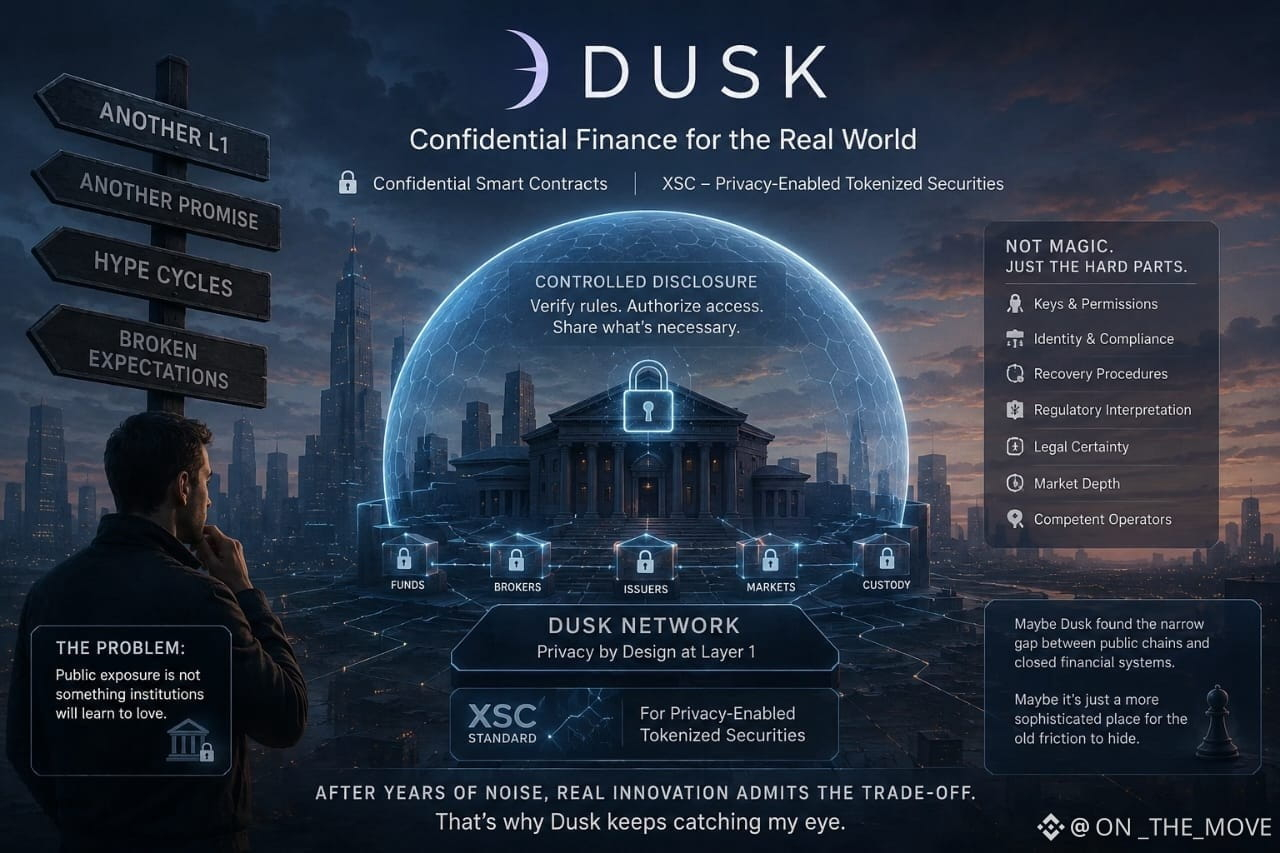
I’m noticing Dusk Network when I would normally stop listening. Another Layer 1, another promise to rebuild finance—I’ve watched that sentence burn through whole market cycles. Most chains act as if public exposure is a feature institutions will learn to love. I doubt it. Funds, brokers and issuers do not want every balance, position and counterparty exposed because settlement moved on-chain.
That is why Dusk keeps catching my eye. It puts confidential smart contracts at the base layer, with the XSC standard for privacy-enabled tokenized securities. The idea is not total secrecy; it is controlled disclosure, where rules can be verified and authorized parties see what they must. Something about this feels different, mainly because the problem is boring and painfully real.
Still, I don’t fully trust it. Financial privacy comes with keys, permissions, identity checks, recovery procedures and regulators who may read the same transaction differently. Code can enforce a transfer rule, but it cannot create legal certainty, market depth or competent operators. I’ve seen this before: elegant infrastructure arrives long before anyone is willing to use it.
Maybe Dusk found the narrow gap between public chains and closed financial systems. Maybe it built a more sophisticated place for the old friction to hide. I’m not sure yet. But after years of noise, I keep noticing projects that admit the trade-off instead of pretending it disappeared.
@Dusk #dusk $DUSK
That is why Dusk keeps catching my eye. It puts confidential smart contracts at the base layer, with the XSC standard for privacy-enabled tokenized securities. The idea is not total secrecy; it is controlled disclosure, where rules can be verified and authorized parties see what they must. Something about this feels different, mainly because the problem is boring and painfully real.
Still, I don’t fully trust it. Financial privacy comes with keys, permissions, identity checks, recovery procedures and regulators who may read the same transaction differently. Code can enforce a transfer rule, but it cannot create legal certainty, market depth or competent operators. I’ve seen this before: elegant infrastructure arrives long before anyone is willing to use it.
Maybe Dusk found the narrow gap between public chains and closed financial systems. Maybe it built a more sophisticated place for the old friction to hide. I’m not sure yet. But after years of noise, I keep noticing projects that admit the trade-off instead of pretending it disappeared.
@Dusk #dusk $DUSK