One TermMax example made me look at FT discounts in its fixed-rate borrowing markets a little differently.
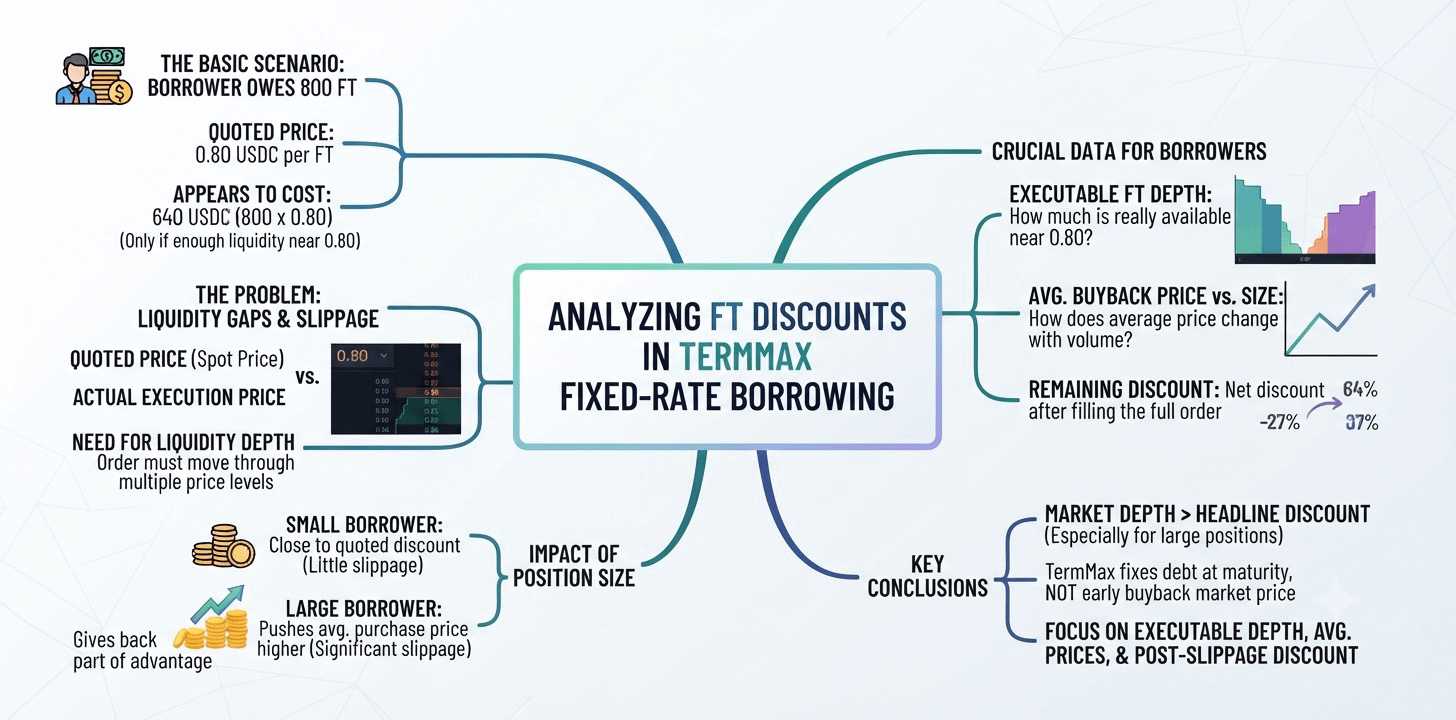
A borrower might owe 800 Fixed-rate Tokens (FT). If FT is quoted at 0.80 USDC, buying back the full amount appears to cost 640 USDC.
But that only holds if there is enough FT available near 0.80.
The quoted price tells me where the market is trading. It does not tell me what it would actually cost to buy 800 FT, especially if the order has to move through several levels of liquidity.
That gap matters more as position size grows. A small borrower may get close to the quoted discount. A larger one could push the average purchase price higher and give back part of that advantage through slippage.
What I don't know yet is how quickly that happens in TermMax's FT markets.
The useful data would be the depth behind the quote: how much FT is available near 0.80, how the average buyback price changes with size, and how much of the discount to face value is still there once the full order is filled.
That tells me more than the spot FT price on its own.
TermMax can fix what a borrower owes at maturity. It cannot fix the price the market will offer when that borrower tries to buy the debt back early.
For larger positions, that makes market depth more important than the headline discount.
I am watching executable FT depth, average buyback prices across position sizes, and how much of the discount survives after slippage.
#termmax @TermMax