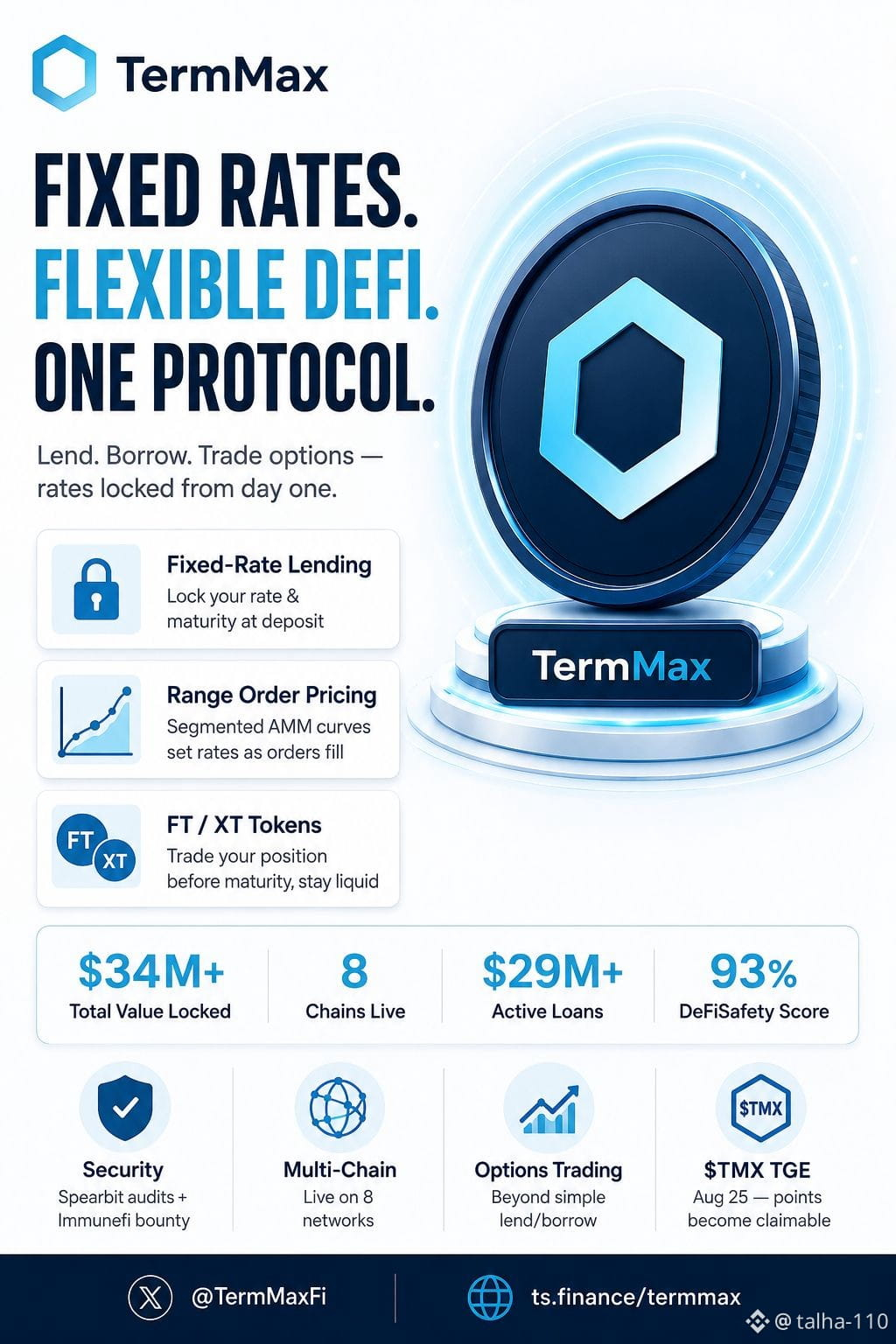
TermMax: Protocol Overview & Mechanism Analysis
Initial assumption walking in: another fixed-rate lending protocol chasing a trend. Deeper analysis of the mechanism reveals a more deliberate design.
Core Purpose:
Conventional DeFi lending operates on floating rates — utilization-driven, unpredictable, and shifting between the moment of deposit and the moment of withdrawal. TermMax eliminates that variable entirely. Both rate and maturity are fixed at position entry. The return is known from day one, not discovered at the end.
Underlying Mechanism:
The system is built around two core instruments — FT (Fixed-rate Token) and XT. Lending generates an FT, which represents a binding commitment: one debt token repaid at maturity. Critically, the FT remains liquid pre-maturity — it can be traded on the open market, meaning capital isn't locked for the full term.
Pricing execution runs through Range Orders — segmented pricing curves where the applicable rate shifts as an order fills across segments. This is an AMM-based architecture (V1), an evolution from the earlier orderbook-and-auction model, engineered specifically to improve liquidity aggregation.
Verified Metrics:
The protocol is live across 8 chains (Ethereum holding the dominant share), with $34M+ in Total Value Locked and $29M+ in active loans — indicating deployed capital and real usage, not idle liquidity.
The Broader Thesis:
Fixed-rate infrastructure isn't just a UX improvement — it's a prerequisite. As tokenized stocks and real-world assets move onchain, predictable financing becomes as critical as the asset itself being onchain.
Open question: Is TermMax positioning as a lending market, or as the fixed-rate credit infrastructure the next DeFi cycle will require?
#TermMaxFi #termmax @TermMax
$STAR
$BTW
$TUT
Initial assumption walking in: another fixed-rate lending protocol chasing a trend. Deeper analysis of the mechanism reveals a more deliberate design.
Core Purpose:
Conventional DeFi lending operates on floating rates — utilization-driven, unpredictable, and shifting between the moment of deposit and the moment of withdrawal. TermMax eliminates that variable entirely. Both rate and maturity are fixed at position entry. The return is known from day one, not discovered at the end.
Underlying Mechanism:
The system is built around two core instruments — FT (Fixed-rate Token) and XT. Lending generates an FT, which represents a binding commitment: one debt token repaid at maturity. Critically, the FT remains liquid pre-maturity — it can be traded on the open market, meaning capital isn't locked for the full term.
Pricing execution runs through Range Orders — segmented pricing curves where the applicable rate shifts as an order fills across segments. This is an AMM-based architecture (V1), an evolution from the earlier orderbook-and-auction model, engineered specifically to improve liquidity aggregation.
Verified Metrics:
The protocol is live across 8 chains (Ethereum holding the dominant share), with $34M+ in Total Value Locked and $29M+ in active loans — indicating deployed capital and real usage, not idle liquidity.
The Broader Thesis:
Fixed-rate infrastructure isn't just a UX improvement — it's a prerequisite. As tokenized stocks and real-world assets move onchain, predictable financing becomes as critical as the asset itself being onchain.
Open question: Is TermMax positioning as a lending market, or as the fixed-rate credit infrastructure the next DeFi cycle will require?
#TermMaxFi #termmax @TermMax
$STAR
$BTW
$TUT